
Key points:
- Foreign job seeker interest in Canadian jobs fell from almost 8% of all clicks in July 2023 to 3% by September 2026, a drop that closely tracks the country’s own efforts at reining in temporary migration.
- US job seekers represented only 21% of foreign clicks on Canadian jobs in Q3 2026, down from 28% in Q4 2024, coinciding with the deterioration in the US-Canada trade relationship.
- Non-permanent residents powered Canada’s 2022-23 population boom but are also the single biggest drag on population growth since.
- Engineering roles, which saw some of the largest percentage-point declines in foreign job seeker interest, could be part of why those sectors are also driving job growth in Canada.
Foreign interest in Canadian job postings has fallen sharply since 2023, a trend that broadly coincides with Canada’s shift toward a tighter temporary-immigration policy. After approaching 8% of all clicks in 2023, the foreign share of clicks on Canadian jobs declined to 3% by September 2026. But while the decline is a natural and perhaps even intended consequence of policymakers’ direct actions, the downstream effects — including a tighter labor supply, slowing population growth and potentially diminished spending — will also need to be carefully managed.
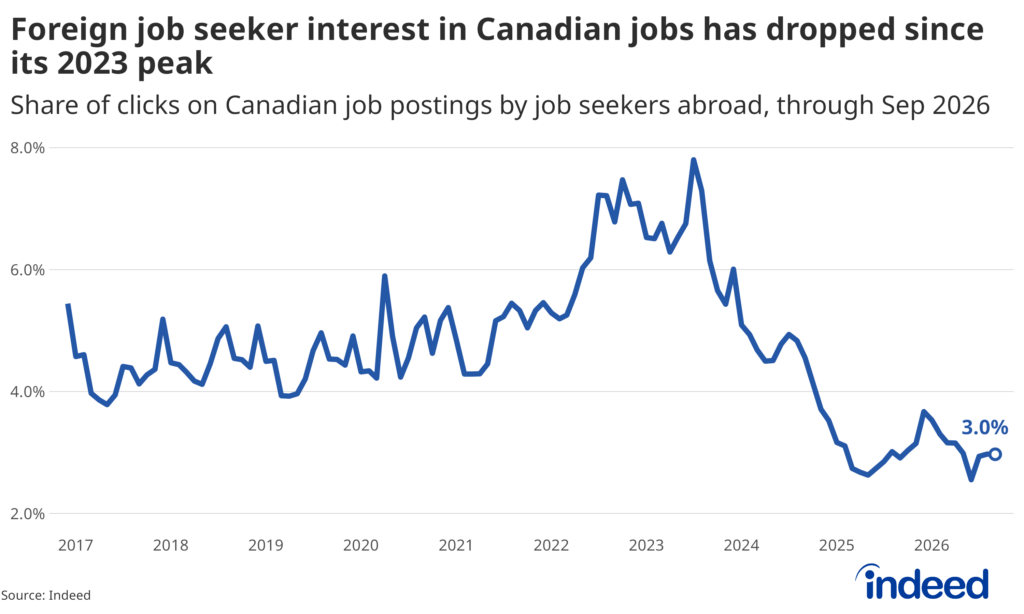
Indeed job seeker-click data has previously been shown to track actual migration patterns across OECD countries, so the decline in foreign job-search activity may point to further slowdowns in actual arrivals. The sustained decline is consistent with the country becoming less accessible, and potentially less attractive, to temporary migrants than it was just a few years ago.
In January 2024, Canadian officials began capping international study permits, aiming for a 35% reduction from 2023 levels. The cap was further reduced for 2025 and subsequently extended through 2026. Additionally, in October 2024, the federal government’s 2025–2027 Immigration Levels Plan introduced explicit targets for temporary residents, like students and workers on temporary visas. Fewer study and work permits issued to workers coming from abroad has meant fewer prospective migrants with an immediate reason to search for Canadian jobs.
This lines up with what has been happening to Canada’s population. In 2023, non-permanent residents added as many as 308,000 people in a single quarter, more than any other component of growth. Since then, the trend has reversed: the same group shrank the population in five of the seven quarters through mid-2026, sometimes by nearly 80,000 people per quarter. Permanent immigration, by contrast, stayed relatively steady over the same period.
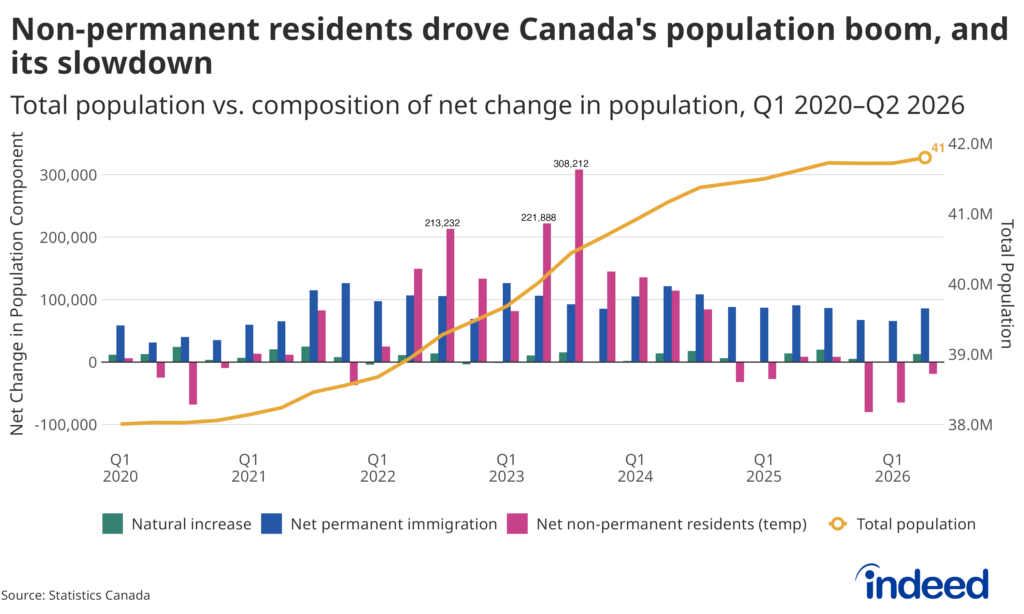
That reversal matters for the labor market. Temporary residents have supplied a meaningful share of the workforce in recent years, with a higher labor force participation rate. A smaller inflow of this population may ease some localized pressures on housing and public services, but it also reduces the number of people available to enter the workforce. An overall slowdown in population growth also means fewer consumers, which could eventually weigh on consumer spending and economic growth. That slowdown would also mean fewer consumers, which could eventually weigh on consumer spending and economic growth. These effects are unlikely to be spread evenly. Industries that have leaned most heavily on temporary workers and international students, such as accommodation and food services, retail and agriculture, are likely to feel the squeeze first.
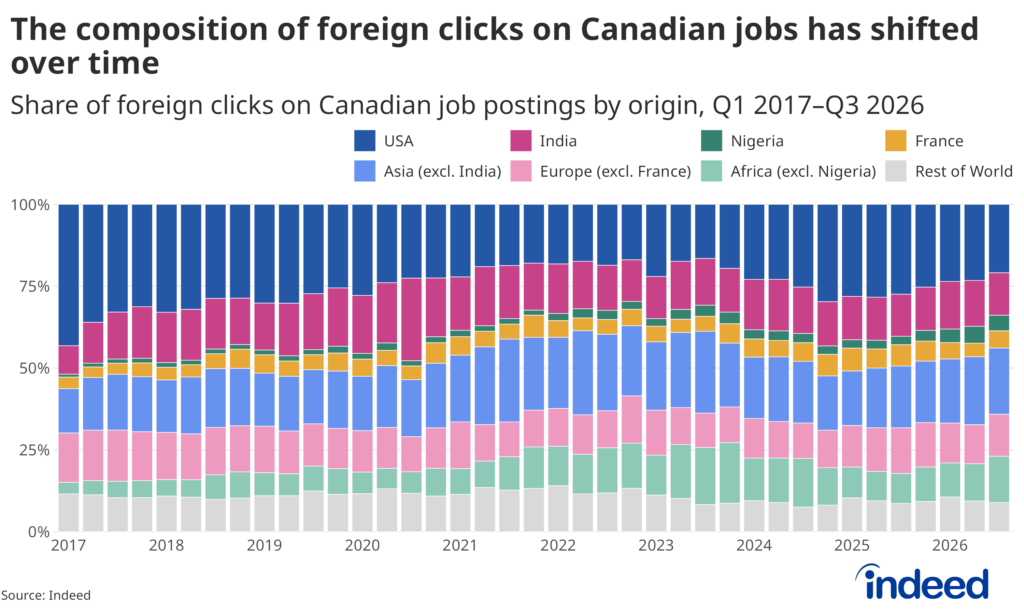
The click data also shows a shift in who is still looking. Because foreign job seekers include potential future temporary and permanent migrants, the mix of where they come from offers an early read on Canada’s future talent pool. The United States accounted for 28% of foreign clicks on Canadian job postings at its post-pandemic high in Q4 2024. Since then, its share has fallen by 7 percentage points by Q3 2026.
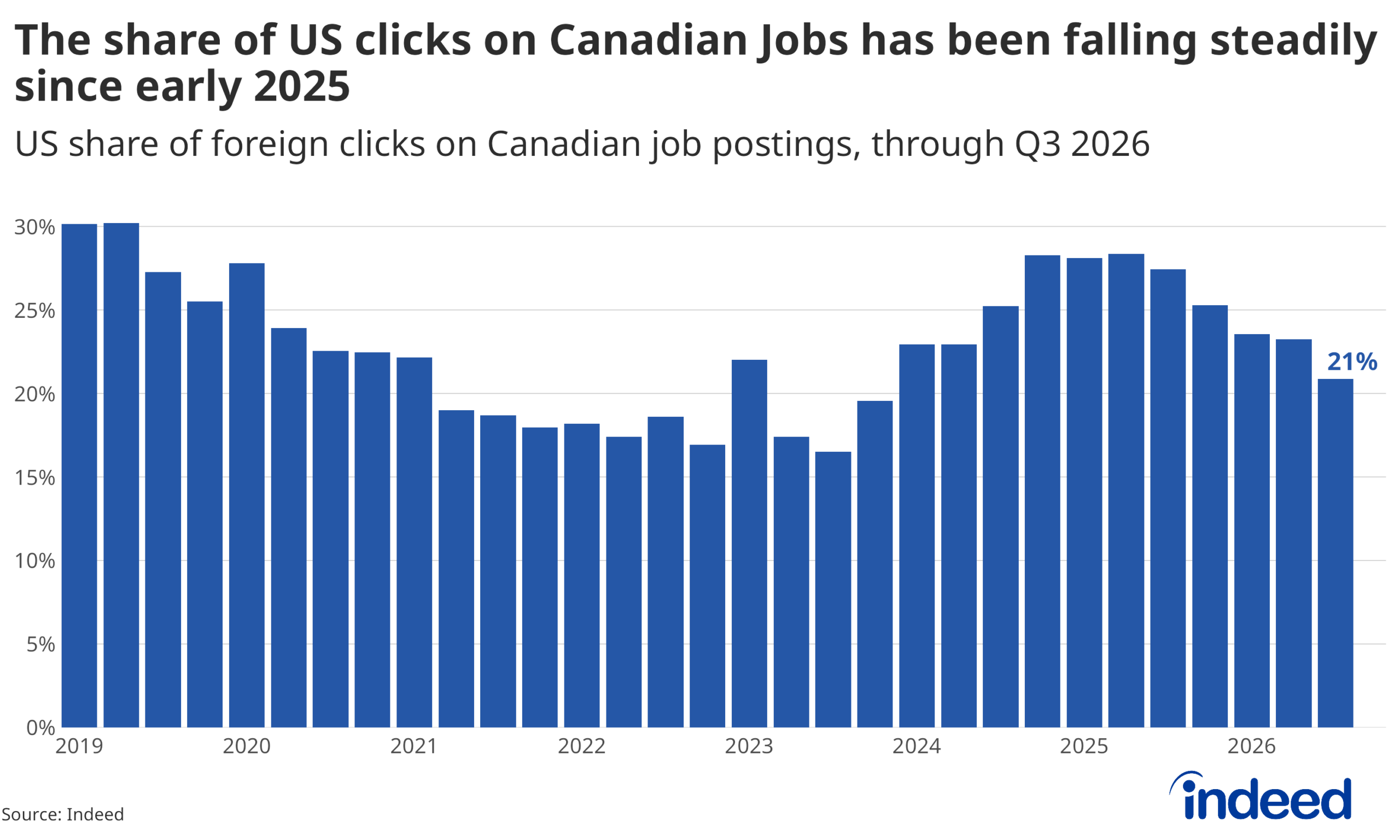
Interest is cooling in the other direction as well. The US remains the top destination for Canadian job seekers looking for jobs abroad, drawing 55% of outbound clicks as of Q3 2026. But that share has been falling steadily since a post-pandemic peak of over 72% in Q4 2023, and both trends coincide with a deterioration in US-Canada trade relations.
The declining US share means a comparatively larger share is coming from other parts of the world. As of Q3 2026, the largest share of foreign clicks came from Asia rather than the US, as it has since Q1 2018, the last time the US share exceeded Asia’s. What has changed is the size of the gap, which is now the widest in almost two years. Nigeria’s growing presence is also notable; its share of foreign clicks has risen from a rounding error in 2017 to almost 5% by Q3 2026. Taken together, the foreign job seekers still looking at Canada are increasingly coming from Asia and Africa rather than from its southern neighbor.
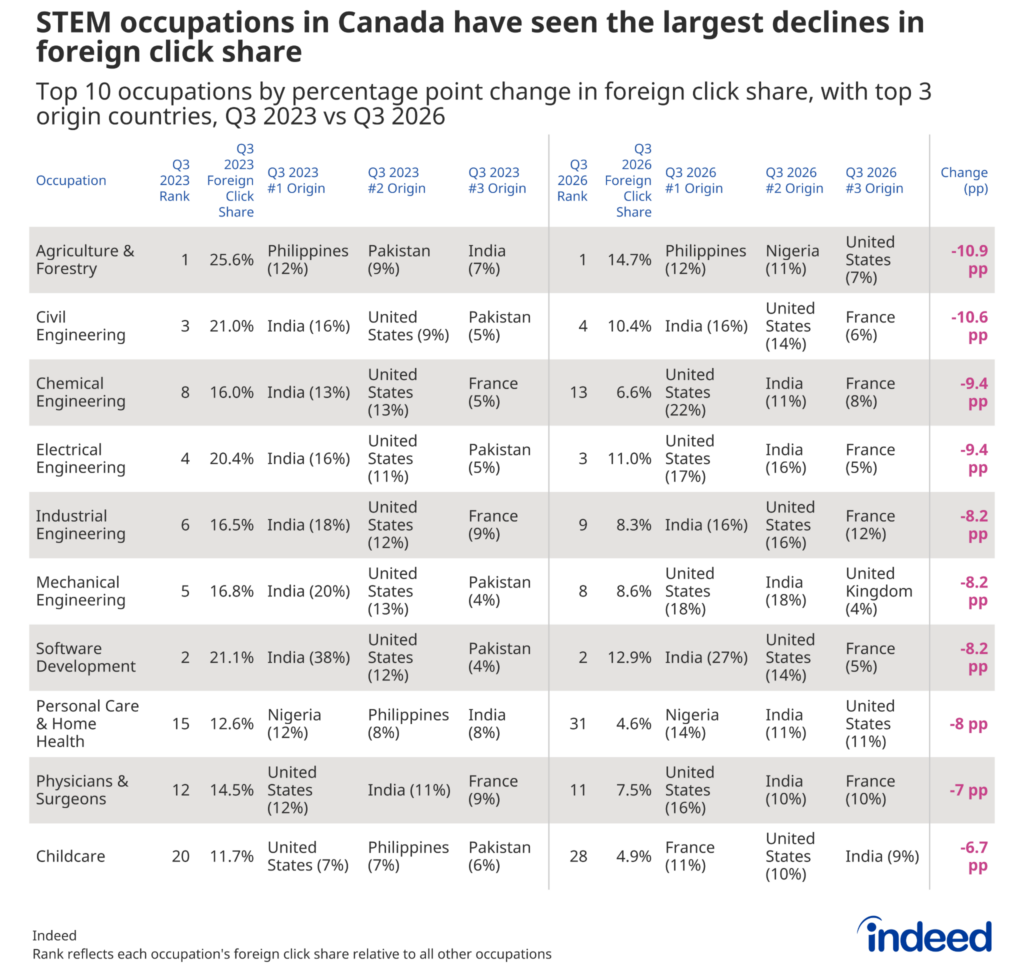
The contrast is further illustrated at the sectoral level. At their peak, foreign job seekers accounted for roughly one-fifth of clicks in several engineering, technology and agriculture-related occupations. Three years later, foreign click share had fallen in every sector, with particularly large declines in agriculture & forestry, civil engineering, chemical engineering and electrical engineering.
The impact may already be visible in job postings. Indeed’s Job Postings Index (JPI) shows that postings in engineering fields, including civil, electrical and industrial engineering, are well above the headline JPI and rising quickly. Part of this reflects stronger labour demand from the data centre build-out. But a shrinking supply of candidates may also play a role. With fewer temporary migrants and less foreign interest in these fields, employers have a smaller pool to draw from and may face higher turnover, making these roles harder to fill.
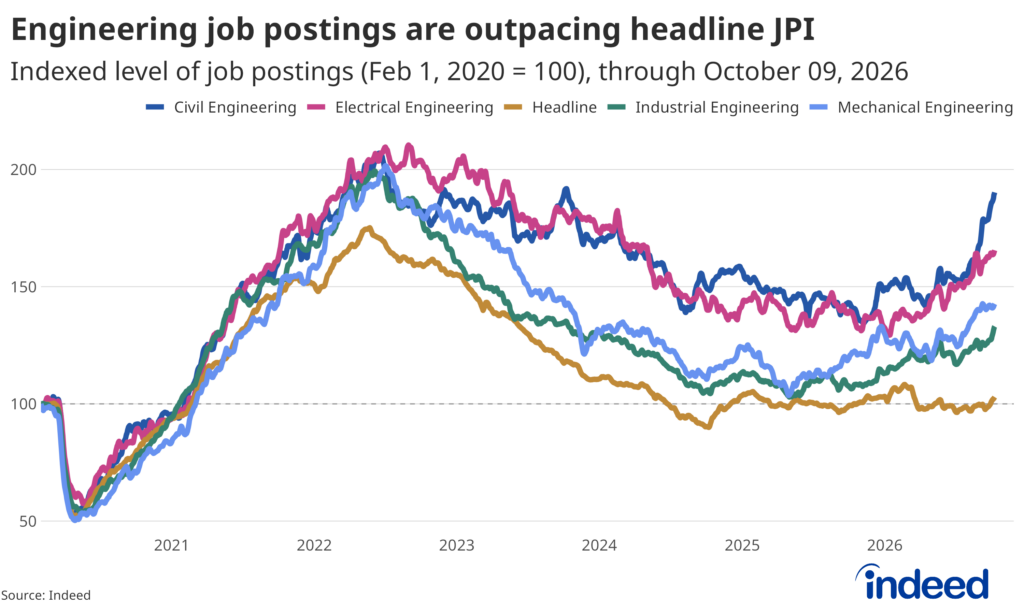
Canada’s tighter temporary-immigration policy is doing what it was designed to do, but its effects will not stop at its intended targets. The occupations seeing the steepest drops in foreign interest, particularly engineering, are also the ones where postings are climbing, which could deepen hiring difficulties in fields central to keeping the country’s JPI positive. Communities that have leaned on international students, such as college towns, may also feel the loss in local spending and thinner staffing in retail and hospitality. There is a reputational risk as well: if Canada comes to be seen as less welcoming, it may be passed over by the talent it competes with other destinations for, and those perceptions can outlast the policies that created them. Even a temporary narrowing of the door can have lasting effects, since migrant networks are slow to rebuild once they weaken. Managing these trade-offs, rather than treating lower inflows as a pure win, will be the central challenge for policymakers in the years ahead.
Methodology
We assess foreign job seeker interest by tracking the share of total clicks on Indeed job postings in a given country by job seekers with IP addresses outside of that country. Data from job seekers in 254 countries and overseas territories was included in this analysis. Job seekers whose location could not be determined were removed from the analysis. All data in the post are summarized by month, unless noted otherwise.
The number of job postings on Indeed.com, whether related to paid or unpaid job solicitations, is not indicative of potential revenue or earnings of Indeed, which comprises a significant percentage of the HR Technology segment of its parent company, Recruit Holdings Co., Ltd. Job posting numbers are provided for information purposes only and should not be viewed as an indicator of performance of Indeed or Recruit. Please refer to the Recruit Holdings investor relations website and regulatory filings in Japan for more detailed information on revenue generation by Recruit’s HR Technology segment.