
Key Points:
- Canada’s knowledge, tech, and government hubs are most exposed to potential GenAI-driven change, while metros built on energy, agriculture, and manufacturing are less exposed.
- A high score means GenAI could transform more local jobs. Transformation will sometimes include job displacement, but more often leads to changes in skills and tasks within jobs.
- The speed of transformation depends heavily on how quickly employers adopt AI technology.
Will AI change your job? The honest answer is: it depends on what you do. And, because different places specialize in different work, it also depends on where you do it. Some Canadian metros are dense with the kind of knowledge work that GenAI is poised to reshape, while others run on hands-on work AI barely touches. A new Hiring Lab metric scores the exposure of every major Canadian metro (Census Metropolitan Area, or CMA).
The AI exposure metric is built by combining information on the kinds of jobs each metro advertises on Indeed with the extent to which the skills behind those jobs are exposed to GenAI transformation. The result is a comparable metro score that is highest in the knowledge, tech, and government hubs and lowest where the economy relies on hands-on work.
How the metric works
The AI exposure metric is built from Indeed Hiring Lab’s AI at Work Report 2025 and its GenAI Skill Transformation Index, which scores almost 3,000 workplace skills by how much GenAI could change the way they’re performed and how much human involvement is likely to still be required. Skills were rated on a scale from minimal transformation, in which humans would still be largely required to perform the skill and AI assistance is negligible, to full transformation, in which GenAI could potentially perform the skill with limited or no human involvement. The measure captures the potential transformation of tasks, not the replacement of workers. And while the index was originally calculated using US skill data, it can be easily applied to the distribution of jobs in Canada.
Each sector’s national exposure score is then weighted by a given metro’s advertised job composition – the share of its Indeed postings in each sector over the past 12 months – and averaged across sectors. Put plainly, a metro’s score is the share of skills in its typical job postings that are prone to GenAI transformation. For instance, a software-, management-, or finance-heavy metro scores high while a metro built on natural resources and manufacturing scores low.
By design, the metric reflects a metro’s job composition. High exposure means more of the local work could be reshaped by GenAI, not that jobs will disappear. Whether potential exposure becomes real change depends on how quickly employers adopt the technology and how workers adapt to it.
What the map shows
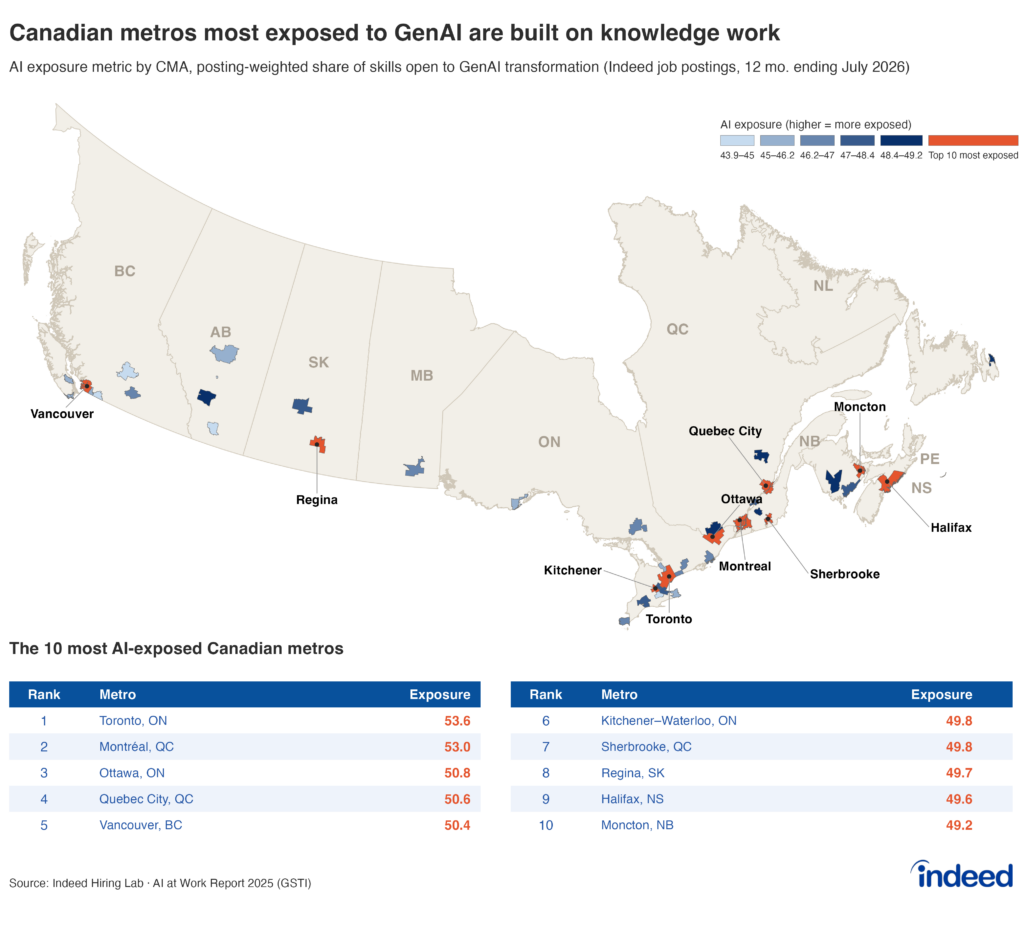
The AI exposure score ranges from about 44 to 54 across metro areas in Canada, with an average score of 48. That means in the typical Canadian metro, about 48% of the skills in an Indeed job posting are open to GenAI transformation. The 10-point score gap between the most- and least–exposed metros is meaningful and implies that about 10 more of every 100 skills that employers ask for could be reshaped by AI in Toronto (54) compared to in Red Deer (44).
The five most exposed metros are where Canada’s knowledge work is concentrated: Toronto (54), the most exposed in the country, followed by Montreal (53), Ottawa and Quebec City (each at 51), and Vancouver (50). Rounding out the top 10 are Kitchener-Waterloo, Sherbrooke, Regina, Halifax, and Moncton (each ≈49-50). It’s a revealing mix, with tech centers, including Toronto, Montreal, Vancouver, and Kitchener-Waterloo, sitting alongside government and administrative capitals, including Ottawa, Quebec City, and Regina. All heavily feature the kinds of office and technical work GenAI is best positioned to transform.
Red Deer and Lethbridge, AB; Chilliwack and Kamloops, BC; and Brantford, ON (each ≈44-45) anchor the other end of the list, all smaller metros built on hands-on, in-person work – including in energy, agriculture, and manufacturing – that AI is less likely to transform.
A closer look at the pattern
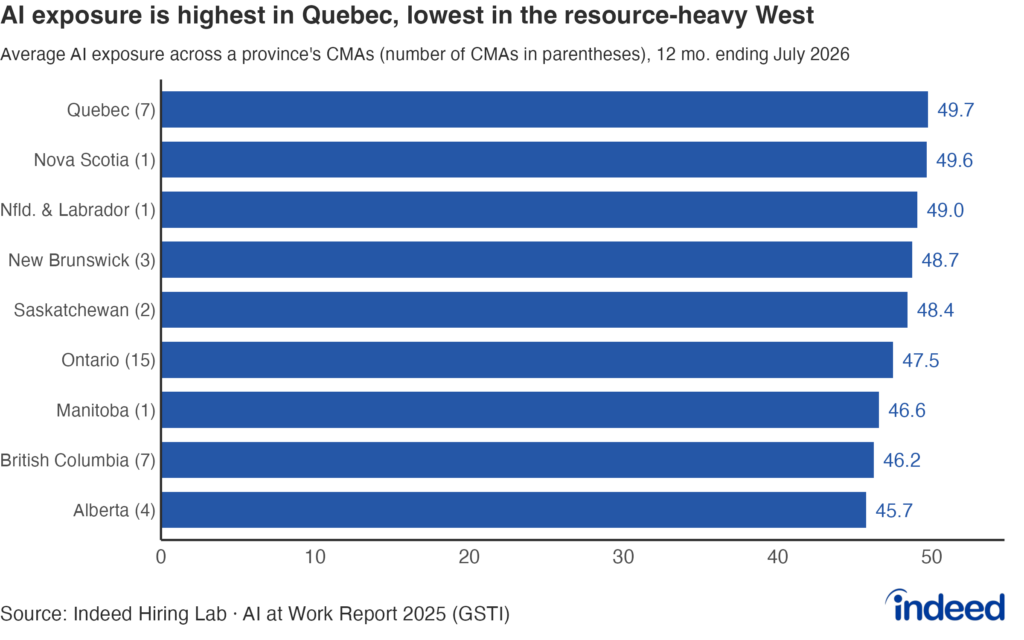
Exposure varies widely by province. It runs highest in Quebec, which averages 49.7 across its seven CMAs, and is above the national average score of 48 throughout Atlantic Canada. Quebec overall features a strong mix of professional work likely to be transformed by GenAI, extending from finance, insurance, and public administration in Quebec City to the research and tech base in Sherbrooke. The Montreal metro alone ranks among the country’s most-exposed metros, on the strength of its local software and data industries. It runs lowest in Alberta (45.7), British Columbia (46.2), and Manitoba (46.6).
Conclusion
AI transformation is well underway. While this will undoubtedly result in some level of job disruption, it will also transform the distribution of skills and tasks within jobs. Our AI exposure metric measures this potential transformation, not the replacement of workers. Whether that potential becomes real change depends on how quickly employers put GenAI to work. High-exposure metros face the biggest opportunity – and the biggest adjustment – as GenAI diffuses through their dominant industries. Lower-exposure metros are more insulated in the near term, but that also means fewer of the productivity gains GenAI may bring.
For workers, exposure is a starting point for asking which skills to build, not a verdict of which jobs will survive. It reads on two levels: the role you do and the place you do it. A higher score for the role means more of its everyday tasks could change. Similarly, a higher score for the metro means the local job market is concentrated in that kind of work, so the shift is likely to arrive sooner in that area, even if your role is less exposed.
For employers, the map is a workforce-planning tool, not a cost-cutting one. In highly exposed metros, the payoff comes from reskilling workers and redesigning roles around AI augmentation. In lower-exposed metros, there’s more runway, but it’s worth watching GenAI adoption in similar industries.
Methodology
The AI exposure metric is built from Indeed Hiring Lab’s AI at Work Report 2025 and its GenAI Skill Transformation Index, which rates workplace skills by their exposure to GenAI-driven change. Specifically, we measure the share of a sector’s skills judged to have hybrid or full transformation potential. While the index was originally calculated using US skill data, it can be easily applied to the distribution of jobs in Canada. For each metro, those national per-sector scores are weighted by the share of its Indeed postings in each sector and averaged, giving the share of skills in a typical local posting that are exposed to GenAI transformation.
The score uses distinct Indeed Canada job postings over the 12 months ending July 2026, grouped by sector at the city level and rolled up to metros (CMAs). Coverage is 41 CMAs with an average score of 48 and scores ranging from 44 to 54.