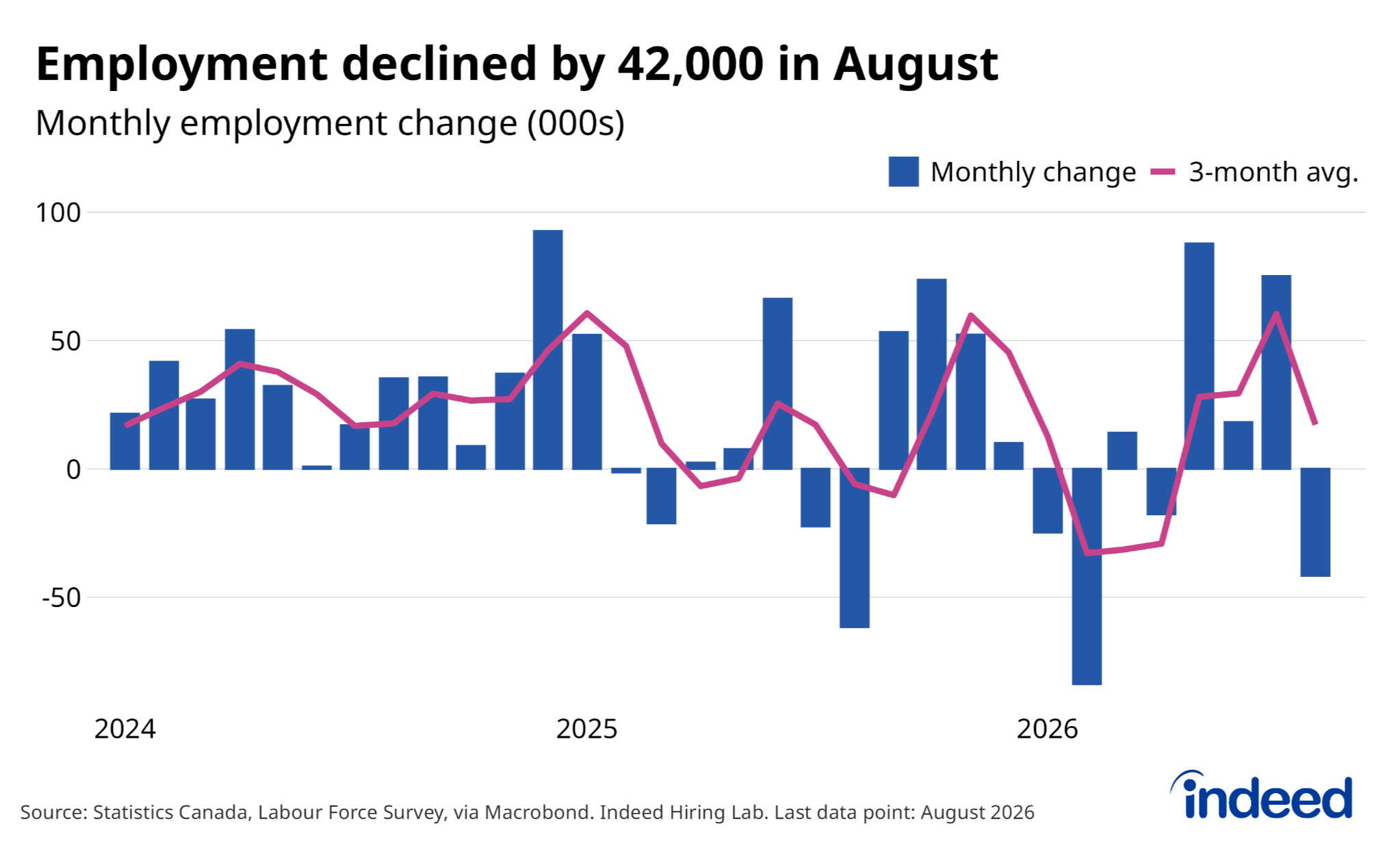
Key Points:
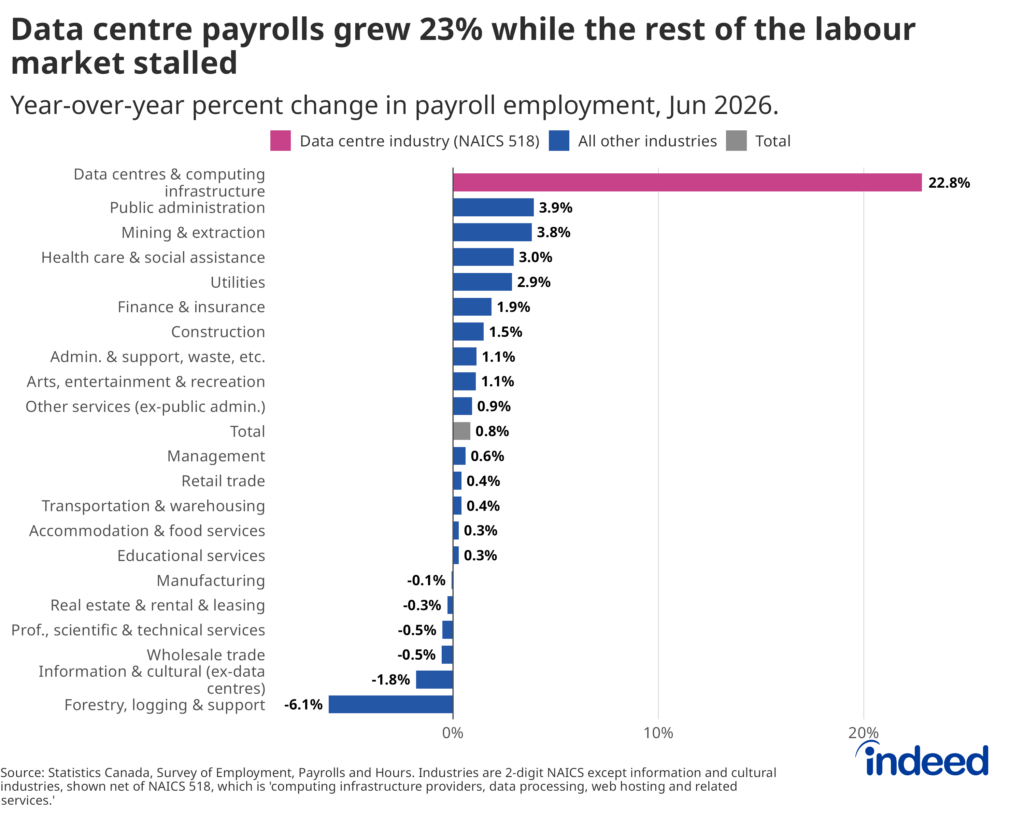
- Data centre payroll employment has surged 23% over the past year, according to official data from Statistics Canada.
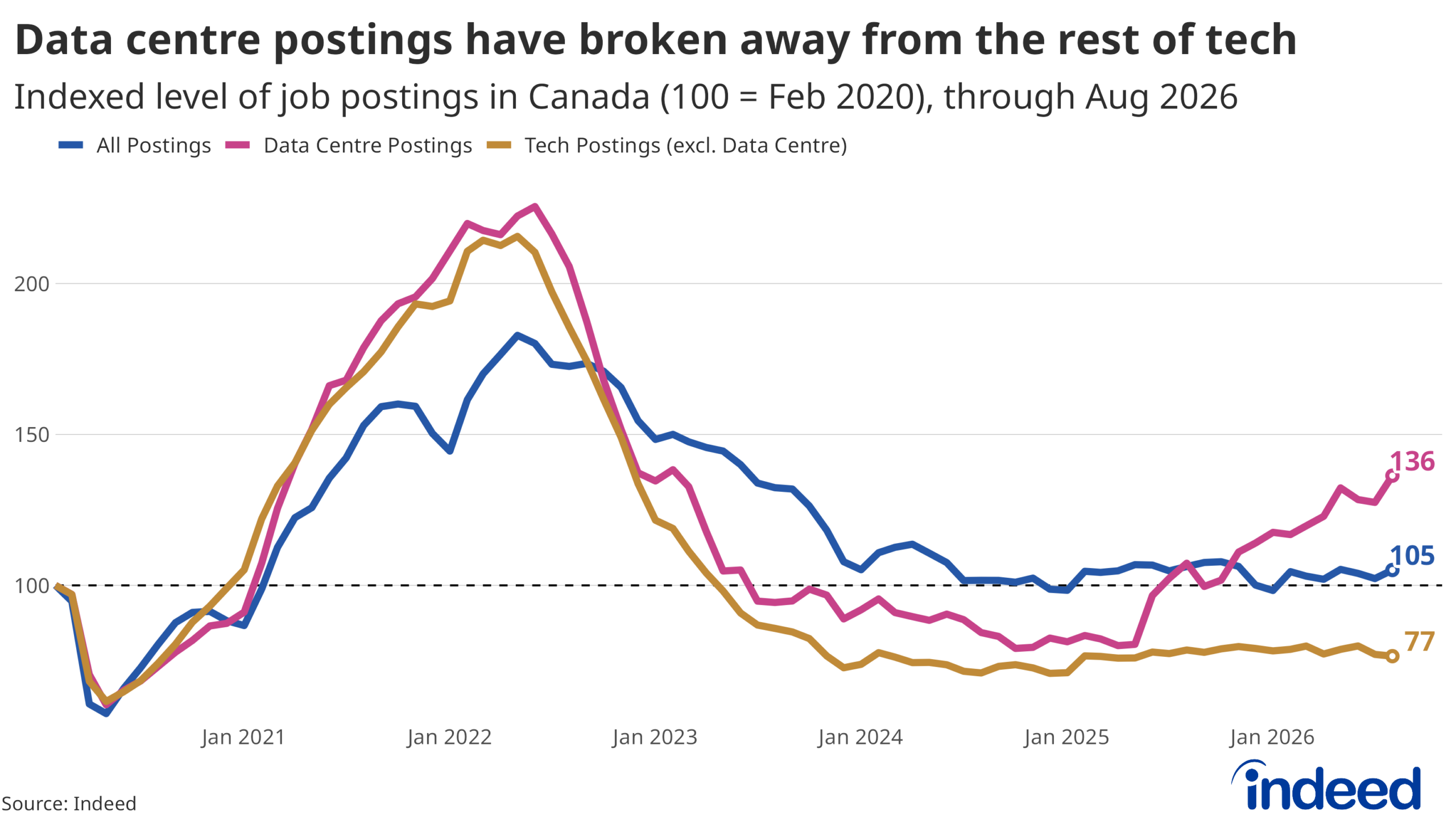
- Indeed job postings for data centre roles have climbed 68% since January 2025, though the geographic distribution and occupational mix of postings suggests this hasn’t entirely been due to the AI build-out thus far.
- Data centre postings carry a clear pay premium relative to the same job title elsewhere in the Canadian labour market.
Canada’s data centre industry has been a standout pocket of job growth in an otherwise sluggish labour market. In the past year, payroll employment surged by 22.8% in the subsector most closely related to data centres, according to the most recent data from Statistics Canada’s Survey of Employment, Payrolls, and Hours (SEPH). By contrast, total payroll employment inched up slightly over the same period, growing by only 0.8%, while the broader information sector (excluding computing infrastructure) contracted by 1.8%.
While the roughly 8,000 workers added over the past year represent a small share of the total Canadian workforce, the AI build-out in Canada is still in its early stages. Forward-looking data from Indeed job postings suggest there is substantial room to run as computing infrastructure expands to meet surging demand for generative AI.
Indeed job posting data suggest more growth ahead
Job postings on Indeed echo the official payroll data, illustrating strong momentum in data centre-related hiring. Data centre postings spiked alongside the rest of the tech labour market during the post-pandemic hiring boom, then drifted downward for most of 2024. In early 2025, however, hiring demand related to data centres broke away. Since the beginning of 2025, job postings for data centre roles have risen 68%, even as total job postings in Canada grew only 7% and postings for other tech jobs rose a modest 8%. As of the end of August, data centre postings were 36% above their pre-pandemic level, while other tech postings were 23% below their pre-pandemic level.
Data centre roles are still niche, and only about 6 in every 1,000 Canadian postings mention any data centre keywords. But their share is growing rapidly, following patterns seen in the States. And while Canada’s AI build-out looks to be earlier-stage than its southern neighbour’s, it is accelerating on a similar timeline.
A breakdown of occupations further indicates Canada’s generative AI build-out is still in a foundational phase. Year-to-date, a significant portion of data centre postings are for centre management roles. These roles could, in theory, refer to AI facilities, but are more likely postings to staff pre-existing storage data centers. Moreover, “Cloud Consultant” ranks as one of the most common job titles. That pattern is consistent with hiring still driven by the continued push to migrate Canadian businesses from on-site servers to existing cloud infrastructure, rather than by AI demand directly.
Even so, the nascent build-out is showing up in the postings data. Roughly 1 in 10 Canadian data centre postings year-to-date have been for installation and maintenance roles.
Posting locations show a mix of legacy sites and new build-outs
The geographic distribution of data centre postings on Indeed similarly reflects both ongoing maintenance of legacy storage and crypto-mining facilities as well as indications of an AI-driven build-out to come. The highest concentration in the country is in Prince George, British Columbia, where 0.9% of local postings mention data centre keywords — a direct read-through from old crypto mines being retrofitted for AI. In addition to the labour required for the transition, data centre employment should remain higher in the region as AI is more labour intensive than bitcoin mining (at least according to companies in the build-out).
Legacy capacity explains much of the Montréal-Toronto corridor. In Montréal and in Ottawa-Gatineau, 0.8% of local job postings contain data centre keywords, but most existing facilities are built for storage and connectivity rather than AI compute. Outside reporting suggests few AI facilities are coming to Québec, as policy decisions there have impacted the availability of hydroelectric power.
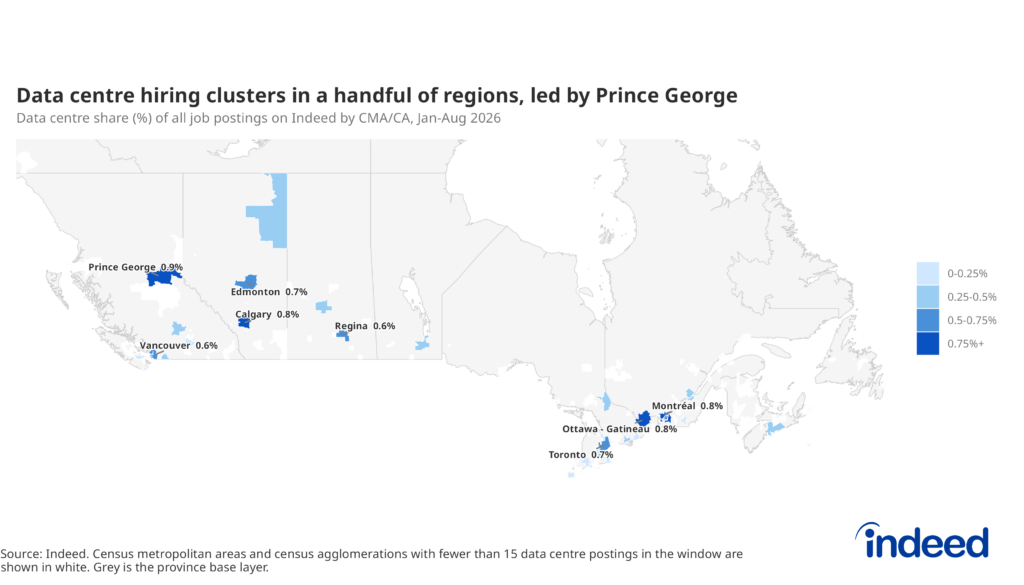
Alberta, however, presents a distinct trajectory suggestive of a nascent AI infrastructure boom. Data centre postings in Calgary sit at 0.8% and Edmonton at 0.7%, mid-pack nationally, and provincial payroll employment in the subsector grew just 1.4% over the year. But these numbers have the capacity to explode. Announced data centre projects indicate the next, much larger wave of data centre growth is likely to occur in Alberta, and Meta has just broken ground on its first Canadian data centre (and the largest project currently under construction in Canada), just north of Edmonton. On a megawatt basis, Alberta accounts for a staggering 92% of the planned capacity in announced and pipelined data centre construction projects. If even a portion of this proposed capacity materializes, it will add significant hiring momentum to a provincial labour market that is already outperforming other provinces’ employment growth.
For job seekers, the fact that data centre hiring largely tracks Canadian population centres means that job opportunities remain highly localized, especially in major cities. In Montréal and Toronto, roughly 80% of applicants for data centre positions reside within the respective metro areas. This local concentration diminishes in less densely populated regions; in Regina, Saskatchewan, for instance, 42% of applicants for data centre roles come from outside the province entirely. Prince George and Halifax see similarly high out-of-metro interest.
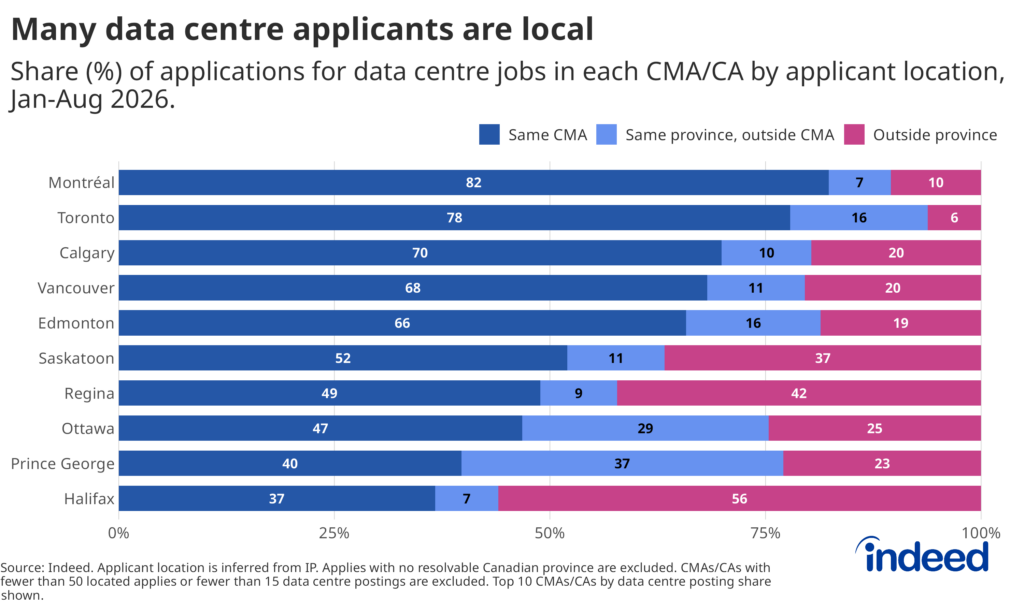
The reliance on local talent mirrors trends in the US, where just over half of applications to data centre postings originate from within the same metro or micropolitan area. This suggests the labour market for these roles draws more heavily on local pipelines than one might expect for such a highly specialized, hyperscaler-driven industry. Still, across Canada, a meaningful 40% of data centre applications come from outside the job’s metro area. This share is 10 percentage points higher than the Canadian average (30%), meaning that data centre roles are more likely to attract talent from afar compared to the average Canadian job posting. Even as data centre jobs offer opportunities for qualified local applicants, the hyperscaler build-out has the potential to reshape some of the human geography of Canada.
Data centre positions pay more and are not temporary
Examining posted pay on Indeed job ads reveals that data centre postings carry a clear pay premium over the same job title elsewhere in the Canadian labour market, though the size of that premium depends heavily on the particular role. Among salaried positions, sales shows the largest gap — data centre-specific sales roles pay a 43% premium. Management roles also carry a sizable 28% pay premium, while IT infrastructure operations & support workers earn 25% more per year at data centre employers, if wage advertisements hold true.
Hourly workers see a premium as well. Within the security & public safety field, workers at a data centre could be looking at an additional $9 per hour (a 40% gain). But installation & maintenance workers — one of the largest occupational groups in the build-out — see just a $5-per-hour (17%) premium. This is a notably smaller gap than in the US, where installation & maintenance hourly worker job ads post a 42% premium over comparable roles elsewhere.
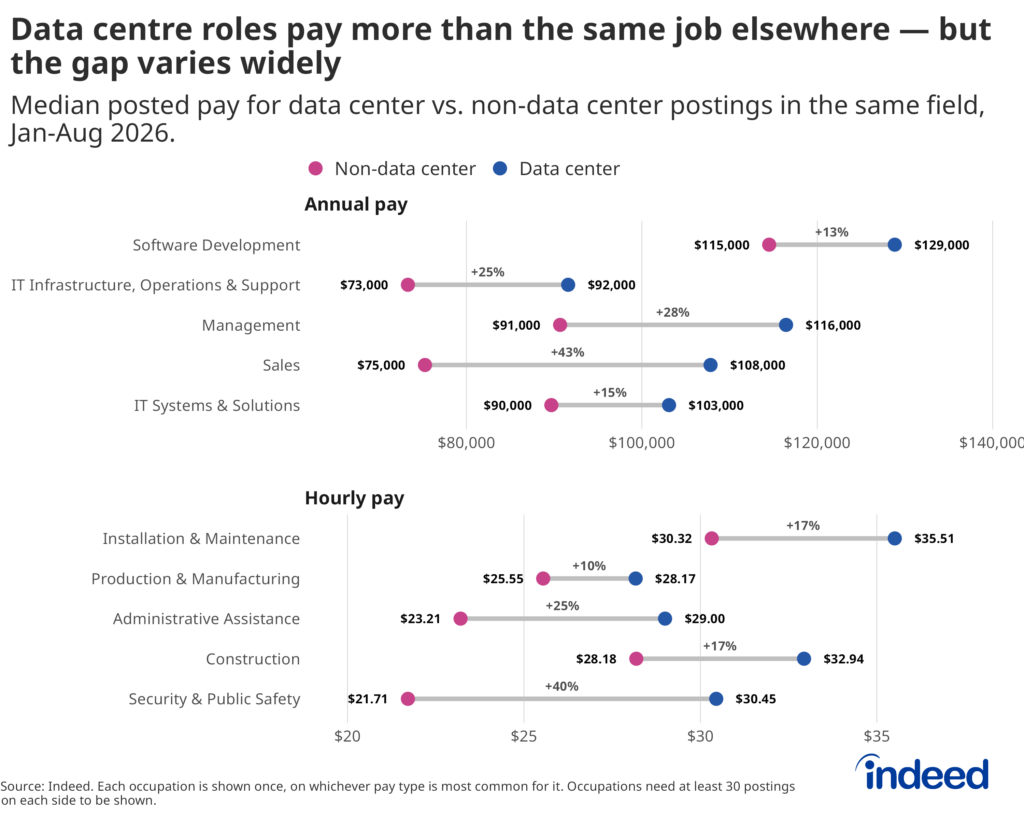
Some of the pay bonus is likely a matter of employer composition. Data centre roles are often with big tech companies, though hyperscalers like Amazon dominate the Canadian market less than they do the American one.
Employer composition may also shape how durable these jobs are. There has been much conversation about how many of the jobs generated by data centre construction will remain once the construction firms have left the site. Similar to the patterns observed in the US, Canadian data centre postings are more likely to be permanent positions than non-data centre postings. In fact, data centre postings are more than three times less likely to be labeled as temporary or contract relative to non-data centre postings. Of course, as we noted for the US market, just because a role is advertised as permanent does not necessarily mean the role will last once the build-out is complete.
Canadian job seekers are responding to growing data centre opportunities
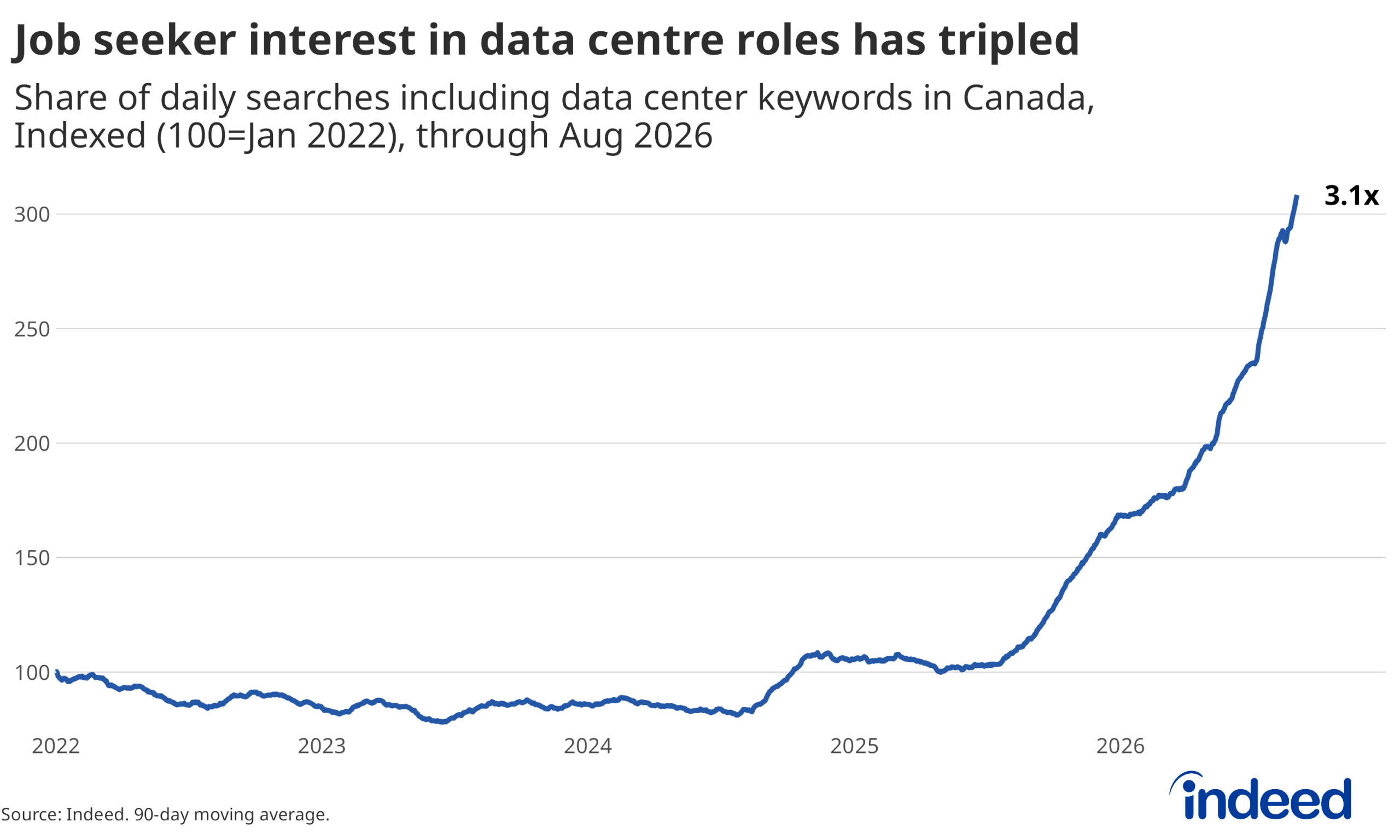
Canadian job seekers are adjusting to employment trends and pay incentives. The share of searches on Indeed containing data centre keywords is now roughly three times its January 2022 level. That share actually drifted downward from 2022 through mid-2024, turned upward in late 2024, and then has risen steeply and without interruption from mid-2025 through present.
Conclusion
Canada’s data centre build-out remains far smaller than its US counterpart, but the direction is unambiguous: payroll employment in the subsector has stepped up sharply, postings have decoupled from a tech sector that has otherwise not recovered, and job seekers are following. Pay premiums are substantial, if uneven across roles.
What remains unsettled is the ultimate scale of this trend, especially amid growing backlash. Massive data centre projects have been proposed across the country, with the most ambitious focused on Alberta. If even a fraction of the announced capacity clears the power and permitting hurdles, the surge in Canadian data centre employment is far from over.
Methodology
We track data centre postings by tallying job postings on Indeed in Canada that include any of the terms in a keyword list ( “data center”, “datacenter”, “data-center”, “data centre”, “datacentre”, “data-centre”, “data centers”, “datacenters”, “data-centers”, “data centres”, “datacentres”, “data-centres”, “centre de données”, “centre de donnees”, “centres de données”, “centres de donnees”, “centre de traitement de données”, “centre de traitement de donnees”) either in the job title or in the job description. This method doesn’t capture the full extent of data centre labour demand and picks up roles that are not actually to do with data centres but whose job description may include the terms. Still, we believe this method provides a gauge of recent trends.
We follow a similar methodology to identify data centre searches, and tabulate searches on Indeed in Canada that include the same keywords noted above in the search query. Search figures reflect Indeed’s user base, which may differ from the overall Canadian workforce.
The number of job postings on Indeed, whether related to paid or unpaid job solicitations, is not indicative of potential revenue or earnings of Indeed, which comprises a significant percentage of the HR Technology segment of its parent company, Recruit Holdings Co., Ltd. Job posting numbers are provided for information purposes only and should not be viewed as an indicator of performance of Indeed or Recruit. Please refer to the Recruit Holdings investor relations website and regulatory filings in Japan for more detailed information on revenue generation by Recruit’s HR Technology segment.