
Key Points:
- In each of the 10 European countries analysed by Hiring Lab, data centre job postings on Indeed are above their pre-pandemic level, while postings for other tech roles lag behind.
- Between 50% and 60% of data centre postings in every country analysed come from just five occupations: IT infrastructure, operations & support; software development; management; installation & maintenance; and project management.
- European employers advertise substantially higher pay for data centre roles than for the same occupation elsewhere, similar to the US and Canada. What stands out in the European data is how broad the premium is: of the 29 country-occupation pairs measured, 28 pay more for data centre work.
Europe is trying to keep up in the global infrastructure race to build the data centres that power generative AI. In June, the European Commission proposed the Cloud and AI Development Act with the explicit aim of tripling EU data centre capacity within five to seven years. With €176 billion of investment across the continent expected in the next five years, what does this mean for European workers?
Indeed Hiring Lab analysed data centre-related job postings, advertised pay, and jobseeker searches across 10 European markets: Belgium, France, Germany, Ireland, Italy, the Netherlands, Poland, Spain, Switzerland, and the United Kingdom. The picture is one of an AI build-out that is earlier-stage than its North American counterpart, but one that is already reshaping where and for whom tech-adjacent jobs are being created.
Demand for data centre workers is picking up
Demand for data centre workers is accelerating across all 10 markets analysed, on a timeline similar to that observed in Canada and the US. European data centre postings on Indeed, indexed to their pre-pandemic level, have risen over the past year, while other postings, particularly in tech, have continued to slide.
The recent rise is most notable in Spain, Italy, and Ireland. In Spain, the upswing in postings coincides with the ramp-up at Amazon’s Aragón campuses. Italian data centre postings reached nearly 2.5x their pre-pandemic level in August as new projects broke ground in Milan over the spring and summer. In Ireland, postings jumped in early 2026, shortly after the end of a de facto four-year moratorium on new data centre grid connections around Dublin and the introduction of a new government plan to steer new facilities toward regions with spare renewable capacity.
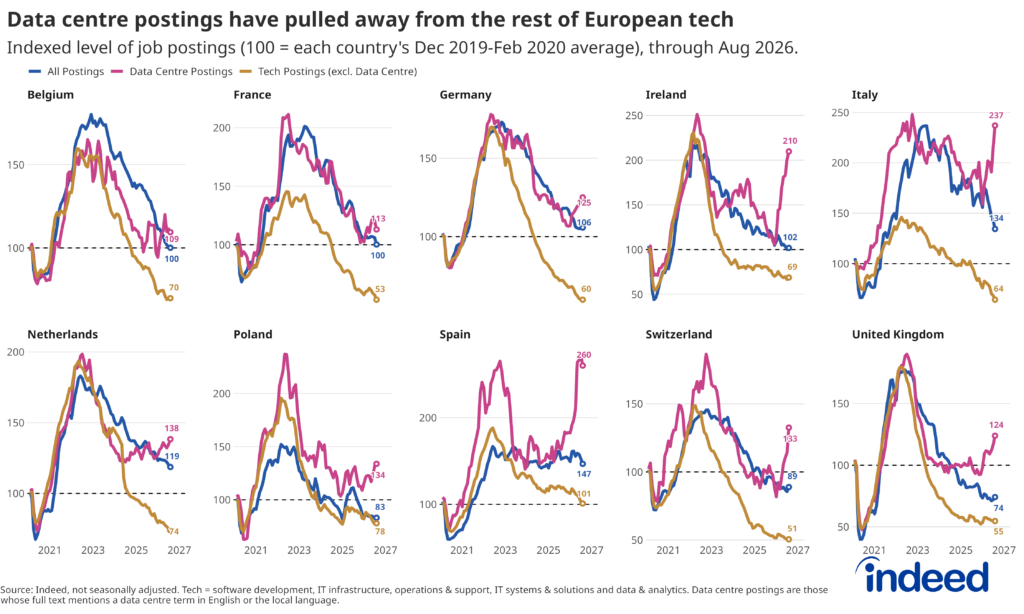
Other countries have seen a less meteoric surge. Still, the decoupling of data centre demand from other tech hiring remains significant, especially in larger countries such as Germany and the UK. In the UK, strong data centre-related hiring stands out in a country with some of the lowest overall labour demand in Europe – UK data centre demand is 24% higher than pre-pandemic levels. In comparison, demand for other tech roles remains 45% below the February 2020 baseline.
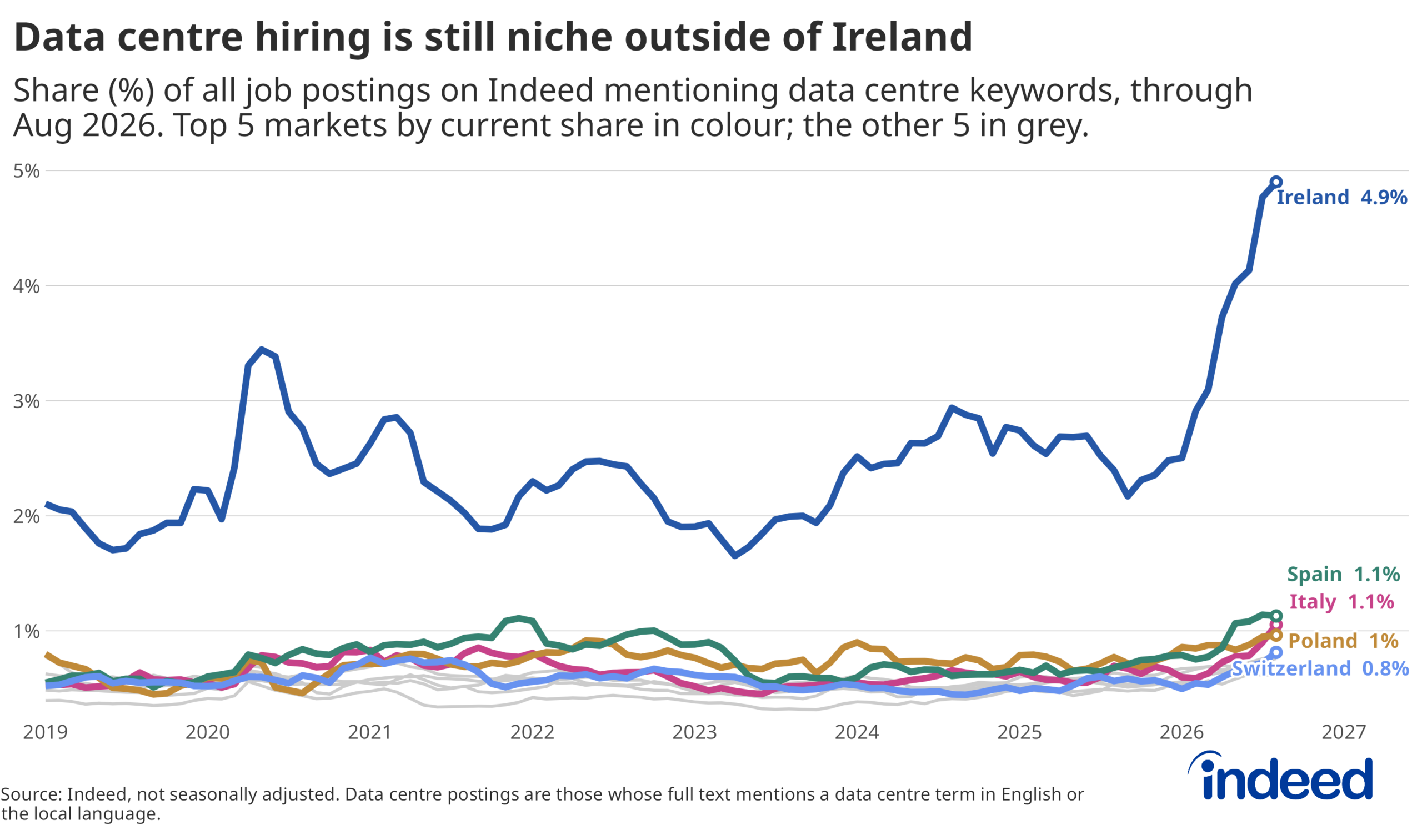
Even as demand for workers has picked up, data centre roles remain a small share of each country’s total postings. In most of the countries analysed, the share is about or below 1%. Ireland is the exception: nearly 5% of all Irish job postings on Indeed now mention a data centre, roughly double the share from 2019 through 2025. That figure reflects Ireland’s position as home to much of the European cloud capacity for the largest US hyperscalers, as well as its relatively small labour market.
Postings favour tech and management over construction
The occupational mix of data centre hiring in Europe points to two things happening at once: continued staffing of existing data storage and cloud facilities, and a nascent boom in new AI-related construction. Five occupations account for between 50% and 60% of data centre postings in every country analysed: IT infrastructure, operations & support; software development; management; installation & maintenance; and project management.
Across Europe, hiring demand tilts toward technology roles associated with operating and building services on top of existing infrastructure. IT infrastructure, operations & support and software development together account for around a quarter of data centre postings in each country other than Poland, whose software development-heavy mix (30% of data centre postings) is a bit of an outlier.
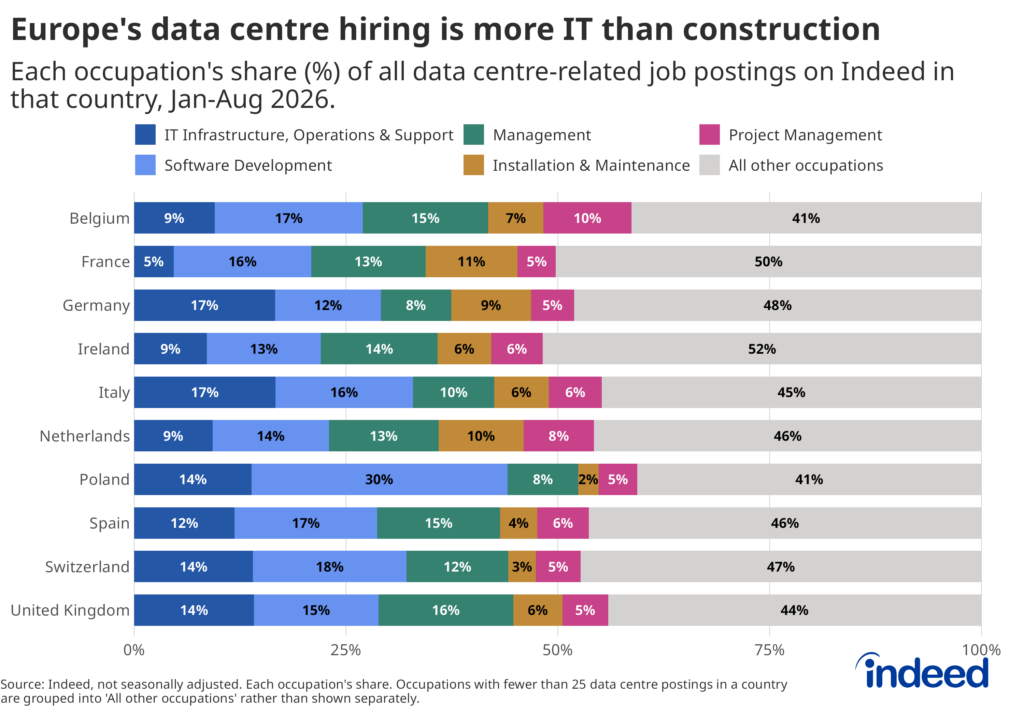
Management is also a prominent data centre sector, with the highest concentrations observed in the UK, Spain and Belgium. The Netherlands (10%) and France (11%) have relatively high installation & maintenance shares, in line with ongoing data centre construction in Groningen and around Paris. That said, installation & maintenance workers are a smaller slice of data centre hiring in Europe than in the US, where they account for roughly a quarter of postings, a sign that much of Europe’s data centre construction wave may still be yet to come.
Local data centre hiring is most intense in Aragón, Spain, though Europe’s cities still contribute heavily
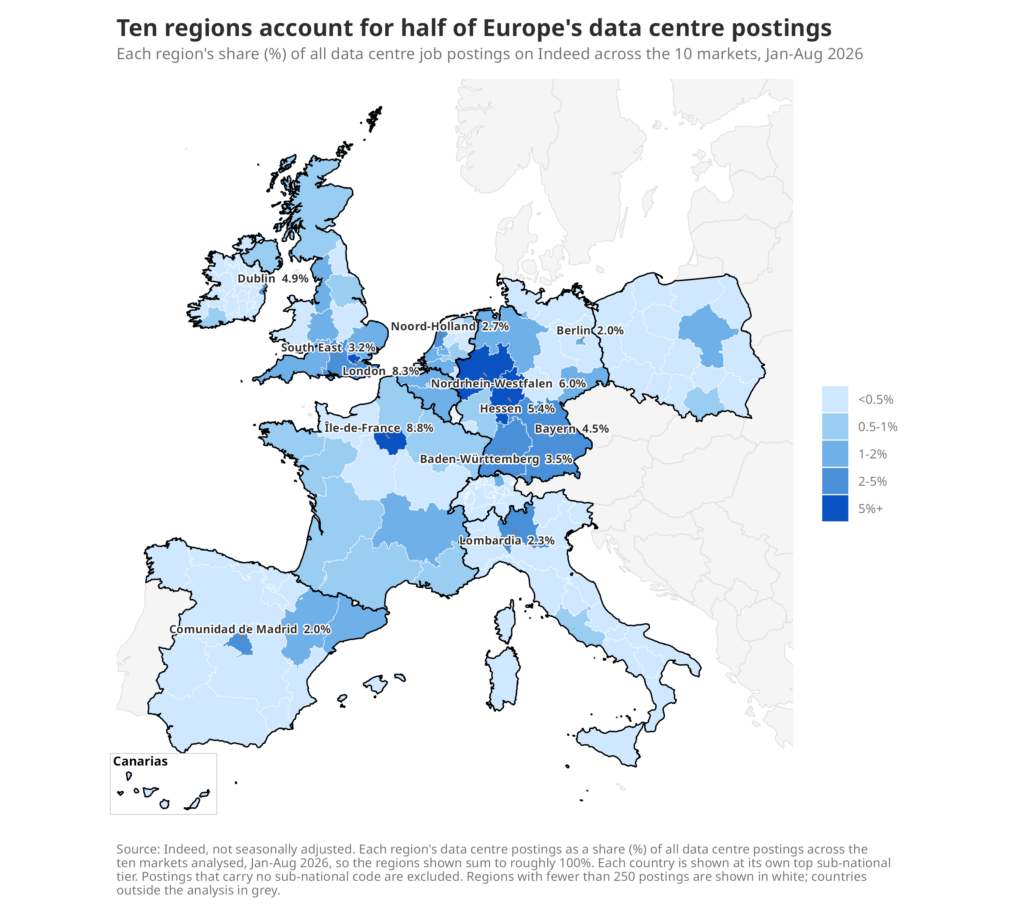
We also analysed the regional concentration of data centre posting activity in each of the 10 countries, broken down into the highest-level sub-national geography available (cantons in Switzerland, autonomous communities in Spain, counties in Ireland, etc.). In each region, we examined the percentage of that area’s total job postings related to data centres.
The stand-out region for data centre labour demand is in Aragón, Spain, where 8.1% of postings mention data centres. The intensity of activity reflects Amazon’s €33.7 billion build-out plan and numerous other projects in the pipeline. Ireland also dominates the landscape, accounting for 7 of the top 10 European regions with the highest concentration of data centre hiring. Groningen (Netherlands) and Ticino (Switzerland) round out the top 10.
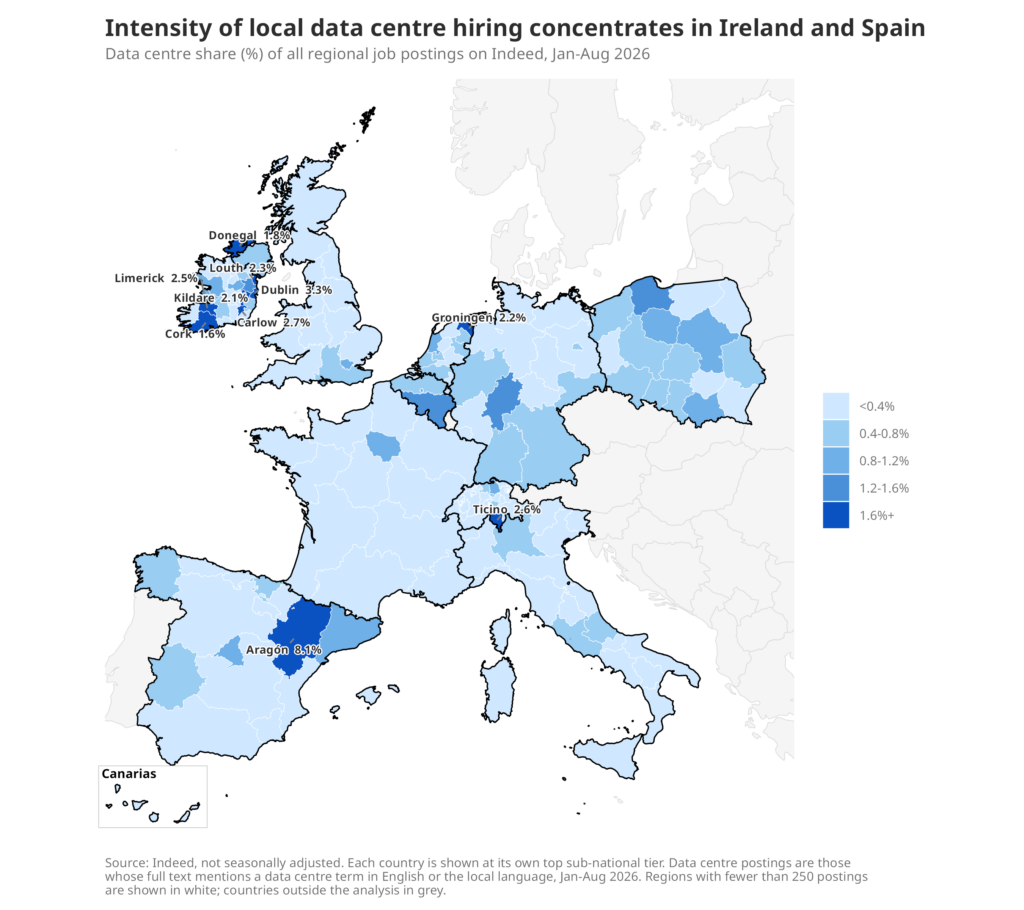
When looking at the intensity of data centre hiring as a share of the local labour market, populous and diversified regions will, by definition, see a smaller impact from the rising but still-niche data centre trend. As a result, the map above understates the relevance of some regions to European data centres, especially larger cities. If you look at each region’s share of total European data centre postings, the map of data centre hiring shifts.
Île-de-France, where Paris is located, accounts for 8.8% of all data centre postings across the 10 European countries analysed, with London (8.3%) close behind. The German states of Nordrhein-Westfalen and Hessen together capture 11.4% of European data centre hiring. The concentration in these areas is due to two factors: more populous areas have more job postings in general, and therefore should carry more weight in the European composition. Moreover, legacy data centres have historically been located near large population centres to be closer to end users. The relevance of larger cities in the AI infrastructure build-out may be limited going forward, as land availability and the need for more affordable electricity push future developments further afield.
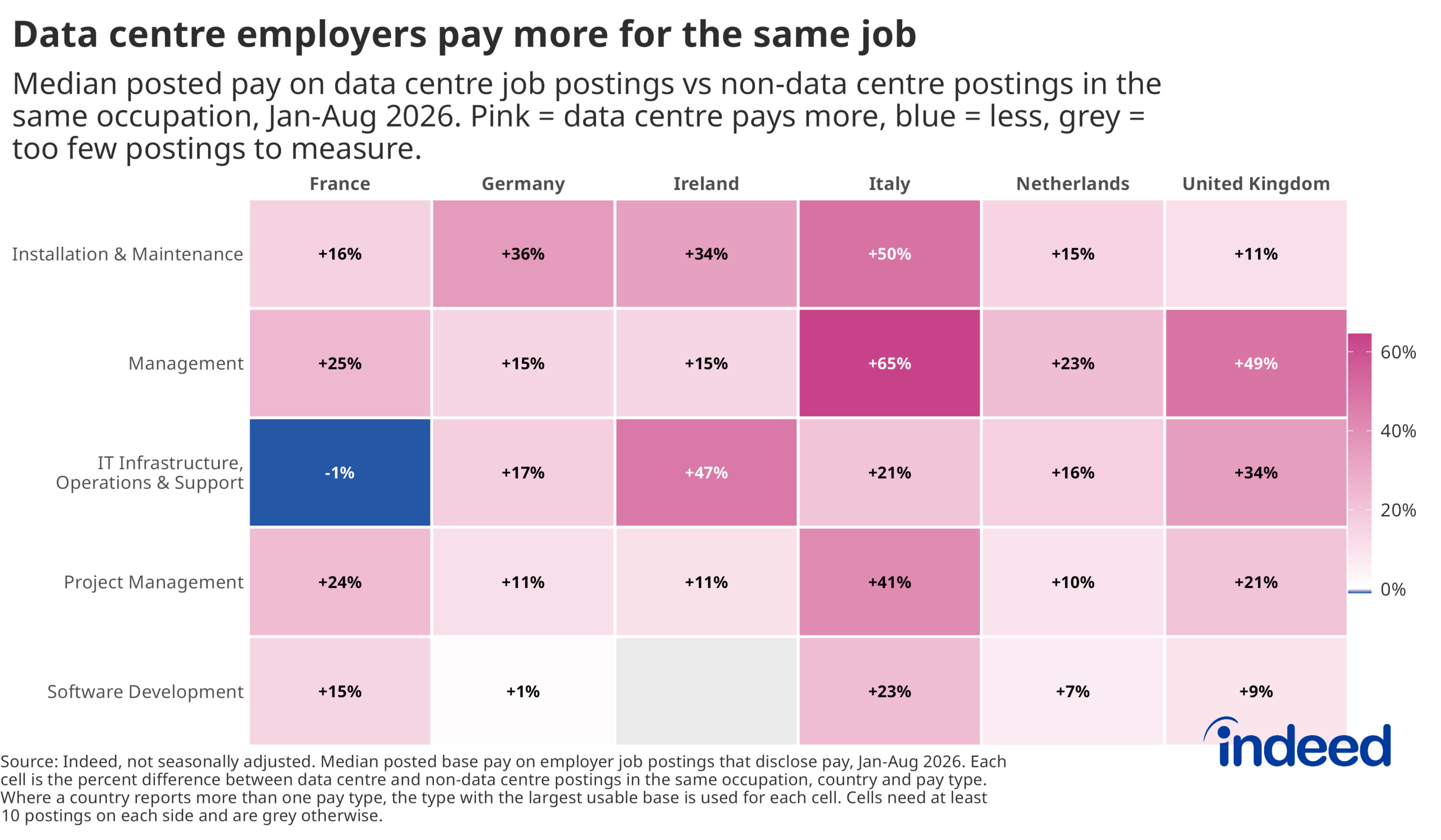
Data centre employers pay a premium for the same roles
As in the US and Canada, employers advertise substantially higher pay for data centre roles than for the same occupation elsewhere. What stands out in the European data is how broad the premium is: of the 29 country-occupation pairs we measured, 28 favour data centre work, and the lone exception is a marginal case (IT infrastructure, operations & support in France, at −1%).
The premium for data centre-related work over similar work that is not data centre-related is generally largest for hands-on workers directly tied to the site. The premiums for installation & maintenance workers range from +11% in the UK to +50% in Italy, a range largely in line with the 42% hourly premium we found for the same workers in the US.
Posted wages for data centre roles in management and project management fields are similarly high, with the largest premiums observed in Italy and the UK. Software development roles tied to data centres offer the smallest pay premiums, ranging from +1% in Germany to +23% in Italy. Given that salary transparency in job ads remains low in many European countries and posted wage data are sparse in some places, these figures are best read for direction rather than magnitude. And the direction is clear: demand for data centre workers is driving up wages.
European jobseekers are taking notice
Europeans are increasingly looking for data centre work. We track the share of all searches on Indeed that include a data centre keyword in English or the local language, indexed to August 2024, so that the series shows growth in data centre interest after controlling for growth in total search volume.
Spain, Poland and Italy have seen the largest recent gains: the data centre share of searches is now 3 times higher than it was just two years ago in these countries. Belgium (2.7x) and the Netherlands (2.5x) follow. Growth in Irish data centre searches looks small by comparison, but this is due to Ireland already showing outsized interest over the past few years. That is, the modest growth reflects a high starting point rather than middling interest. Data centre searches accounted for 0.05% (or 1 in 2000) of total searches in the country in August 2026 – more than double the share in any other country – and fitting the bill for a country where AI adoption is already among the highest in the world.
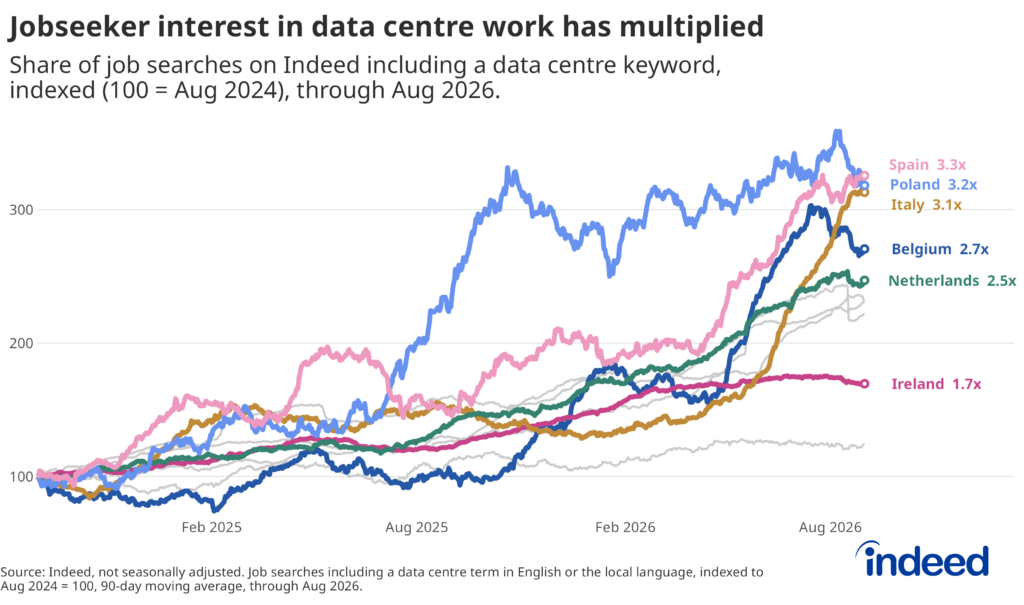
Overall, while the growth is notable, it is important to keep the base in mind: data centre searches represent fewer than 1 in every 1,000 searches in all 10 countries, whereas other common searches (i.e., for part-time or remote roles) account for something closer to 1 in 50 or 1 in 20 searches, depending on the market. The acceleration is real, but data centre work remains a specialist pursuit.
Conclusion
Europe’s data centre build-out is smaller and at an earlier stage than the one underway in the US, but it is now visible in every labour market metric we track: postings, pay and jobseeker interest. It is also one of the very few sources of growing tech-adjacent hiring on a continent where tech postings remain deeply depressed and where the broader labour market continues to soften.
Europe’s data centre build-out leaves many of the same open questions as similar initiatives in North America, chief among them how many of these jobs will remain once the construction crews leave. In Europe, it remains to be seen whether €176 billion in direct investment over the next five years buys a durable jobs boom that meaningfully lifts local economies, or only a temporary and limited reprieve for a continent struggling to find new dynamism.
Methodology
We track data centre postings by tallying job postings on Indeed in Belgium, France, Germany, Ireland, Italy, the Netherlands, Poland, Spain, Switzerland, and the United Kingdom whose title or description includes a data centre keyword in English or the local language (including, for example, “data centre,” “datacenter,” “centre de données,” “Rechenzentrum,” “centro de datos,” “centro dati,” “datacentrum,” and “centrum danych”). This method doesn’t capture the full extent of data centre labour demand and picks up roles that are not actually related to data centres but whose job descriptions may include the terms. Still, we believe this method provides a gauge of recent trends.
We follow a similar methodology to identify data centre searches and tabulate searches on Indeed in each country that include the same keywords in the search query. Pay comparisons use median advertised base pay on postings that disclose pay, comparing data centre and non-data centre postings within the same occupation, country, and pay type (i.e., annual or hourly). Regional shares pool postings from January to August 2026 and use each country’s top sub-national tier (regions in Belgium, Länder in Germany, cantons in Switzerland, comunidades in Spain, International Territorial Level 1 (ITL1) regions in Great Britain, and so on); regions with fewer than 250 postings are excluded.
Search figures reflect Indeed’s user base, which may differ from the overall workforce in each country.
The number of job postings on Indeed, whether related to paid or unpaid job solicitations, is not indicative of potential revenue or earnings of Indeed, which comprises a significant percentage of the HR Technology segment of its parent company, Recruit Holdings Co., Ltd. Job posting numbers are provided for information purposes only and should not be viewed as an indicator of performance of Indeed or Recruit. Please refer to the Recruit Holdings investor relations website and regulatory filings in Japan for more detailed information on revenue generation by Recruit’s HR Technology segment.