The Big Picture
For the first time in nearly four years, annual growth in the Indeed Job Postings Index (JPI) is positive. Postings on Indeed increased over the month and have trended higher since the start of summer. Whipsawing official data from the past two BLS employment reports do not change the broad narrative of the labor market: For workers already holding jobs, low layoffs mean the situation is largely stable. But for those looking for work, the squeeze is real, and neither the economy nor monetary policy is currently offering a way out.
Job Postings
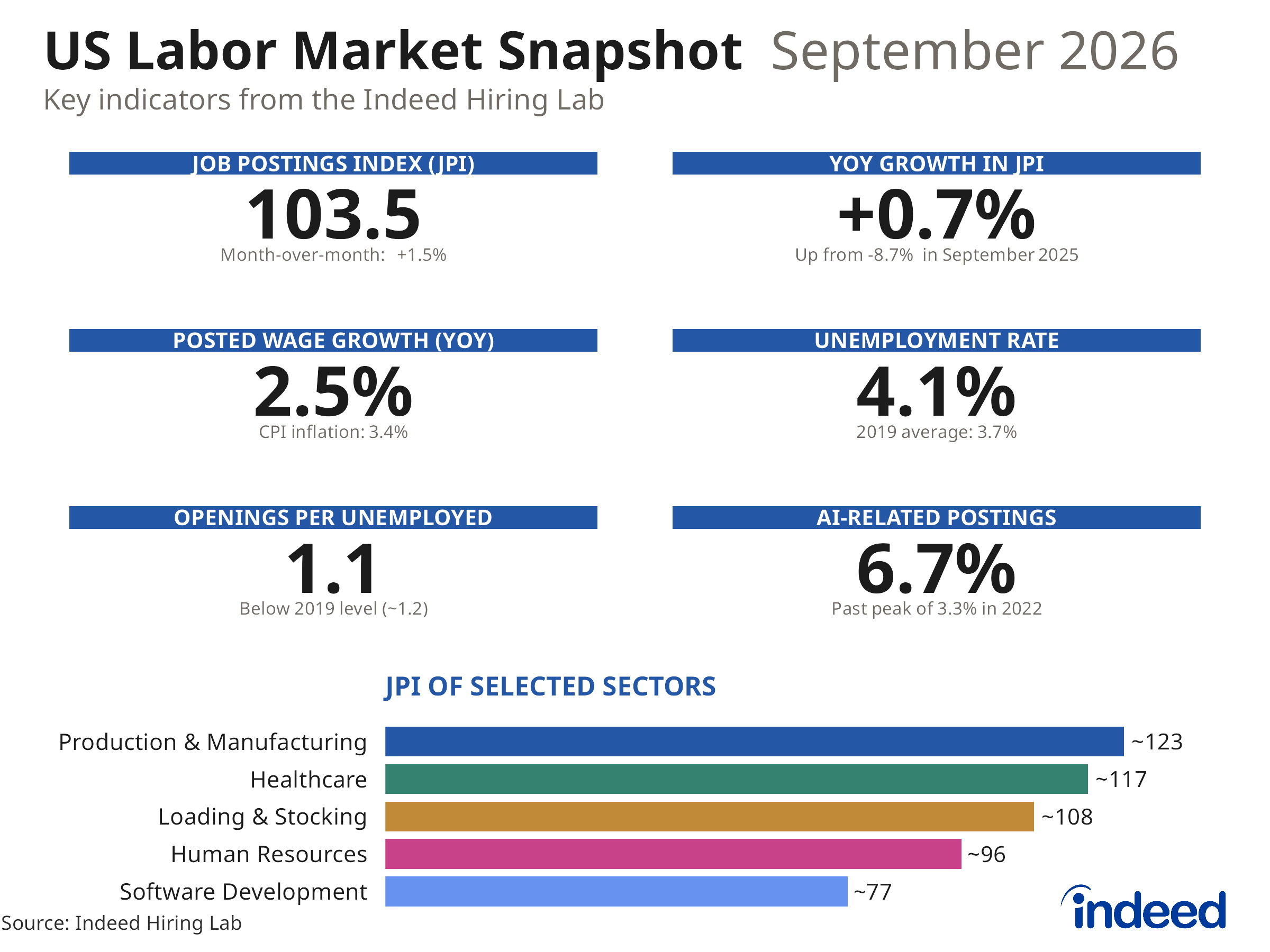
Where we are: Indeed’s JPI has inched higher over the past three months and, at 103.5, is at its highest level since late March, and about 3% above the pre-pandemic level. New postings (job postings on Indeed for 7 days or fewer) have continued to move slightly lower, registering 94.0 on September 18 — about 6% below the pre-pandemic level.
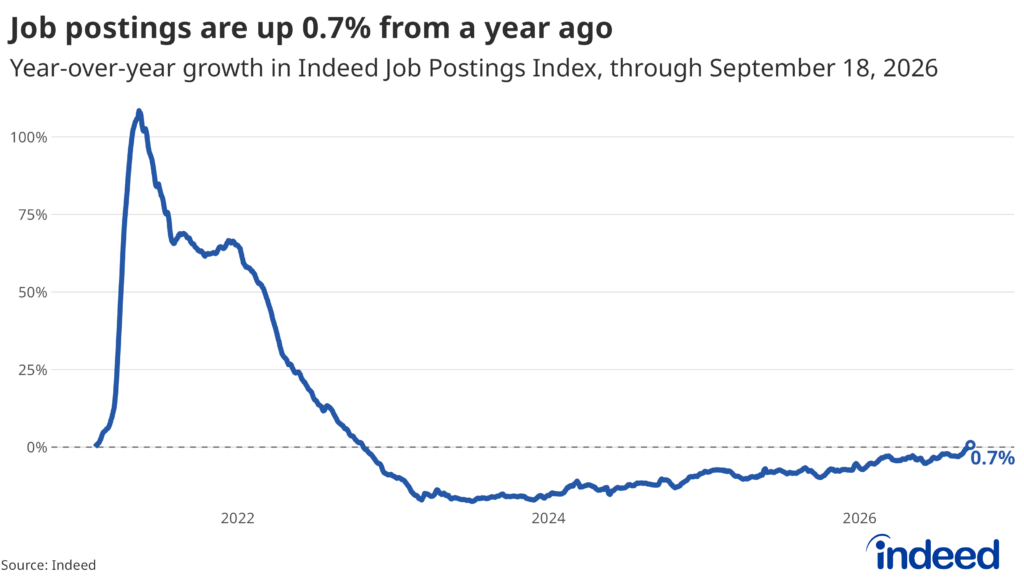
Direction of travel: Labor demand has improved, with the JPI registering 1.5% monthly growth as of September 18. More importantly, the year-over-year percent change in Indeed job postings has broken above zero. Albeit a small increase, 0.7% growth in the JPI is the first positive reading in almost four years. If this trend continues, it means that the annual declines in labor demand that have been ongoing since late 2022 might have run their course.
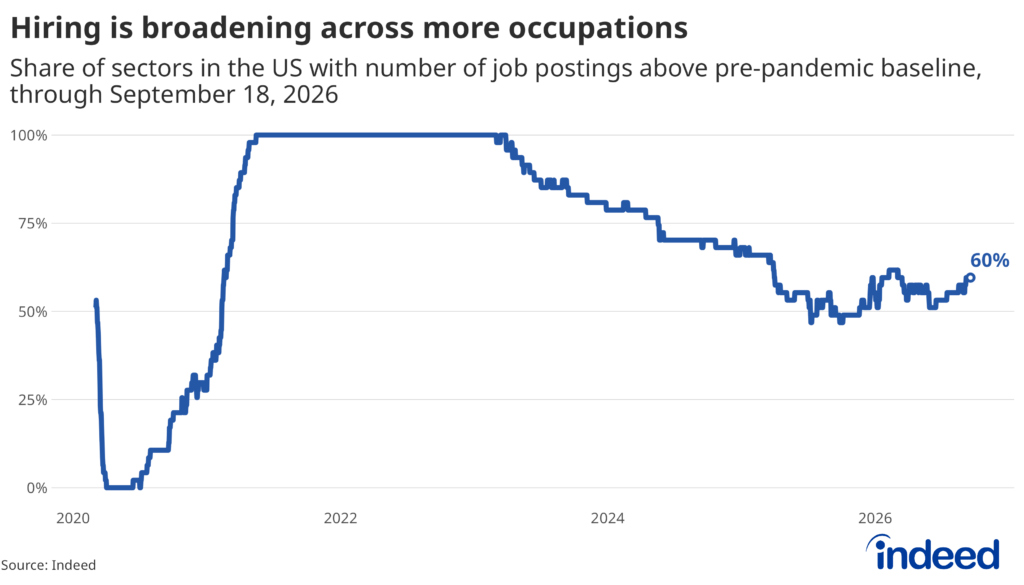
Sector split: The breadth of hiring has increased, with 60% of occupational sectors registering job postings above the pre-pandemic baseline as of September 18, up from 51% at the beginning of June. This is good evidence that the labor market might be improving after months spent bumping along the bottom. Still, the story is two-sided. In some occupations, demand remains strong, particularly for engineers and in Personal Care & Home Health. In others, job seekers are facing a tougher market, most notably in tech, where postings remain depressed despite improving from last year’s lows.
Wages
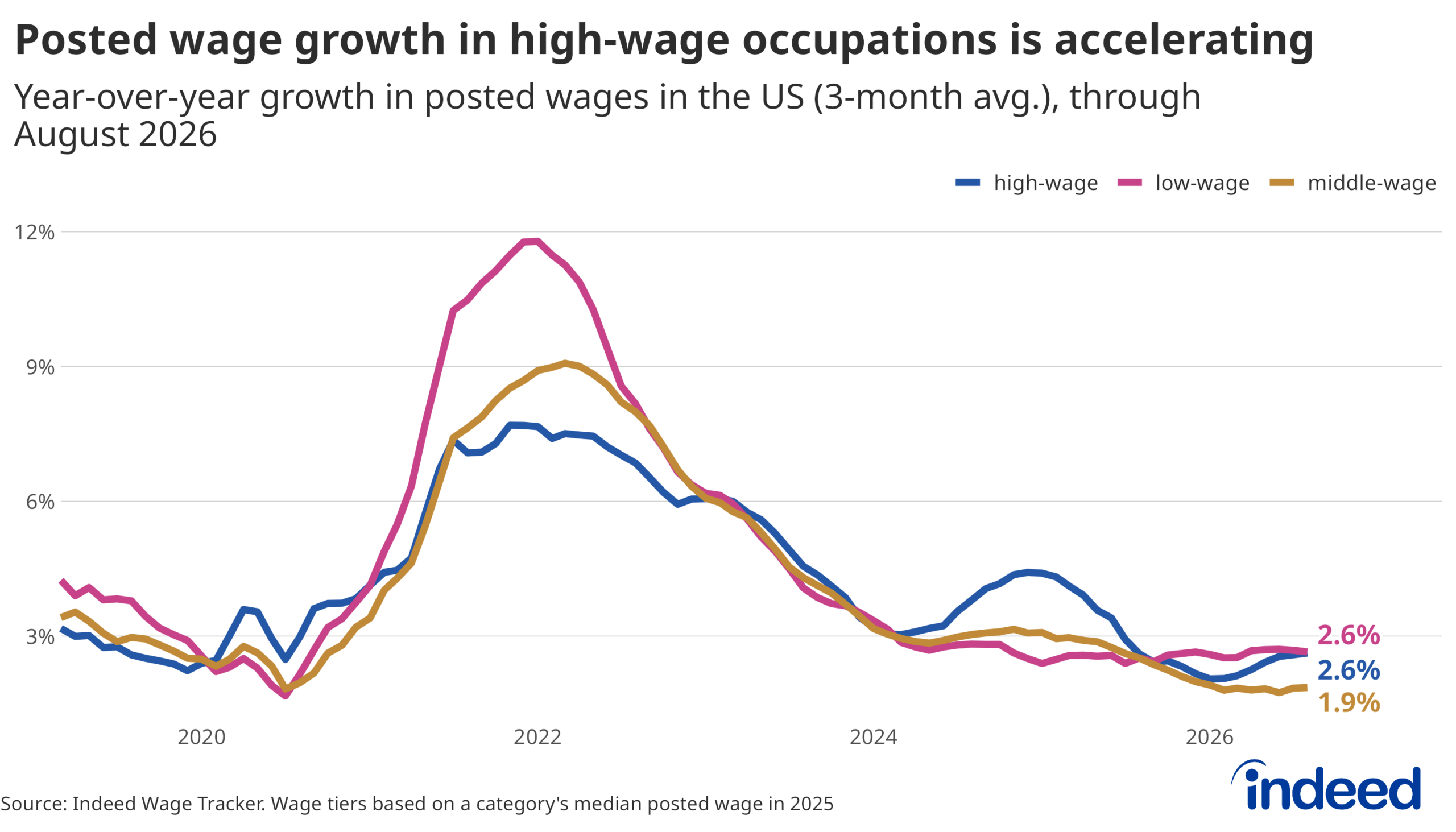
Headline: Posted wages rose 2.5% over the year ending August 2026. While overall growth in advertised wages has been stable over the past six months or so, pay gains aren’t being distributed equally, with wage growth for middle-wage occupations lagging. Since the start of the year, traditionally higher-paying occupations have seen wage growth accelerate from a 2.0% annual rate in January to 2.6% rate as of August. Meanwhile, wage growth in low- and middle-wage occupations has moved sideways.
The Labor Market Balance
Unemployment: The unemployment rate held at 4.1% in July, down from 4.5% at the end of 2025. Unemployment in the low 4s is undoubtedly a good thing, and contained joblessness continues to give the Fed confidence they can raise interest rates without breaking the back of the US economy. However, we continue to stress that the shrinking labor supply makes it mathematically harder for the unemployment rate to increase. Hence, a 4.1% rate today says something very different about labor dynamics than it has historically.
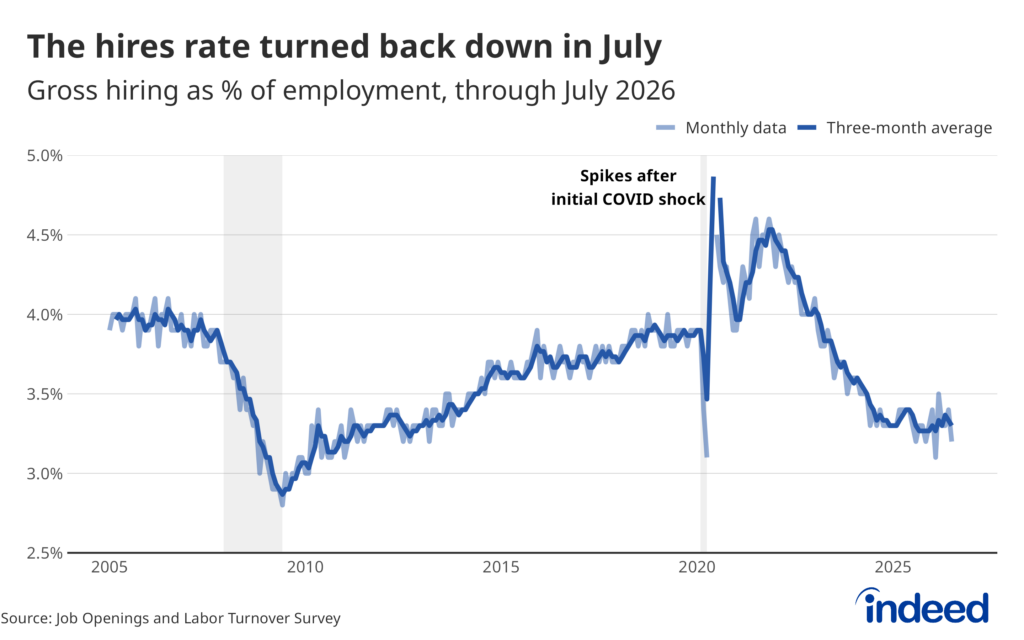
Hires, quits, and layoffs: News of a triumphant resurgence in hiring, if you take August’s blockbuster jobs report at face value, has not reached the JOLTS data. The hires rate, which had shown signs of a revival over the past few months, dropped to 3.2% in the July data release. For context, while a 3.2% rate has been registered a few times this year, outside of the current low-hire, low-fire market, one has to look at the month of pandemic lockdowns (April 2020) or years like 2009-2011 (i.e., the drawn-out recovery from the global financial crisis) to see a similarly slow pace of hires. The quits (1.9%) and layoff (1%) rates remain equally subdued.
What We’re Watching
- Stalling labor force growth: The United States is likely entering a period where hires and payroll employment will be lower than we’ve grown to expect — not because of limited demand, but because there simply aren’t enough workers to fill available jobs. The US labor force has shrunk by around 700,000 workers so far in 2026. Absent a surprise fourth-quarter shift, 2026 will be just the second time since 1948 that we’ve seen a shrinking labor force outside of a recession. If both the supply of workers and jobs available for them shrink, everything else in this economy is at risk of shrinking too.
- Monetary policy: The FOMC raised interest rates at its September meeting and signaled that additional policy tightening is likely to come before the end of the year. Underlying the decision was the view that the US economy had broadly strengthened and that more restrictive monetary policy was necessary for a “timelier” return of inflation to the 2% target. Certainly, many labor market indicators would support the Committee’s analysis. Still, aside from the blowout August jobs report, the labor market is by no means on firm footing to withstand a substantial rate-hiking cycle.
The full chartbook with additional sector, wage, and JOLTS detail is available here.
Methodology
Data on seasonally adjusted Indeed job postings are an index of the number of job postings on a given day, using a seven-day trailing average. February 1, 2020, is our pre-pandemic baseline, so the index is set to 100 on that day. Data for several dates in 2021 and 2022 are missing and were interpolated.
Data on wage growth are the average year-on-year percentage changes in wages and salaries advertised in job postings on Indeed, controlling for job titles.
Data on AI-related postings are the share of AI (and generative AI) job postings, as a percentage of overall job postings, using a seven-day trailing average. We calculate the aggregate share of job postings in a specific location that included keywords associated specifically with: AI (e.g., “Machine Learning,” “Data Science,” and “Artificial Intelligence”) and Generative AI (e.g., “Generative AI,” “Large Language Models,” and “ChatGPT”).