Key Points:
- Job openings were little changed at 7.3 million, according to the Bureau of Labor Statistics (BLS), up from a downwardly revised 7.2 million in June.
- Year-over-year, Retail Trade saw the largest increase in job openings (+155,000), closely followed by Manufacturing (+152,000). Leisure & Hospitality had the largest drop in job openings year-over-year (-187,000).
- There are few indications that major shifts are coming, but if any one force is likely to eventually break this stalemate, one way or another, it’s artificial intelligence.
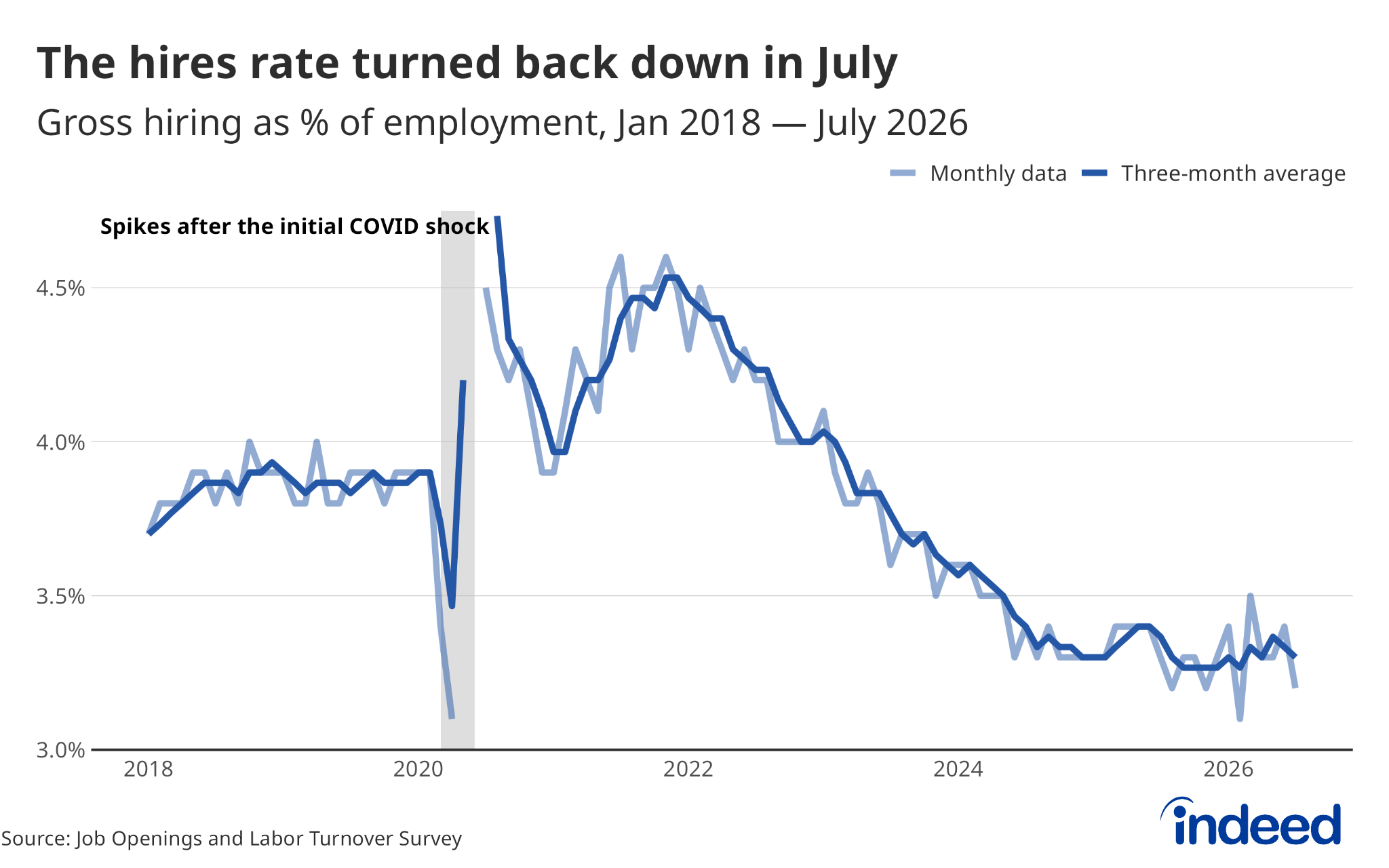
For those looking for some kind of definitive turning point (in either direction) after months of similar job market dynamics, this report isn’t it. Job openings were little changed at 7.3 million, up from a downwardly revised 7.2 million in June. The hires rate fell to 3.2%, quits ticked down to 1.9%, and layoffs dropped slightly to 1%. We’re a ways off from the days of 8 million or more job openings in a given month, but the truth is the market doesn’t need to have that level of open jobs anymore to continue chugging along as it has. The labor market remains low-hire and low-fire, and at this point, it’s starting to look less like a phase and more like the new normal.
Job openings have increased by 182,000 since July 2025, but this headline number smooths out some of the differences noticed between sectors over the past year. Year-over-year, Retail Trade saw the largest increase in job openings (+155,000), closely followed by Manufacturing (+152,000). Leisure & Hospitality had the largest drop in job openings year-over-year (-187,000). Indeed’s Job Postings Index, a real-time measure that has historically tracked JOLTS closely, has been hovering just under 2% above its pre-pandemic baseline in August, suggesting the next few JOLTS reports are unlikely to look much different from this one.
The hires rate, which showed signs of a revival over the past few months, dropped by 0.2 percentage points to the lowest level since February 2026. Professional and Business Services saw the largest decline, with 188,000 fewer hires month-over-month.
If any one force has the potential to break the market out of this ongoing pattern, it’s artificial intelligence. Today’s report also landed shortly after the BLS published a first-of-its-kind measure of AI exposure by occupation, which rates how much of an occupation’s work AI could help with or take over. And exposure isn’t necessarily a bad thing. Indeed Hiring Lab’s Job Postings Index data has already shown the relationship between AI exposure and job openings flip once: AI-exposed occupations led the decline in postings from 2022 to 2026, then led the rebound over the past year. Even in these still-early days, AI is showing its transformative power, and that means going forward, we should treat exposure as a map of where work is changing, not a forecast of where jobs are going.