
Key Points:
- AI’s impact is broad, but still shallow. There is little evidence of widespread job losses driven solely by AI. The Indeed AI Tracker roughly doubled over the past year, and nearly two-thirds of AI-touched job titles are now outside traditional tech.
- An AI-driven productivity boom hasn’t arrived yet. Labor productivity has grown at a 2.1% annual pace since late 2019, in line with its long-run average. 31% of workers say their employer has low-to-zero AI adoption.
- Workers are souring on AI. Only 45% of AI mentions in Glassdoor reviews are positive, down from 82% in 2019, and AI-critical reviewers are far more likely to mention burnout and layoffs. Employers that adopt AI without bringing workers along risk losing them when the market turns.
There is still a great deal of uncertainty around the exact ramifications of AI on the labor market, and whether it will ultimately lead to a jobs boom or bust. While there is scant evidence of an AI-driven “jobpocalypse” as of writing, there are many signs that AI is directly changing roles and attitudes — with big implications for employers and job seekers alike.
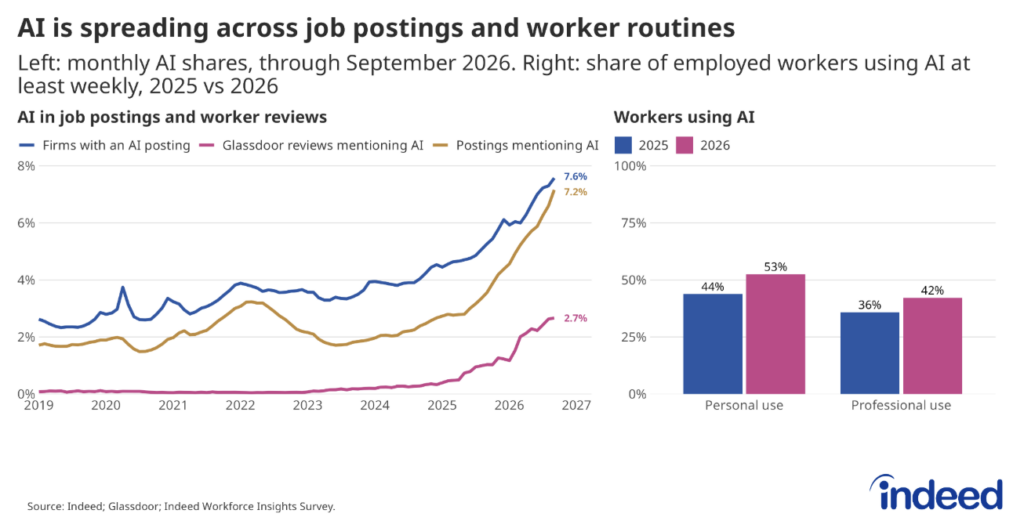
In just the past year alone, the Indeed AI Tracker (which measures the share of Indeed job postings containing AI terms to proxy AI labor demand) has effectively doubled, rising from 3.6% in September 2025 to 7.2% in September 2026. The share of companies with at least one job posting on Indeed that mentions AI is up by 44% over the same time period, and the share of Glassdoor reviews mentioning AI more than doubled. A majority (53%) of employed workers now say they use AI at least weekly in their personal lives, according to the 2026 Indeed Hiring Lab Workforce Insights Report (WIS), up from 44% a year ago, while regular use at work rose from 36% to 42%.
Transformation and opportunities occur across occupations
Dividing the economy into occupations that are “safe from” or “vulnerable to” AI-driven change is an increasingly misguided approach. Yes, AI will have bigger impacts on some occupations and industries than on others, but it is clear that most types of work will eventually be affected. No sector is truly immune from AI-driven change.
AI-related skills, tasks, and tools are now becoming mainstream across the broader labor market. “AI-touched” roles, postings that explicitly include AI in the job title itself, were initially concentrated in the kinds of software and data roles that are most exposed to AI. But today, almost two-thirds of AI-touched job titles are outside of traditional tech occupations. When employers add AI to the titles of truck drivers, retail sales associates, and physical therapists, they are clearly signalling that they expect workers to understand and use AI tools across a wide array of professions.
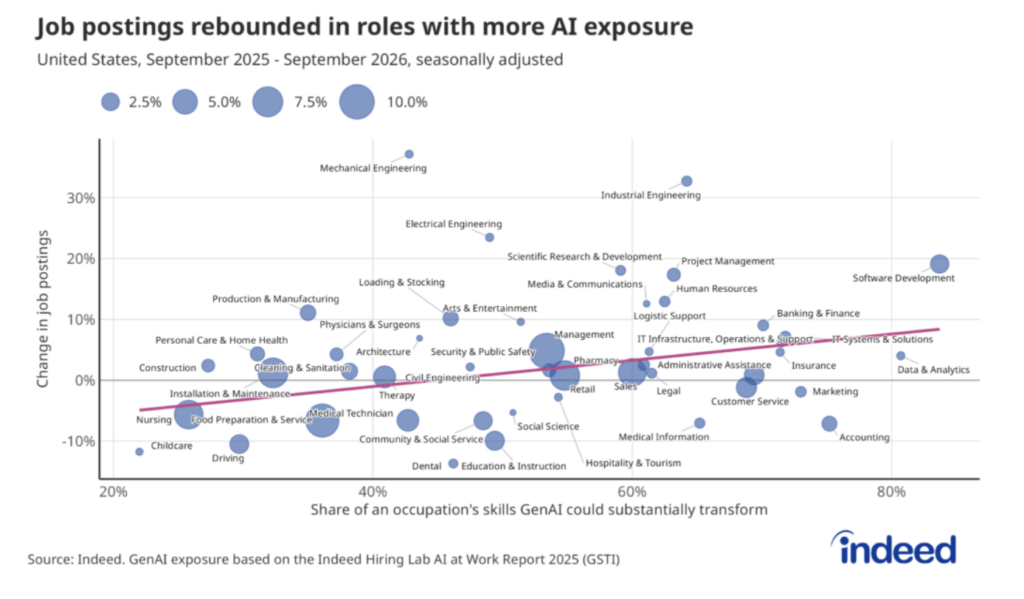
The nationwide AI infrastructure and data center build-out has also sparked a surge in demand for the kinds of hands-on, skilled tradespeople previously considered to have limited exposure to AI itself. In data through the first half of this year, a quarter of data center-related job postings were for installation & maintenance workers. Demand for these workers is running so hot that advertised wages are 42% higher for work of this kind done at a data center, compared to similar installation & maintenance positions unrelated to data centers. Just because AI can’t reliably perform the core functions of a job, like installation & maintenance work, does not mean the occupation will escape AI-driven economic transformation.
Job postings have also rebounded for roles where genAI is most-capable of completing tasks, indicating resilient labor demand and the need to keep a “human in the loop.” The recent resurgence in software development jobs, for example, is being driven by demand for more-experienced and/or AI-related roles: 71% of the increase in Software Development job postings were for senior roles, and 37% explicitly mentioned AI in their title. The AI transformation is not yet driving workers out of certain occupations, but it is impacting the sort of skills and experience that employers are looking for.
AI hasn’t sparked a productivity revolution…yet
Dozens of economic and labor market experts surveyed by Indeed Hiring Lab remain confident AI will meaningfully lift US labor productivity over the next three years. But while the consensus is that AI will boost productivity, we are not yet living in an era of unprecedented productivity growth.
Labor productivity has grown at a 2.1% annualized rate since late 2019, according to the Bureau of Labor Statistics. This is up notably from the 1.5% pace that prevailed from 2008-2019, but in line with the post-1947 long-term average.
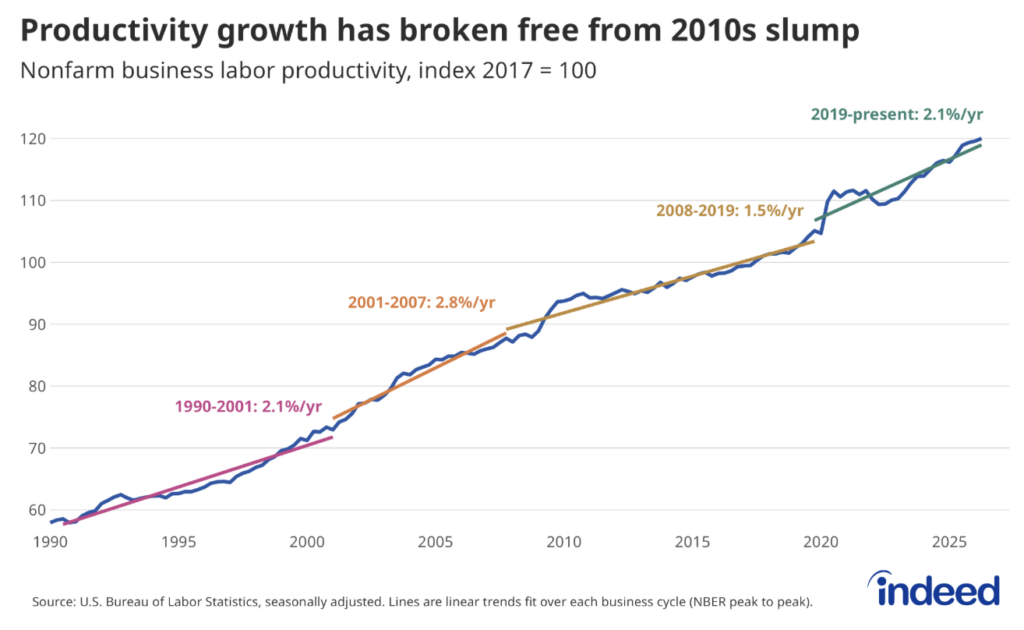
While AI may have contributed to the recent recovery in productivity growth, the data do not yet show a dramatic shift. This doesn’t mean a productivity boom won’t soon come, as it takes time for the economy to adopt new technologies. While individual usage at work is rising, firm-level adoption of the tools remains low. Almost a third (31%) of workers surveyed in the WIS said that their employers had low-to-zero AI adoption, compared to only a quarter (25%) that reported high adoption and integration.
AI still has potential to contribute to seismic improvements in productivity growth, especially as AI capabilities continue to grow and workplace integration becomes more widespread. However, evidence from our survey shows that AI users could see diminishing productivity gains. A majority (56%) of employed US respondents said they did not agree with the statement, “AI makes or could make me more efficient.” Interestingly, among regular AI users at work, estimated daily time savings attributed to the tools actually dropped slightly over the past year, from 2.3 to 2.1 hours.
Worker sentiment on AI is deteriorating
Workers are increasingly sharing critical opinions of their company’s AI adoption strategies in reviews left on Glassdoor. Workers were 2.6x as likely to mention AI in reviews in September 2026 than they were in the prior year, and the tenor of those comments has sharply soured. In 2019, 82% of reviews mentioning AI framed it positively. By 2026, only 45% of AI mentions in reviews were positive and a slim majority (51%) of reviews now mention AI only in the “cons” section.
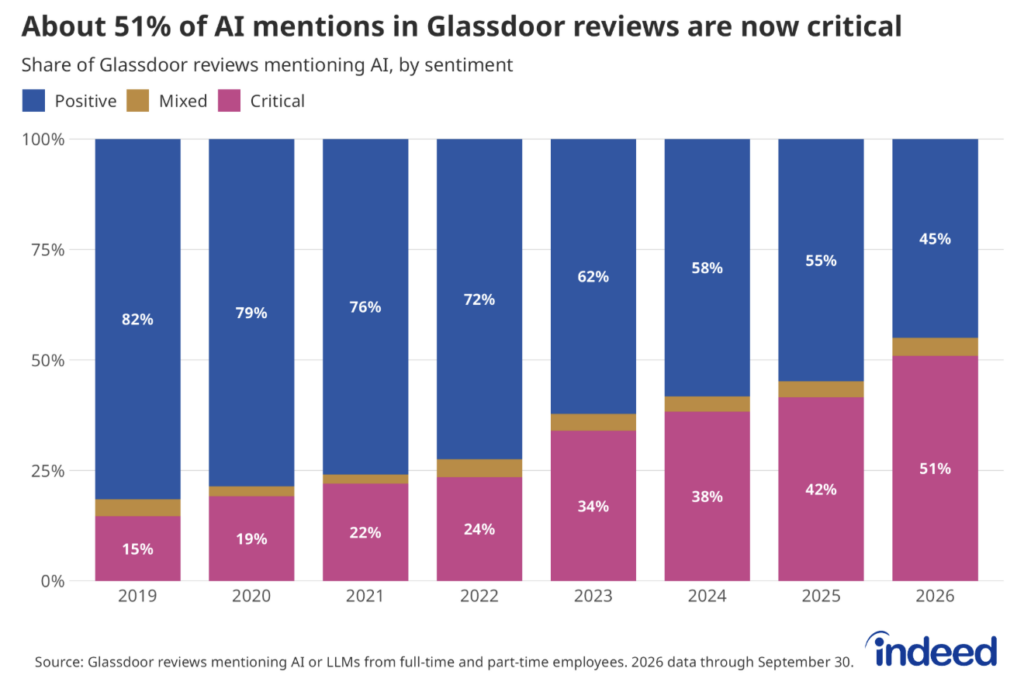
This rising negativity is deeply intertwined with workplace anxiety. Workers making AI-critical comments were 3.5 times as likely to mention burnout, 3.8 times as likely to mention job insecurity, and 7.1 times as likely to mention layoffs than the base rate. In fact, 20% of workers who listed AI in the “cons” section of their review also explicitly mentioned layoffs. This critical sentiment bleeds into overall company outlook as well: only 37% of AI-critical reviewers said they approve of their CEO and just 31% see a positive business outlook, compared to 89% and 85%, respectively, among AI-positive reviewers. AI-critical reviewers tend to give harsher ratings, but these differences aren’t only due to the review being more critical. Statistically significant differences remain even when we account for the review’s overall star rating.
Not all of the negativity has to do with workers’ fear of AI taking their jobs. In a detailed analysis of Glassdoor comments from June 2025 to May 2026, other common complaints concerned how AI had degraded the experience for both workers and customers. Many comments expressed frustration with the AI tools their employers deployed, despite inadequacies. As one reviewer put it, their company made a “big push for use of AI tools that have provided little value.” Although some of the negativity does come directly from workers in occupations facing extreme AI disruption (such as insurance adjusters), there is not a strong relationship between worker sentiment and measures of AI exposure.
Takeaways for employers and job seekers
AI is already triggering subtle but meaningful shifts in the labor market. Some of these are cyclical and likely to fade in coming years, including the boom stoked by red-hot demand for AI infrastructure and hardware. More concerning are the structural shifts occurring alongside these cyclical swings. Structural change requires that jobs be remade to fit a new environment, and that transition can both take a long time to fully unfold and be extremely painful as it does. Navigating these ongoing transformations will require employers, workers and job seekers alike to focus on skills and flexibility.
That is easier said than done. We still don’t know precisely how broad, deep, or durable these shifts are. We do know that AI’s impact is not narrowly constrained to specific jobs or sectors, that there is still robust demand for professional experience, and that workers’ dissatisfaction with AI is growing. Current employees are burnt out and anxious as they incorporate these models into their work, and job seekers need to hit a moving target as skill requirements shift. With current AI capabilities, job seekers should focus on the skills and experience that complement AI, and identify the parts of their professions that still need a human touch.
The challenge for employers is to adapt and innovate without alienating their workforces. The relatively weak labor market has allowed employers to ignore workers’ AI concerns largely without consequence as they focused on AI implementation. But this creates future risks: employers cannot neglect their employees, because they will still need to attract, motivate, and retain workers as long as these large language models are best with a human in the loop.
A downloadable version of our full 2027 US Hiring and Worklife trends report can be found here. Detailed methodology statements for this and each of the six chapters in this year’s report can be found here.