
Key Points:
- Searches on Indeed, including data center-related keywords, have doubled since the start of the year and are 8 times higher than in early 2022.
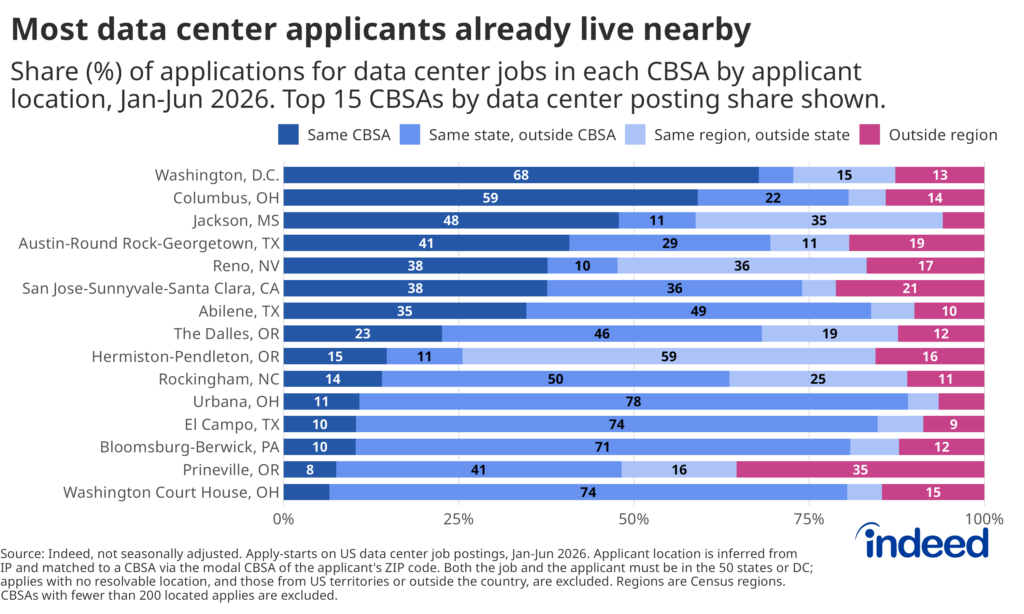
- Job seekers applying for data center positions are local — 55% of applications to data center job postings come from within the same micropolitan or metropolitan area.
- Better pay and more generous benefits packages may attract job seekers, but there are trade-offs.
This is part two of our Indeed Hiring Lab series on Data Centers — who’s hiring for them, and who’s working in them. You can find part one here.
The surge in employer demand for the data center build-out is being met with similarly heightened interest from job seekers. Searches on Indeed, including data center-related keywords, have doubled since the start of the year and are 8 times higher than in early 2022. While job seeker interest in data center positions remains niche as a share of all searches on Indeed, the total number of data center keyword searches has exceeded 1 million so far this year.
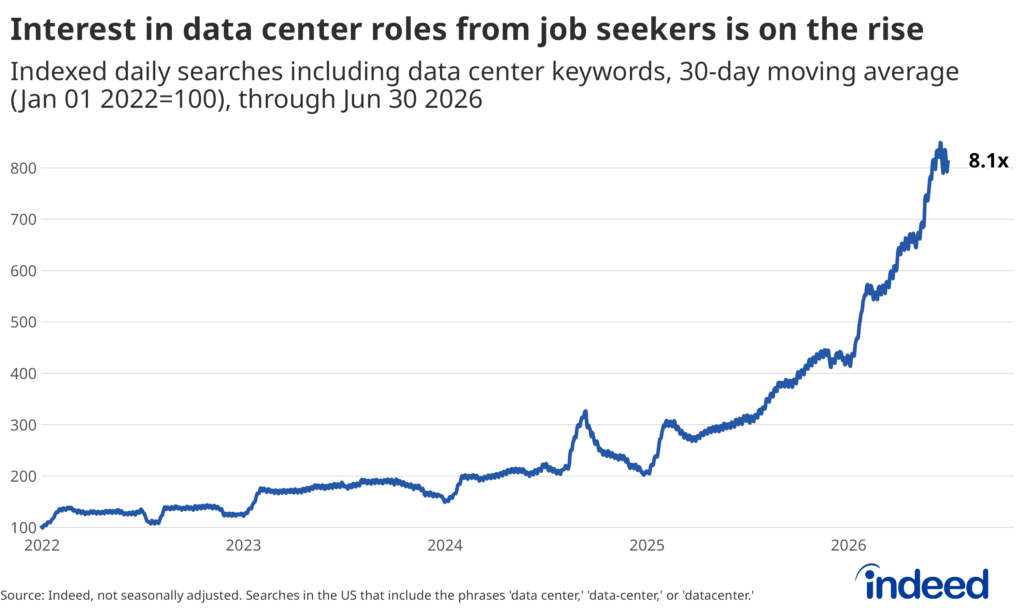
The text of these queries suggests job seekers are open to a range of roles. Just over a third (37%) of data center searches include only the baseline terms (“data center,” “data-center,” or “datacenter”), and many of the top data center searches look for specific company names rather than job titles. Even so, the three most common terms accompanying “data center” are all role-specific: “technician,” which, at a quarter of all data center searches, leads by a wide margin, followed by “engineer” and “electrician.” In other words, job seeker interest already mirrors the build-out’s dual demand for tech expertise and skilled trades.
Who is looking for data center work?
For the most part, job seekers applying for data center positions are local. For each core-based statistical area (CBSA — think metro or micropolitan area), we sort applications to data center postings by the applicant’s location: within the same CBSA, elsewhere in the same state, elsewhere in the same census region, or outside the region entirely. Overall, 55% of applications to data center job postings come from the same CBSA. That majority-local share somewhat runs counter to the image of an itinerant workforce implied by reports of temporary villages built to house data center crews. It is, however, about 10 percentage points below the same-CBSA share for the average US job posting. So, while data center interest is mostly local, it does reach farther afield than typical applications.
In the top 15 CBSAs by data center share of postings, there is more diversification. Larger metro areas such as Washington, D.C., or Columbus, OH, with larger local labor pools, can attract more local applicants. While some more remote data center hubs (including many areas in Oregon) must source labor from out of state or even outside their census region, only three of the top 15 have a majority of out-of-state applicants. Many hyperscalers are now investing in upskilling programs to build a qualified local workforce in their own communities, likely strengthening the local hiring pipeline.
Data center job seekers typically have employment backgrounds that closely align with the industry’s requirements. Indeed data indicate that these postings rarely attract career switchers from unrelated fields. Instead, many users applying to data center roles were most recently employed as network engineers or data center technicians. This trend suggests a specialized workforce that moves from one facility build-out to the next.
Still, that is not to say someone couldn’t break into the data center world if they wanted. Security officers, project managers, and forklift operators are also applying for data center roles — drawing on backgrounds developed in other industries to compete in the race to build and operate data centers.
What is pulling job seekers in?
Three-quarters of searchers who type “data center” into the Indeed search bar are active job seekers (they have started an application in the month of the search or the month prior). What is drawing those job seekers in?
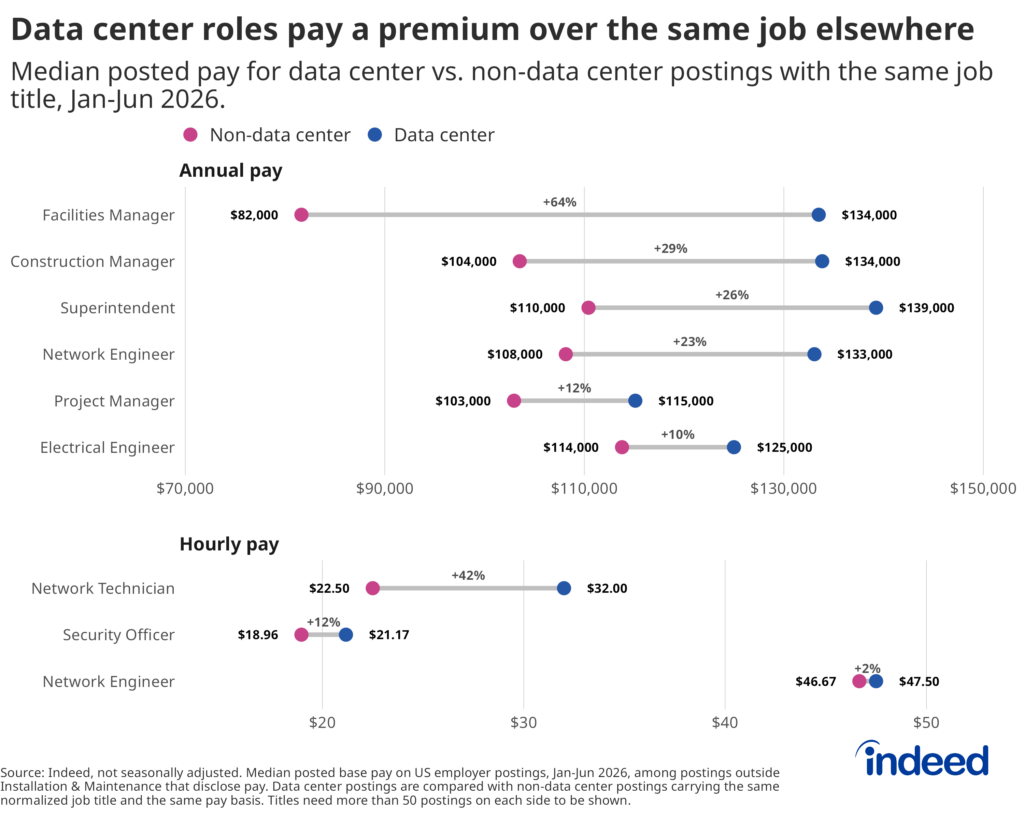
Higher pay is, in general, the primary reason for job search, and data center positions pay a striking wage premium. In our earlier report, we detailed the 42% premium in hourly wages for Installation & Maintenance workers at data centers compared to non-data center roles. However, the pay boost for data center-related positions is not confined to just installers. Facilities managers can expect a $50,000 annual raise in a data center role relative to non-data center options with the same job title. Other notable pay gaps are evident for construction managers and superintendents (both +$30K median annual salary for a data center-related position), network engineers (+$25K median annual salary), and network technicians (+$10 median hourly wage).
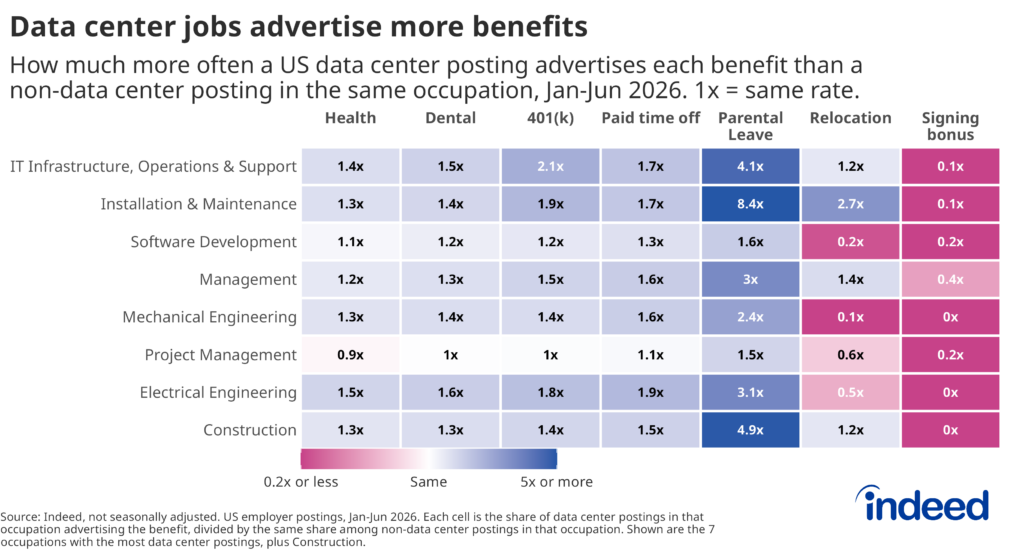
Data center roles also offer a significant premium in employee benefits. In top data center-heavy occupations, job postings mention parental leave four to eight times more often than outside roles. While the increase is less dramatic for standard benefits like health or dental insurance, data center roles consistently offer these core perks at a higher rate than unrelated positions within the same occupational groups. Add to the package that 90% of Installation & Maintenance data center roles and 80% of IT Support data center job postings advertise an employer 401(k) plan (compared to 48% and 38% of non-data center roles, respectively), and workers will find they have access to substantially more benefits if they apply their skill set to the data center build-out.
Data center job postings also feature relocation assistance modestly more frequently than standard job ads, which may not be surprising given the need to attract workers to sometimes remote data center hubs. Construction and IT Support (1.2x), Management (1.4x), and Installation & Maintenance (2.7x) roles are all more likely to see relocation support advertised in data center job postings than other opportunities in those fields. Interestingly, despite the surge in labor demand for data center workers, employers do not feel the need to use signing bonuses to attract immediate labor supply.
What’s the catch?
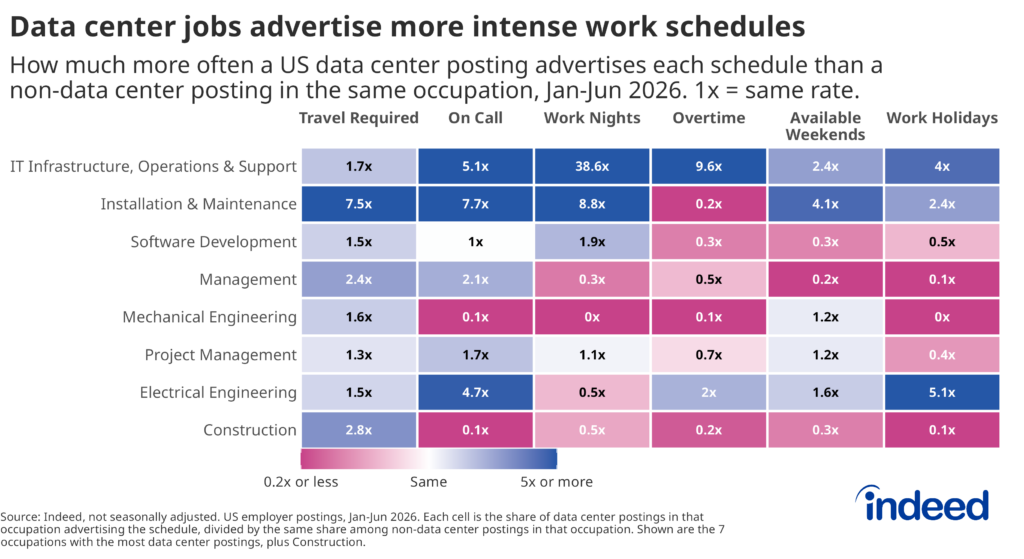
These advantages come with distinct trade-offs regarding work-life balance. Data from Indeed job postings show that data center employers expect workers to be available for irregular work hours or on-call rotations to a greater extent than in other roles within the same occupation. For instance, the IT professionals supporting a data center are nearly 40 times as likely to work nights, based on schedule descriptions in the job posting.
Travel requirements are also significantly higher. Over a quarter (26%) of data center job postings specify “Up to 50% travel,” compared to less than 1% for non-data center equivalents. This overall finding holds even within occupations. Postings requiring any dimension of travel are more common across occupations in data center-related job ads, with a notable lift in Installation & Maintenance roles.
Finally, the open question about the build-out is whether these jobs will last: Constructing a data center requires thousands of workers, whereas operating one requires only a small fraction of that. On paper, at least, employers are hiring for the long haul. Only about 2 in every 1,000 data center postings are flagged as temporary, compared with roughly 10 in 1,000 non-data center postings, meaning data center roles are about five times less likely to be advertised as short-term work.
We’d read that gap as suggestive rather than conclusive. “Permanent” is a label the employer chooses, and there’s reason to think it may overstate how durable these roles really are: Local incentive agreements often require a project to create a set number of permanent positions, which gives employers a reason to post that way regardless of how long a given build-out job actually lasts. What we can say is that data center employers are not advertising this work as temporary.
Conclusion
Ultimately, as every student learns in their first week of Econ 101: People face trade-offs. But a trade-off is not the same as a bad deal. For the specialized workers who data center jobs target, the exchange is explicit: premium pay and atypically generous benefits, often in communities where these opportunities are not plentiful, in return for nights, travel, and more on-call shifts. For many, this is a trade worth making.
The harder question belongs to the communities considering data center projects, as they weigh a real and immediate lift to local employment and wages against longer-term costs, such as strains on power systems and water supplies. Knowing the permanence of the jobs is key to managing this tradeoff. It takes thousands of workers to build a data center; operating one takes many fewer. What we can’t observe today, and what will certainly be worth watching, is the number of workers that will remain after the last construction crew leaves the site.
Methodology
We track data center postings by tallying job postings on Indeed in the United States that include the terms “data center,” “datacenter,” or “data-center” anywhere in the job title or job description. This method doesn’t capture the full extent of data center labor demand and picks up roles that are not actually related to data centers but whose job descriptions may include the terms. Still, we believe this method provides a gauge of recent trends.
We follow a similar methodology to identify data center searches and tabulate searches on Indeed in the United States that include the term “data center,” “datacenter,” or “data-center” in the search query.
All figures reflect Indeed’s user base, which may differ from the overall US workforce.
The number of job postings on Indeed, whether related to paid or unpaid job solicitations, is not indicative of potential revenue or earnings of Indeed, which comprises a significant percentage of the HR Technology segment of its parent company, Recruit Holdings Co., Ltd. Job posting numbers are provided for information purposes only and should not be viewed as an indicator of performance of Indeed or Recruit. Please refer to the Recruit Holdings investor relations website and regulatory filings in Japan for more detailed information on revenue generation by Recruit’s HR Technology segment.