The Big Picture
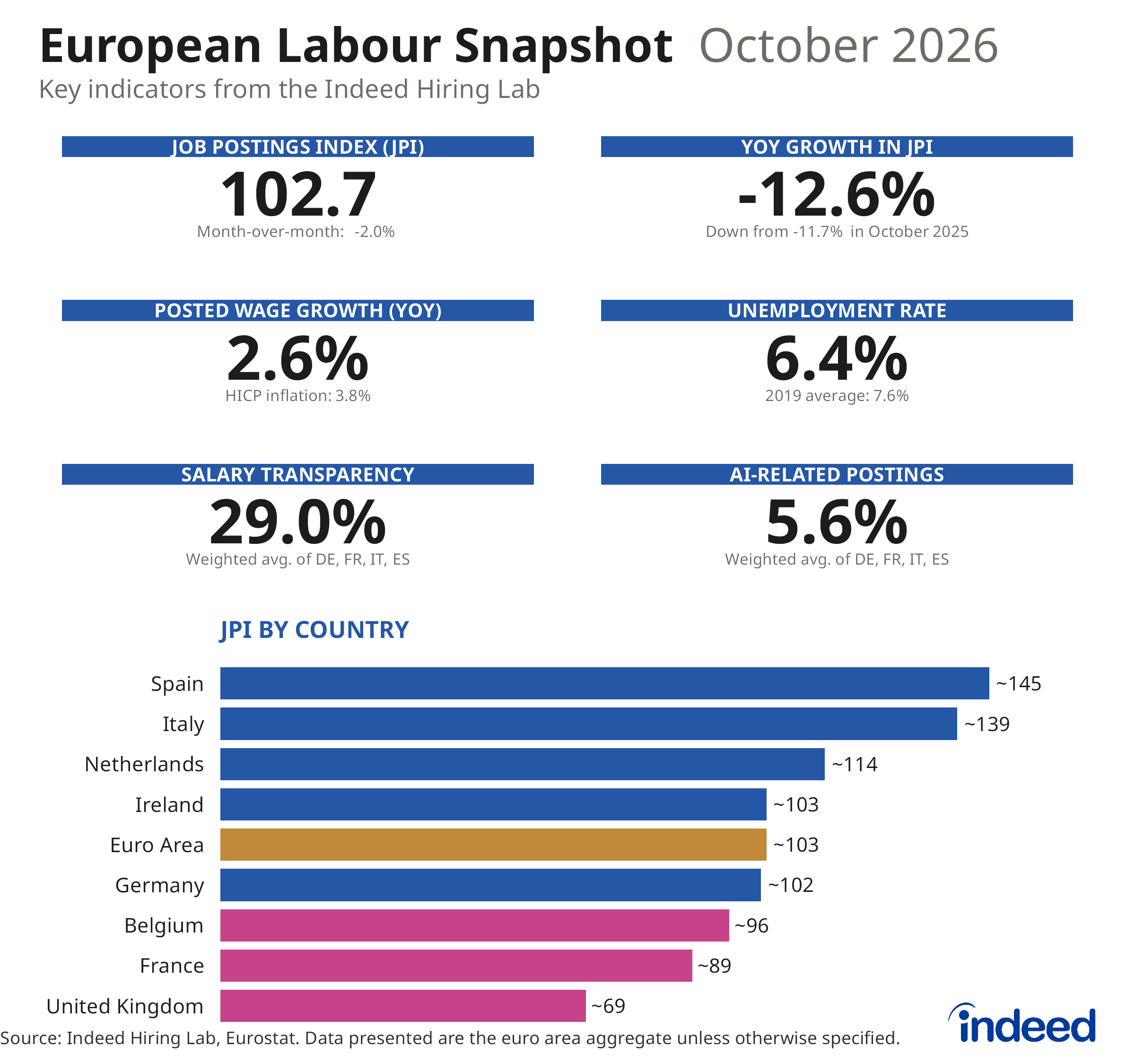
Europe’s labour markets remain resilient in level terms, but hiring growth remains elusive. Indeed’s euro area Job Postings Index stood at 102.7 on 16 October, just under 3% above its February 2020 baseline, and down 13% on the year. In fact, none of the European countries we analyse has seen positive posting growth over the past year. Although at 6.4%, euro area unemployment is still well below its 2019 average (7.6%), joblessness is edging up in many countries.
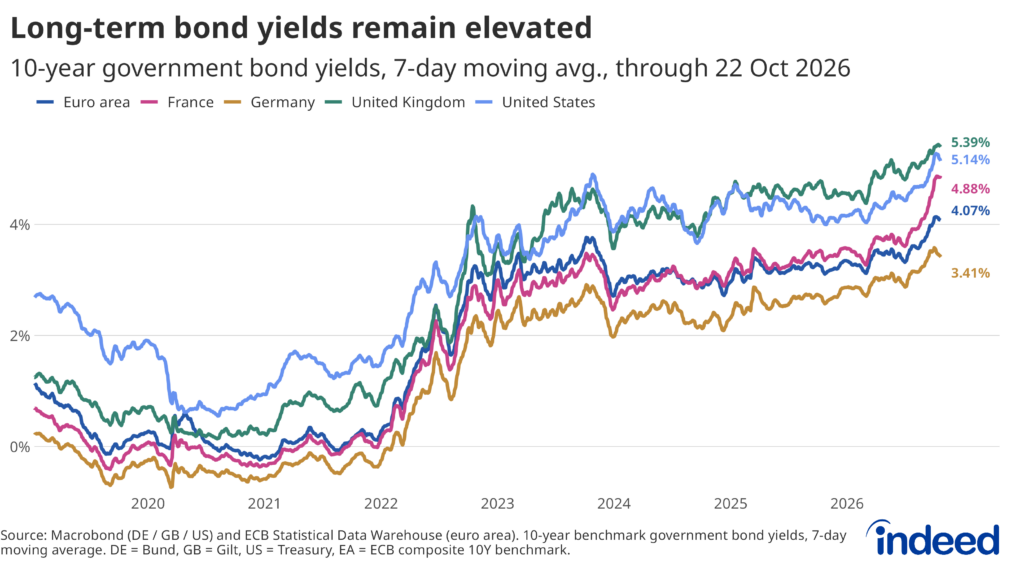
Financial conditions are tightening alongside this. The euro area 10-year yield has risen to about 4.1%, the French OAT is testing 5%, and the ECB has raised rates by 50 basis points this year with another 25 basis points expected in December. Higher borrowing costs weigh on the investment and expansion plans that drive hiring, so this adds to the pressure on labour demand.
Job Postings
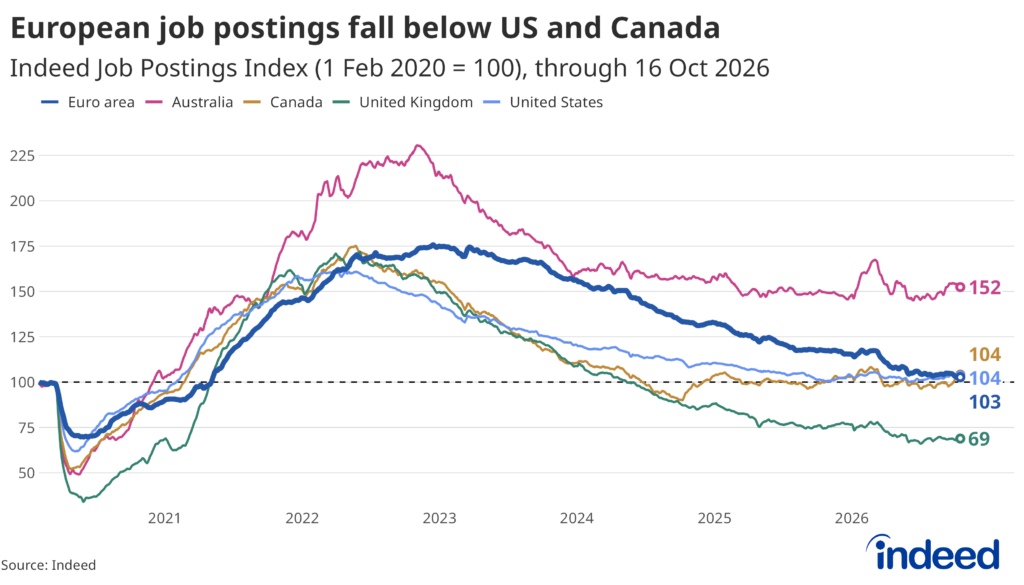
Where we are: Indeed’s euro area JPI hit 102.7 on October 16, pushing overall job postings to just under 3% above their level in February 2020. This is notably lower than where JPI opened the year, at 15% above baseline. New postings (job postings on Indeed for 7 days or fewer) are faring a bit better and registered 105.6 in mid-October.
Direction of travel: The trend in demand for new hires across Europe remains firmly downward. Our euro area postings index is down 13% over the year and 2% over the month, as of October 16. This is in contrast to the United States, which has recently seen annual posting growth break into positive territory – though it may be too soon to call the US labour market strengthening.
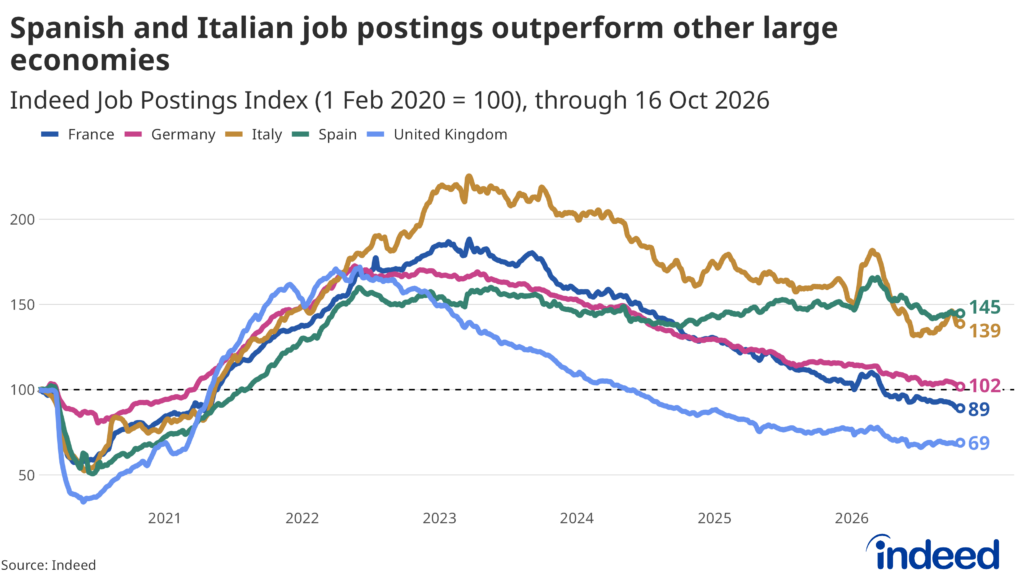
Countries: None of the European countries we analyse have seen positive posting growth over the past year. Even so, a few markets are benefitting from labour demand that is elevated compared to the pre-pandemic baseline. Spain (145) and Italy (139) stand out with the overall level of postings still roughly 40% higher than the pre-pandemic baseline, while the UK (68) and France (89) have seen the largest decline since February 2020. Belgium has also seen the largest year-on-year drop in postings, at -18.7%.
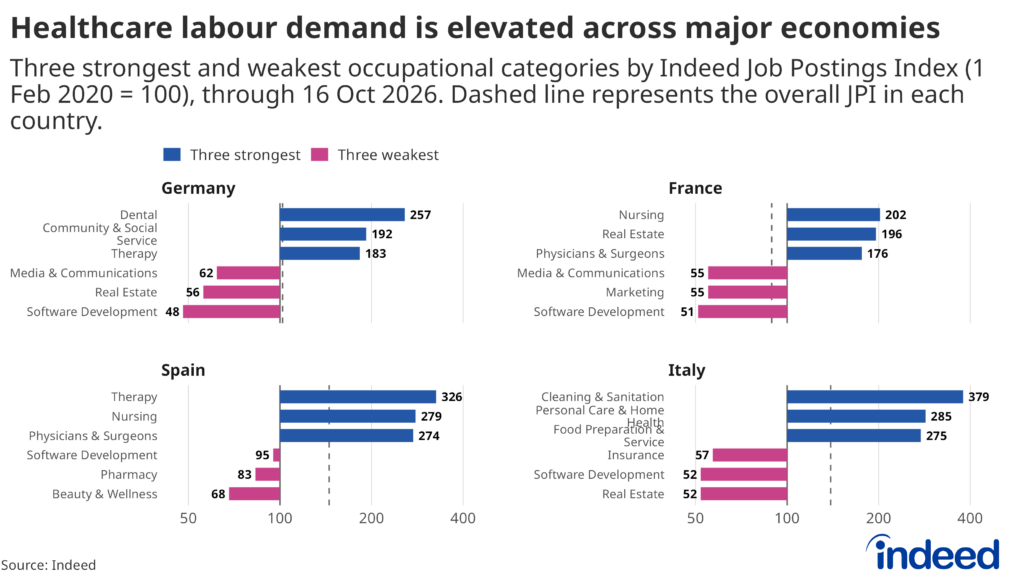
Sector split: Healthcare occupations continue to see the strongest labour demand, with dental, therapy, nursing, physicians & surgeons and personal care & home health roles among the strongest occupational categories in the four largest euro area economies (France, Germany, Italy and Spain). Meanwhile, demand for new hires in marketing, media and software development remains sluggish.
Advertised Wages and Salary Transparency
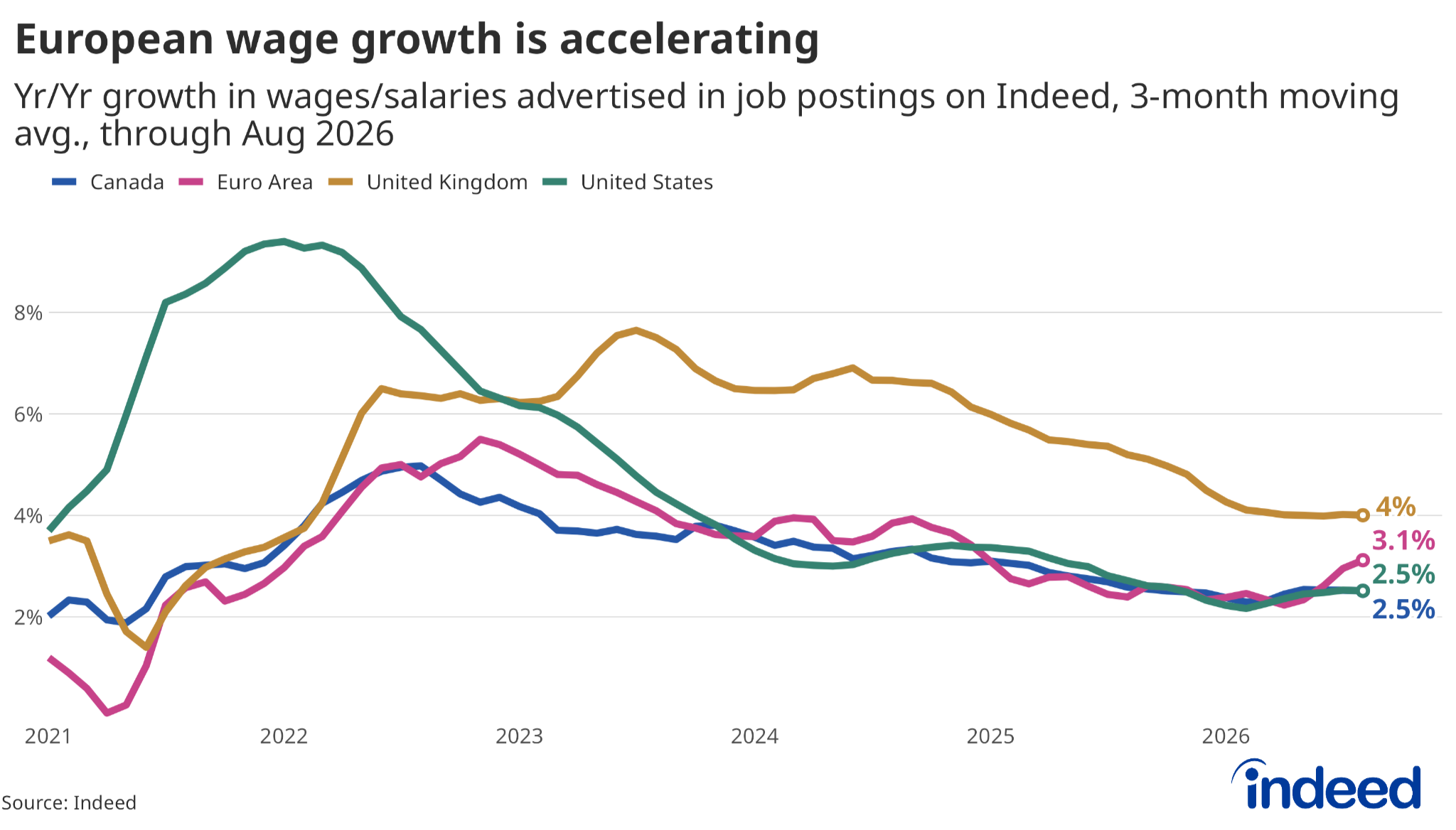
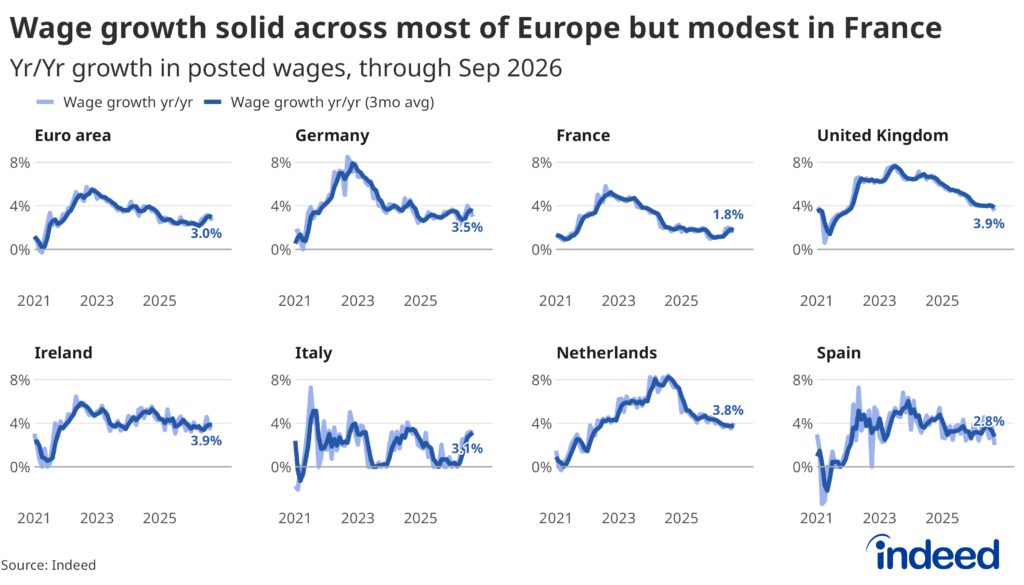
Wages: Wages and salaries advertised in euro area job postings on Indeed rose 2.6% over the year to September, down from 3.1% in August. Despite the deceleration, the three-month average of annual growth held at 3.0%, which is well above both the US and Canada (2.5%). Outside of Italy, where the 3-month moving average of annual posted wage growth ticked up from 2.9% in August to 3.1% in September, posted wage growth was flat or edged down in all the other European countries we track.
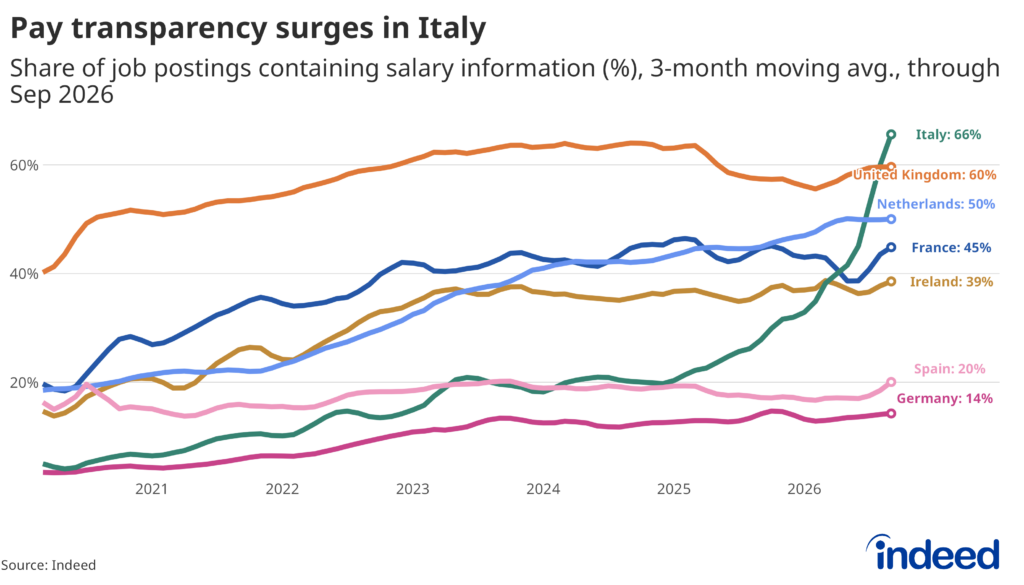
Salary Transparency: Outside of Italy, where pay transparency in job postings is surging, the share of postings on Indeed that include compensation in European countries has remained quite flat – even despite the summer transposition deadline for the EU Pay Transparency Directive. Germany (14%) and Spain (20%) rank among the least transparent countries.
The Labor Market Balance
Unemployment: The euro area unemployment rate remains historically low at 6.4%, but the modest aggregate reading masks diverging trends by country. Spain’s jobless rate continues to decline (10% in August 2026, compared to 10.5% last August). However, the other largest euro area economies have not fared so well. French unemployment rates are up 0.4 percentage points over the year, German unemployment has ticked up 0.2 percentage points over the same period, and Italian joblessness has recently swung in the wrong direction — currently sitting at 6.2%, up from 5.6% as recently as May.
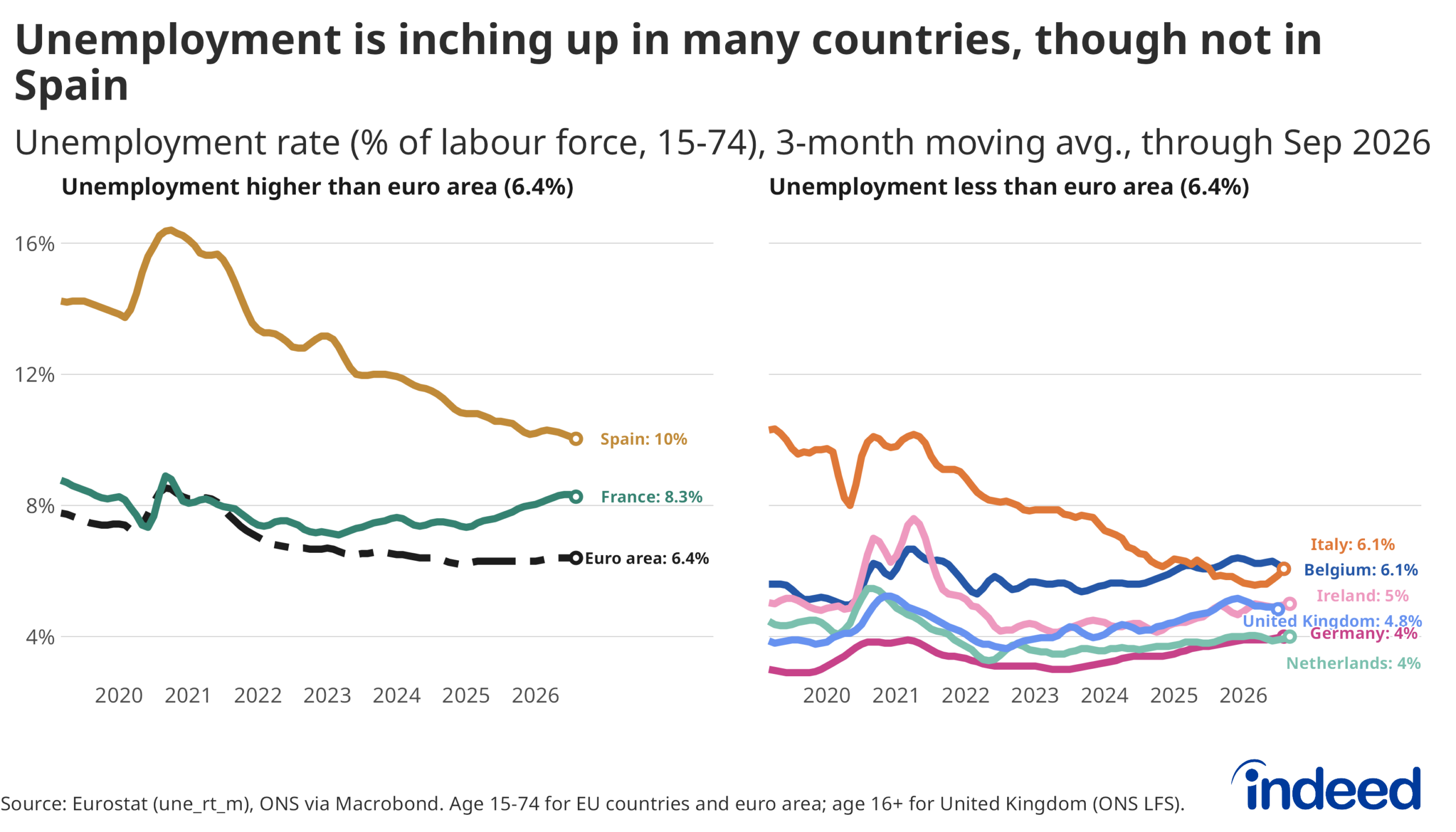
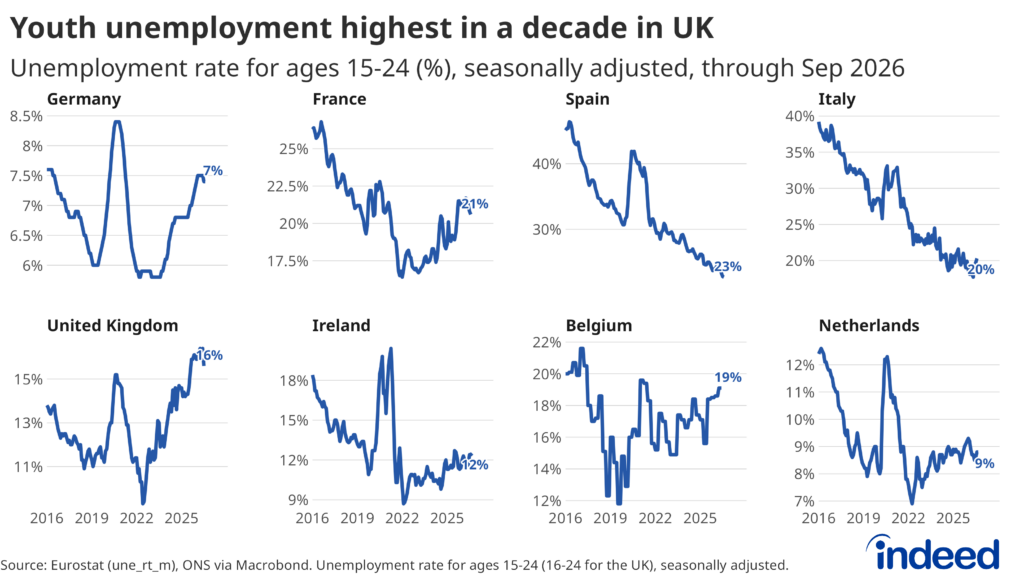
Chart of the Month: Unemployment rates for the youngest workers (those ages 15-24) are worsening across major European economies. The United Kingdom stands out, with youth joblessness at 16.4% in September 2026 – higher than the pandemic peak. Germany has also seen a notable rise in unemployment for young people, and the youth unemployment rate has climbed over the past year from 7.0% to 7.4%. The rise in joblessness coincides with declining job entry level opportunities.
What We’re Watching
Bond Yields and Monetary Policy: A major headwind to European labour markets remains a global bond market sell-off. Global bond yields continue to rise as expectations of monetary policy tightening amid concerns about inflation collide with fierce competition from AI and problematic fiscal conditions (among other factors) to push up borrowing costs. Yields for the 10-year French OAT, in particular, have surged in an ongoing sell-off.
The market is in some ways doing the job of the central bank in tightening financial conditions. The European Central Bank has already increased its policy rate by 50 bps this year, with another 25 bps expected in December. Elevated borrowing costs dissuade businesses from undertaking new projects and, more generally, from expanding, weighing on already tepid hiring plans.
See our full European Labour Market Overview chartbook for a more comprehensive view of the European labour market. Other data, including the Indeed Wage Tracker, is regularly updated and can be accessed on our data portal.
Methodology
Data on seasonally adjusted Indeed job postings are an index of the number of job postings on a given day, using a seven-day trailing average. February 1, 2020, is our pre-pandemic baseline, so the index is set to 100 on that day. Data for several dates in 2021 and 2022 are missing and were interpolated.
Data on wage growth are the average year-on-year percentage changes in wages and salaries advertised in job postings on Indeed, controlling for job titles.
Data on AI-related postings are the share of AI (and generative AI) job postings, as a percentage of overall job postings, using a seven-day trailing average. We calculate the aggregate share of job postings in a specific location that included keywords associated specifically with: AI (e.g., “Machine Learning,” “Data Science,” and “Artificial Intelligence”) and Generative AI (e.g., “Generative AI,” “Large Language Models,” and “ChatGPT”).