The Big Picture
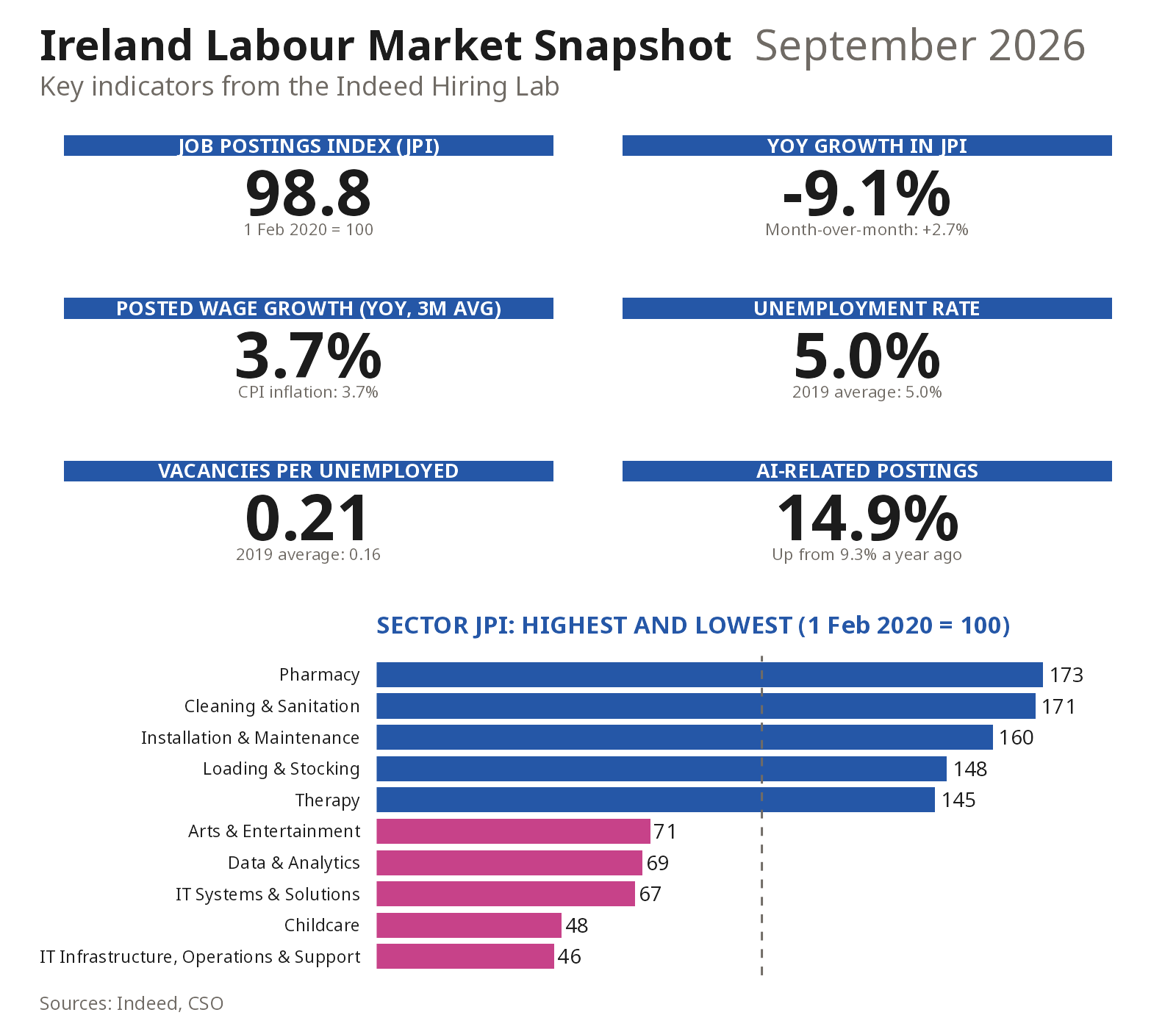
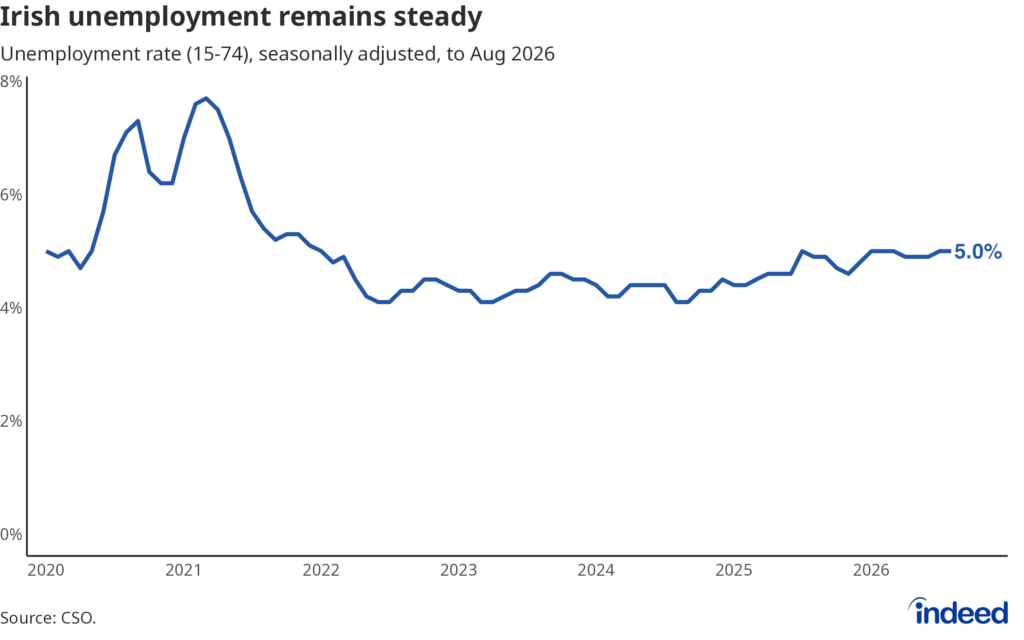
Overall hiring demand in Ireland has steadied in recent months, with job postings sitting broadly at their early-2020 baseline, representing a labour market that has normalised following a period of persistently elevated labour demand post-pandemic. As of 4 September, job postings were 1% below their baseline, having remained in a similar range since around mid-April. Despite this modest softening, Ireland’s labour market remains close to full employment, with the unemployment rate remaining fairly low at 5.0% and the employment rate close to highs.
Job Postings
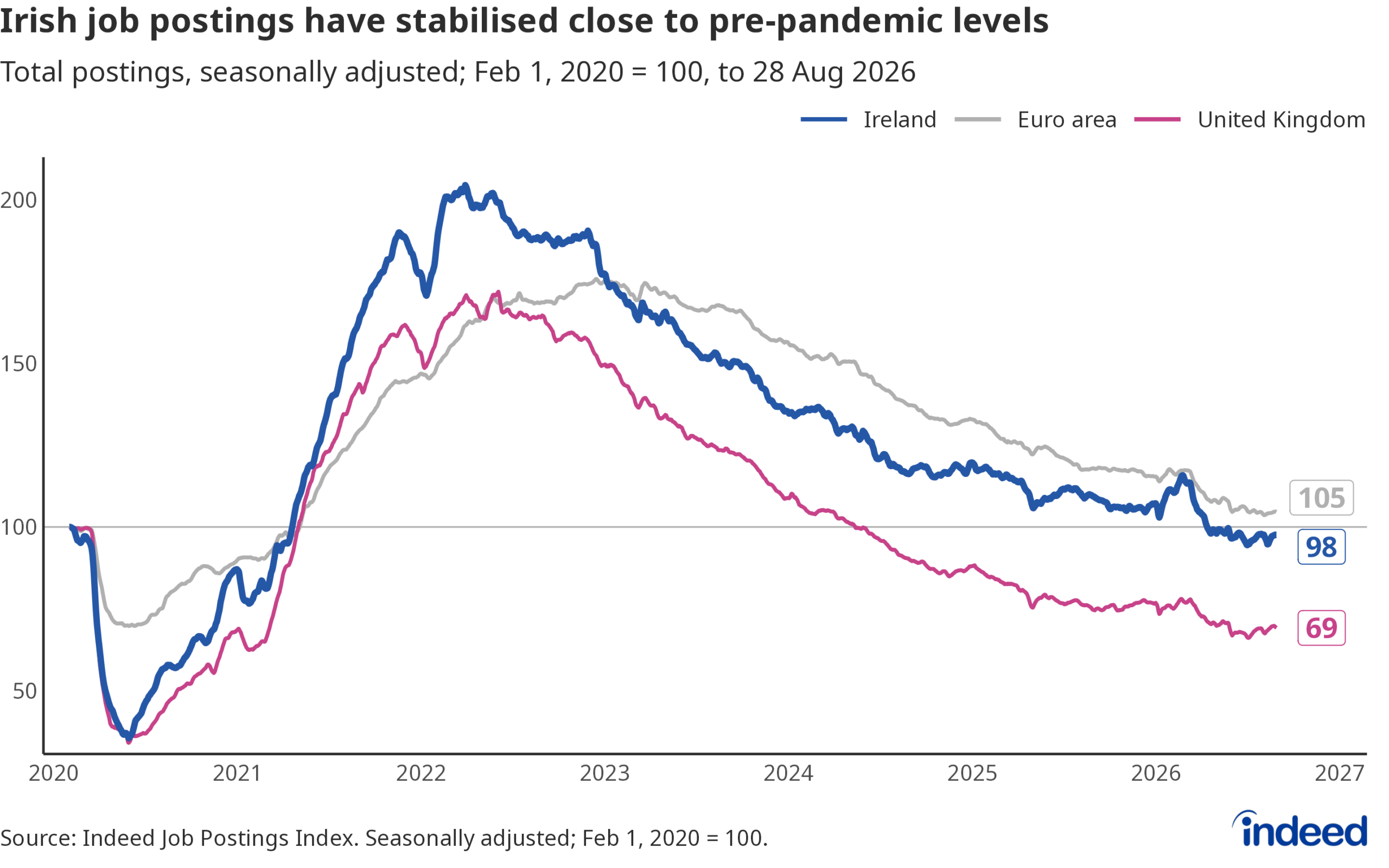
Where we are: The Indeed Job Posting Index (JPI) weakened from February through April, but has stabilised in recent months. Even so, it remains slightly below pre-pandemic levels, standing at 99 (or 1% below the pre-pandemic baseline) as of 4 September. New postings (job postings on Indeed for 7 days or fewer) show a moderately firmer trend, running at a range of around 113 in recent weeks (13% above their pre-pandemic baseline).
Direction of travel: Labour demand has been broadly stable since mid-April, even showing a modest recent improvement. While monthly growth in job postings is positive at 2.7%, the year-over-year change still shows a marked -9.1% fall.
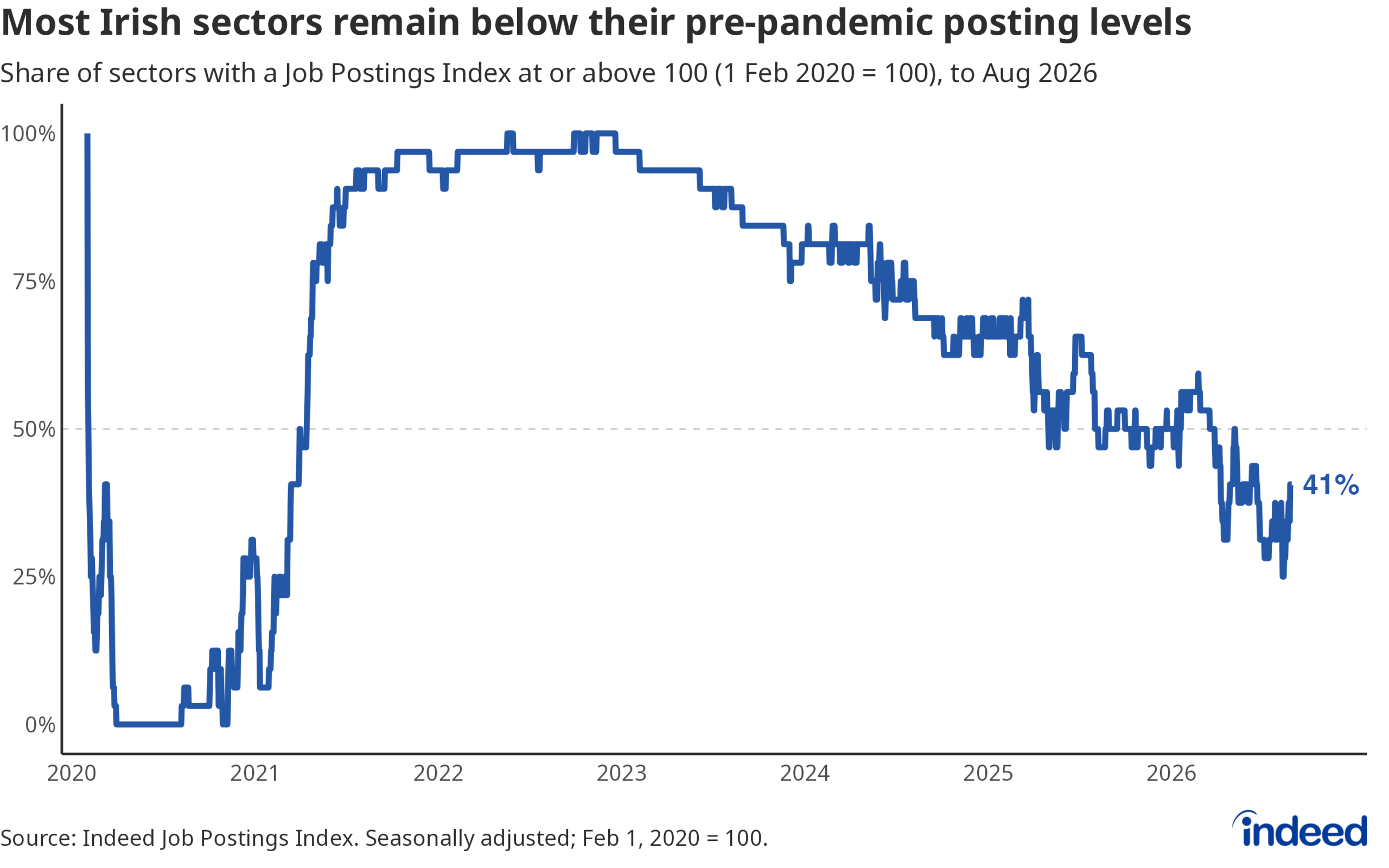
Sector split: The majority of sectors tracked (59%) sit below their pre-pandemic levels in terms of overall postings on Indeed, with the remaining 41% sitting at or above baseline. That share has fallen from 100% back in 2022 after the pandemic reopening. Pharmacy and cleaning & sanitation are furthest above the February 2020 baseline, while IT infrastructure, operation & support and childcare are furthest below pre-pandemic levels.
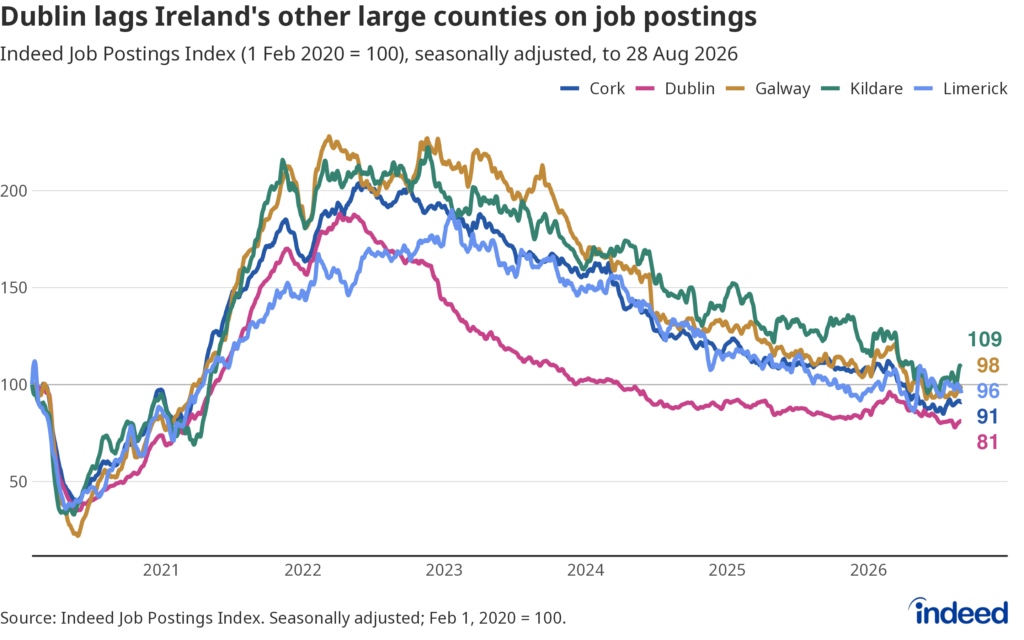
Regional variation: Among the five largest Irish counties, only Kildare has job postings above its pre-pandemic level (+7%). Dublin continues to see the weakest job-posting trend, running 18% below baseline.
Wages
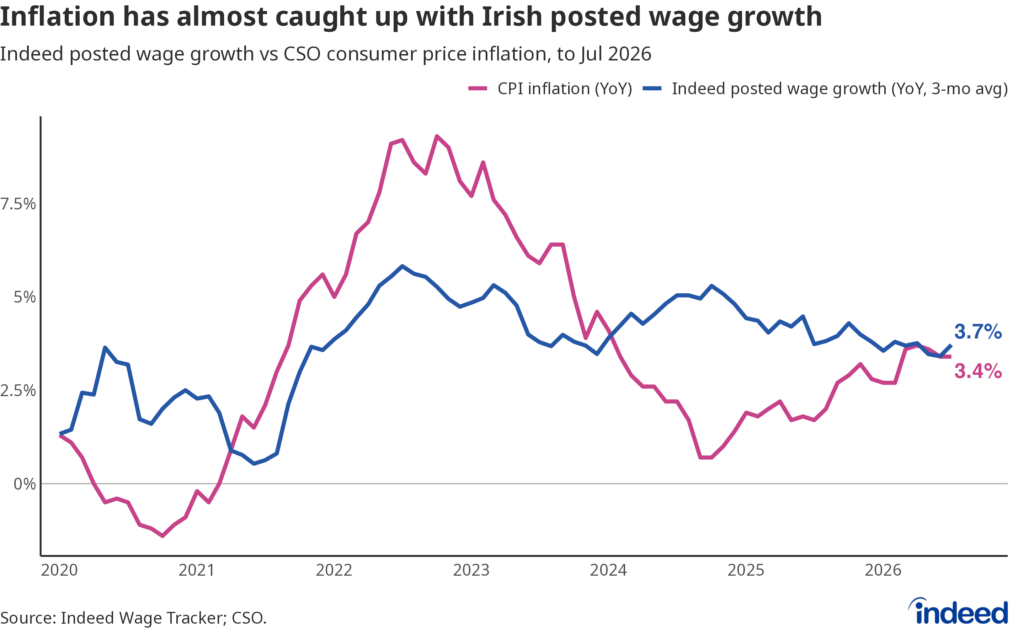
Headline: Posted wages rose 3.7% year-on-year in the three months to July 2026. By comparison, consumer price inflation was running at 3.4% year-on-year in July. The gap between wage and price growth has narrowed in the past couple of years as inflation has picked up while pay gains have gradually cooled.
The Labour Market Balance
Unemployment: The Irish unemployment rate remains relatively low at 5.0%, despite having gradually increased from 4.1% in September 2024. Meanwhile, the vacancy-to-unemployment ratio stands at 0.21, indicating only one available job vacancy for every five unemployed workers.
Job switching and redundancies: The job churn rate fell again in Q2 2026, from 12.0% to 10.7%, and was down from 11% a year ago. Meanwhile, redundancy payment applications remain low.
What We’re Watching
- AI adoption: The pace of AI adoption in Ireland continues to gather momentum. The share of Irish job postings that mention AI in the description continues to rise rapidly, now at 14.9% of all postings – the highest among European countries we track. Ireland also leads Europe in growth of data centre-related job postings.
- Monetary policy: The European Central Bank hiked interest rates by 25 basis points this week, bringing its main policy rate to 2.5%. Uncertainty over the situation in the Middle East clouds the outlook for possible rises in borrowing costs, with policymakers needing to balance inflation risks from higher global energy prices against the risk of overtightening policy and tipping the Eurozone economy into recession.
The European chartbook with additional country coverage, sector and wage detail is available [here].
Methodology
Data on seasonally adjusted Indeed job postings are an index of the number of job postings on a given day, using a seven-day trailing average. February 1, 2020, is our pre-pandemic baseline, so the index is set to 100 on that day.
Data on wage growth are the average year-on-year percentage changes in wages and salaries advertised in job postings on Indeed, controlling for job titles.
Data on AI-related postings are the share of AI (and generative AI) job postings, as a percentage of overall job postings, using a seven-day trailing average. We calculate the aggregate share of job postings in a specific location that included keywords associated specifically with: AI (e.g., “Machine Learning,” “Data Science,” and “Artificial Intelligence”) and Generative AI (e.g., “Generative AI,” “Large Language Models,” and “Chat GPT”).