The Big Picture
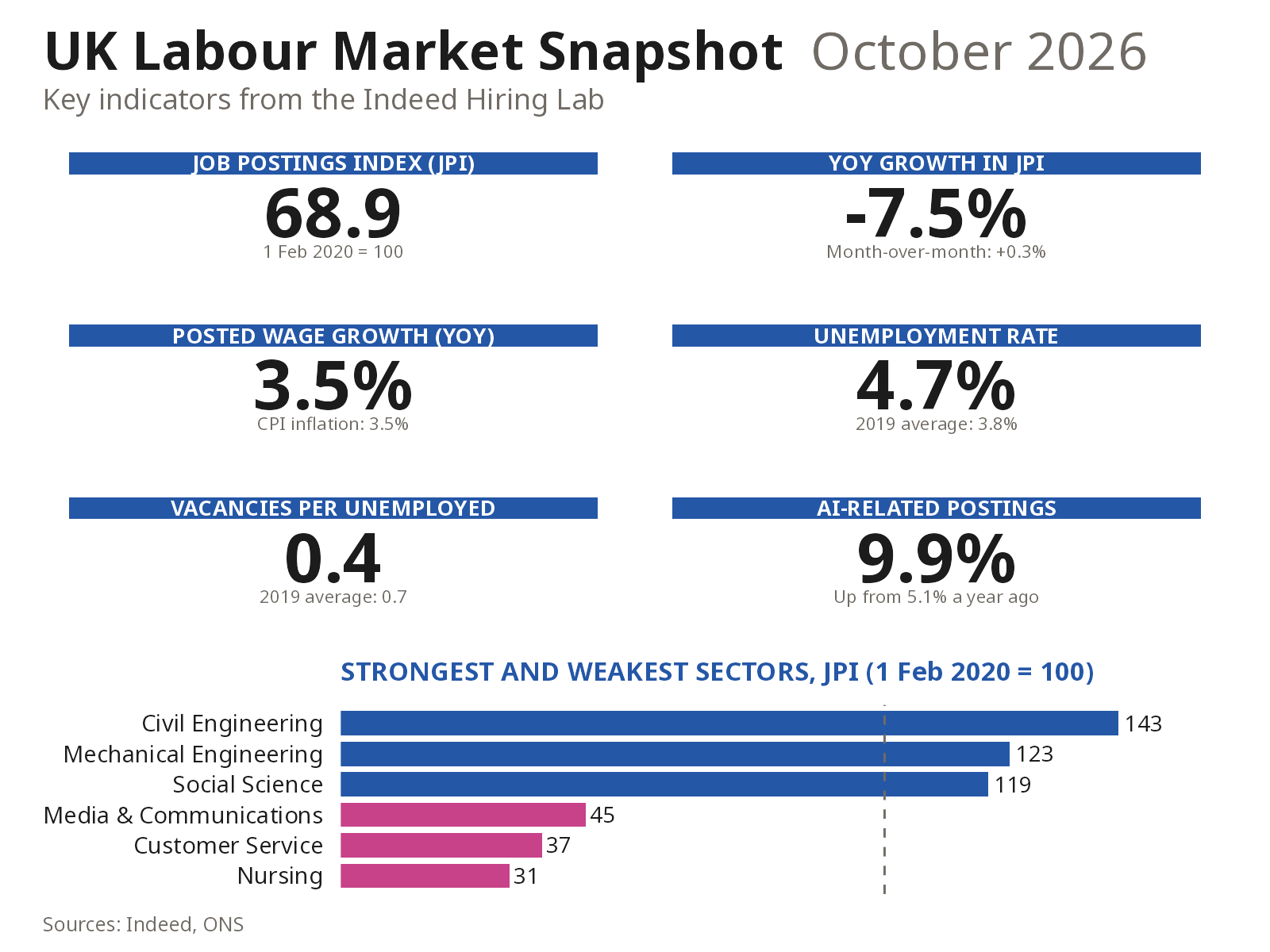
Overall hiring demand remains subdued but stable. UK job postings on Indeed edged up 0.3% in the month to 16 October, but still sit 31% below early 2020 levels. The UK economy has held up better than expected recently, though employers remain cautious on hiring amid ongoing uncertainty and cost pressures.
Job Postings
Where we are: The Indeed Job Postings Index (JPI) weakened between March and June, but has held broadly steady since. Even so, it remains well below pre-pandemic levels, standing at 69 as of 16 October. New postings (job postings on Indeed for 7 days or fewer) show a firmer trend, rising to around 90 in recent weeks (10% below their pre-pandemic baseline) from 84 last month.
Direction of travel: Labour demand has been broadly stable since the start of June. Monthly JPI growth edged up to 0.3% as of 16 October, with the year-over-year decline little changed at -7.5% (from -7.8% in mid-September).
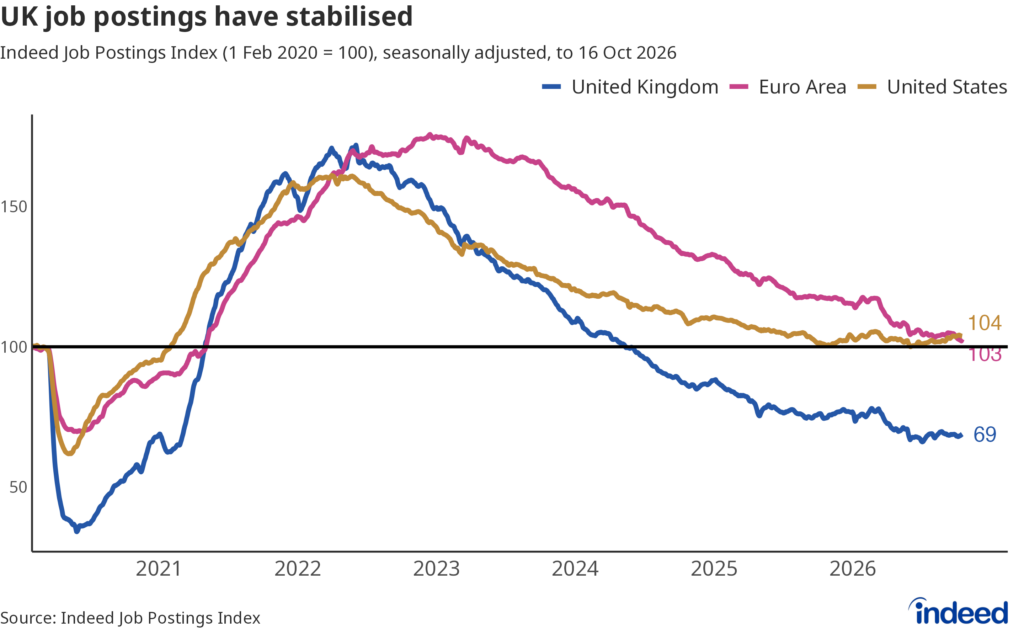
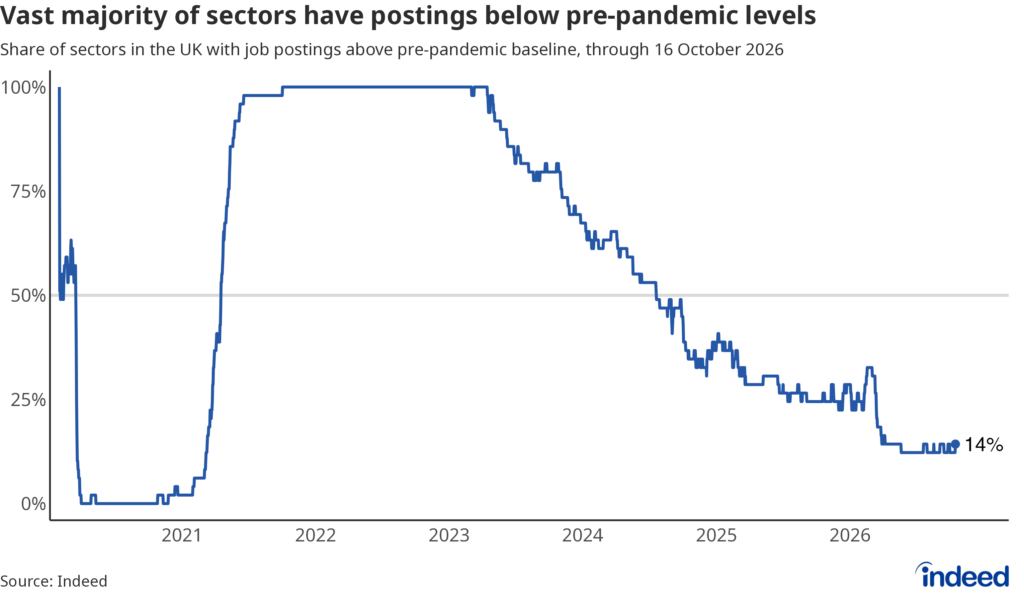
Sector split: The vast majority of sectors tracked sit below their pre-pandemic levels in terms of overall postings on Indeed. Of the 49 categories we tracked, 7 have postings above the baseline. Four of these are engineering disciplines: civil engineering, mechanical engineering, electrical engineering and industrial engineering. Social science, education & instruction and loading & stocking are the others, with loading & stocking only just above its baseline.
Conversely, nursing, customer service, and media & communications roles remain furthest below baseline.
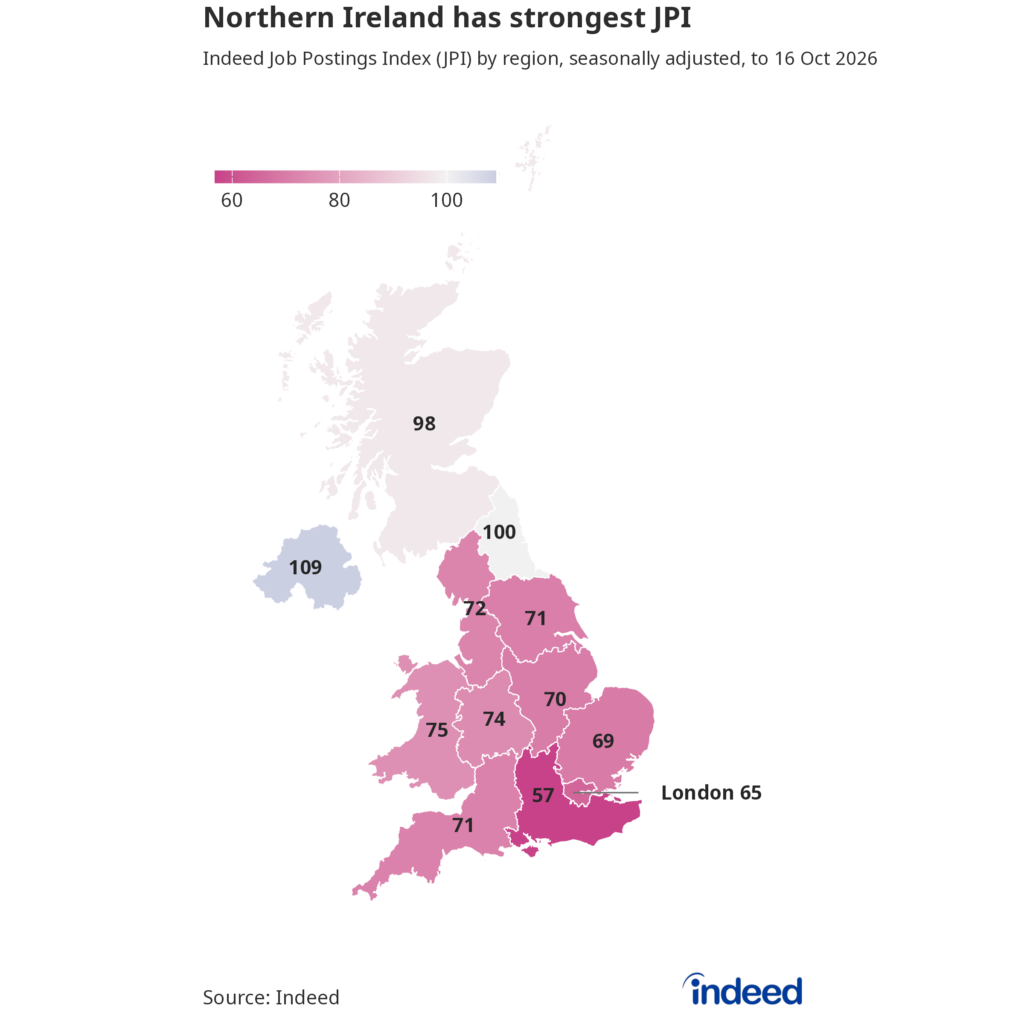
Regional variation: Northern Ireland (109) has the highest JPI of any region analysed, and the North East (100) has edged back up to its pre-pandemic baseline. The South East (57) and London (65) have the lowest JPI levels.
Middlesbrough has the highest JPI (107), followed by Sunderland (105) and Belfast (104). Slough (47), Reading and Brighton (both 51) have the lowest JPI. Only 3 of the 58 cities and large towns tracked have seen their JPI rise over the past year, each by around one point: Coventry (to 63), Glasgow (to 95) and Edinburgh (to 76).
Wages
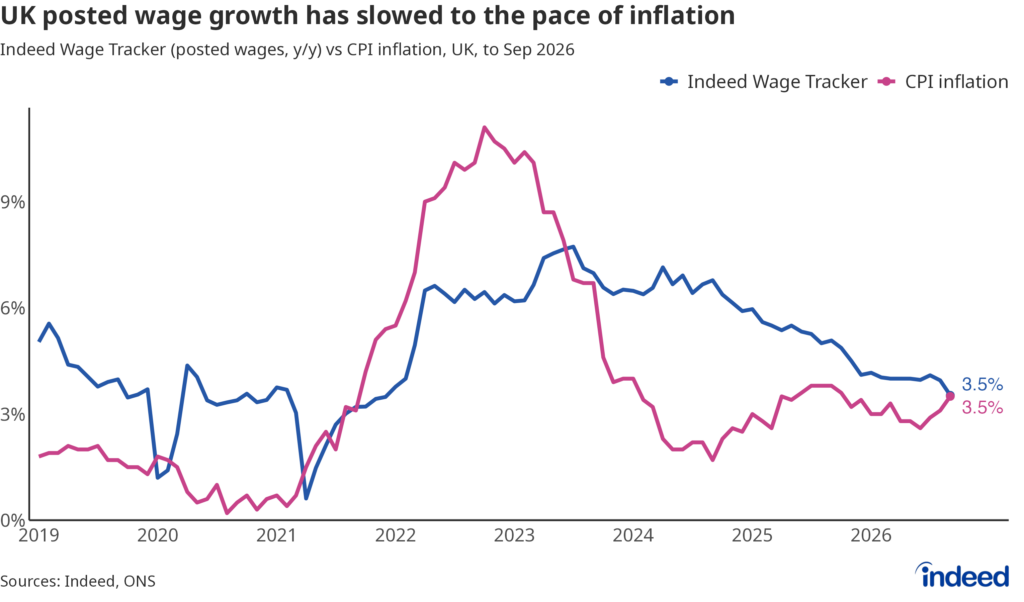
Headline: Posted wage growth has cooled to 3.5% over the year to September 2026, down from around 4% through the spring and summer. Advertised wages have grown faster than prices since mid-2023, but that gap has now closed: with inflation rising to 3.5% in September, posted wage growth is only now matching inflation.
The Labour Market Balance
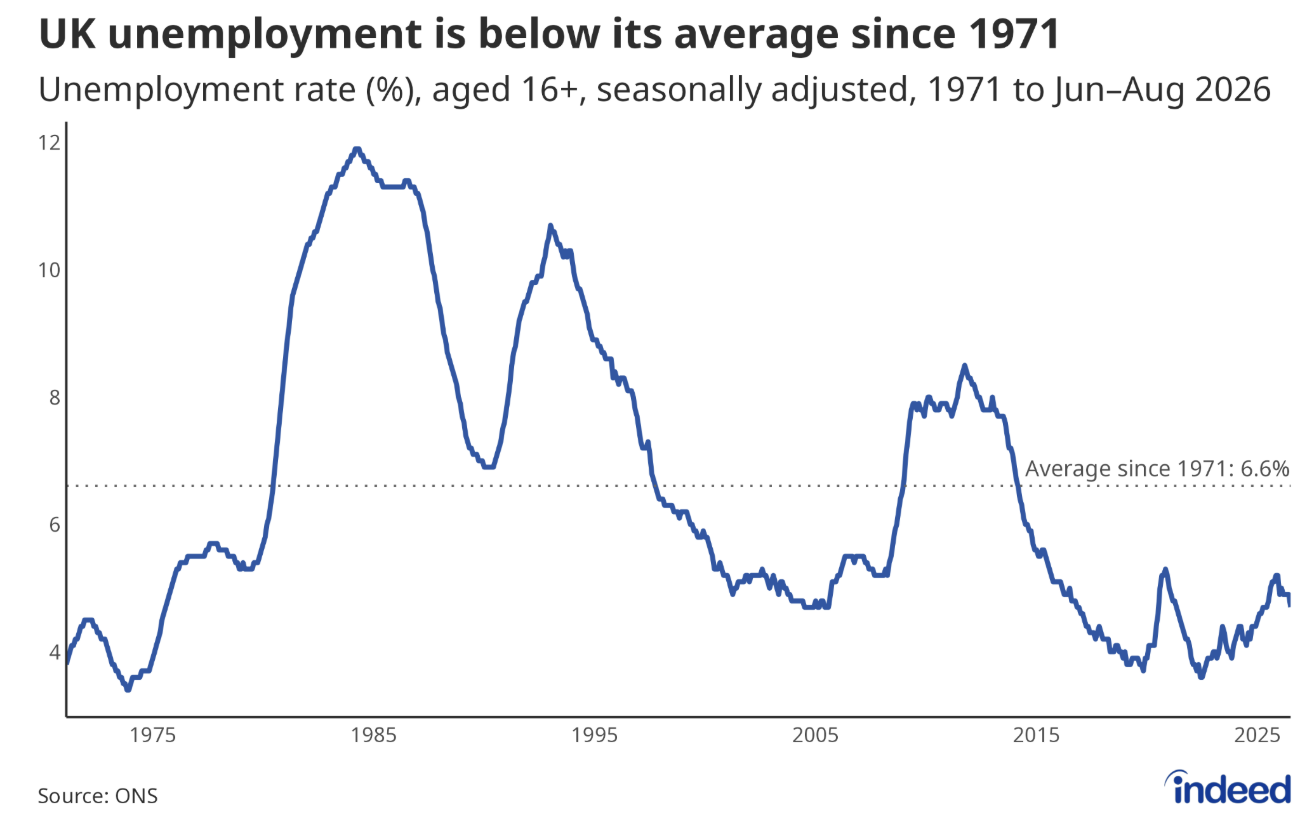
Unemployment: The unemployment rate remains relatively low by historical standards, having fallen to 4.7% in the three months to August. Alongside a drop in vacancies, the vacancy-to-unemployment ratio was stable at 0.4, meaning around one job vacancy for every two and a half unemployed workers.
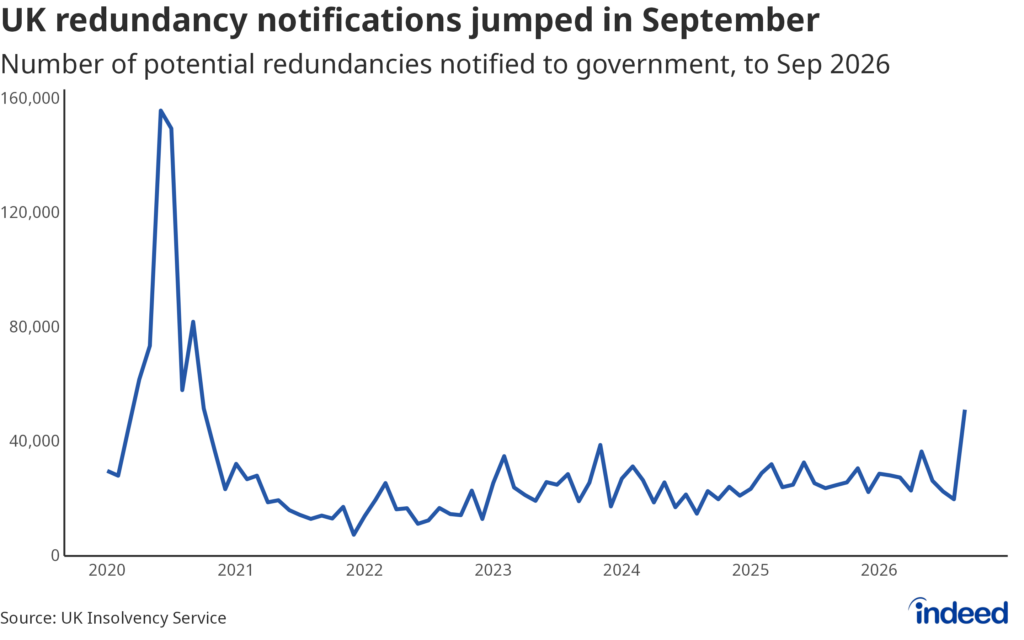
Job switching and redundancies: Rates of job-to-job switching remain close to historic averages, running at 2.3% in the second quarter of 2026. Meanwhile, redundancy notifications rose in September to their highest since late 2020. The rise came from a handful of unusually large notifications rather than more employers filing, so it may prove a blip, though it is worth watching whether it marks the start of a sustained trend.
What We’re Watching
- The Budget: Chancellor Healey will unveil his maiden Budget this week. Areas of focus pertaining to the labour market may include health-related inactivity, youth unemployment and business costs, while next year’s minimum wage will be confirmed.
- Monetary policy: The Bank of England is expected to raise its policy rate from 3.75% to 4% in November to help contain inflation pressures, after growth and inflation data came in higher than expectations. With the labour market having shown signs of finding a floor, rate setters are likely to feel more comfortable hiking rates in the near-term while mitigating downside risks to the economy.
The European chartbook with additional country coverage, sector and wage detail is available here.
Methodology
Data on seasonally adjusted Indeed job postings are an index of the number of job postings on a given day, using a seven-day trailing average. February 1, 2020, is our pre-pandemic baseline, so the index is set to 100 on that day.
Data on wage growth are the average year-on-year percentage changes in wages and salaries advertised in job postings on Indeed, controlling for job titles.
Data on AI-related postings are the share of AI (and generative AI) job postings, as a percentage of overall job postings, using a seven-day trailing average. We calculate the aggregate share of job postings in a specific location that included keywords associated specifically with: AI (e.g., “Machine Learning,” “Data Science,” and “Artificial Intelligence”) and Generative AI (e.g., “Generative AI,” “Large Language Models,” and “Chat GPT”).