
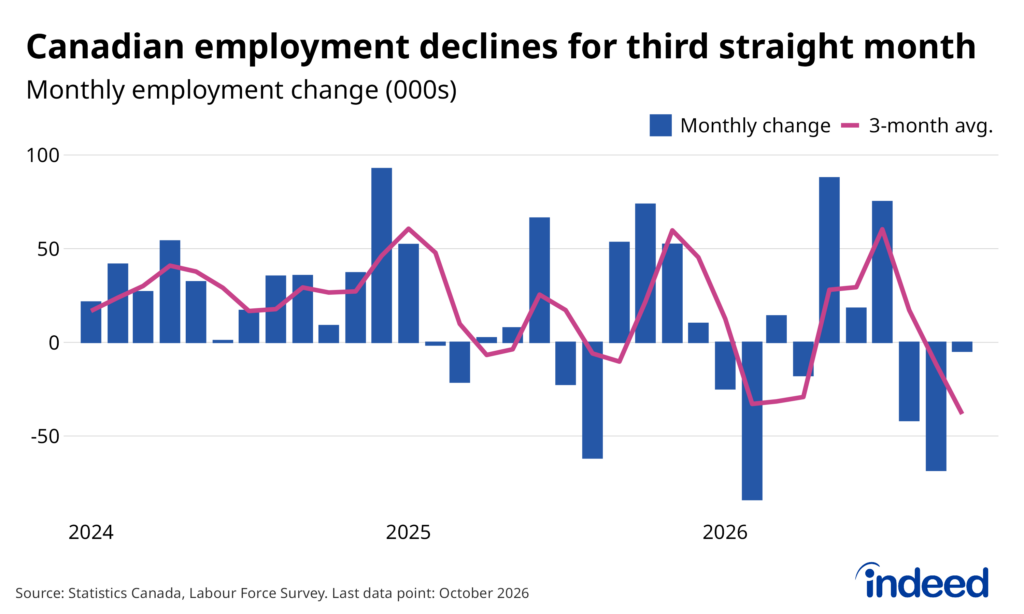
For the third straight month, Canadian employers failed to meet more-optimistic projections for job growth, and instead delivered another month of negative growth in October. While one or even two misses could be chalked up to usual data volatility, three misses in a row point to a sustained shift in momentum.
Canada shed 4,700 jobs in October, below expectations for roughly 15,000 new jobs, and has now lost a net 46,000 jobs so far this year. Compared to last October, employment is essentially flat (+0.1% year-over-year), and the unemployment rate rose to 6.7%, compared to expectations for it to fall to 6.4%.
South of the border, the US jobs report, also released this morning, showed nonfarm payrolls rising more than expected, by 165,000 in October. The contrast with Canada is stark, highlighting how differently the two economies are weathering the current environment.
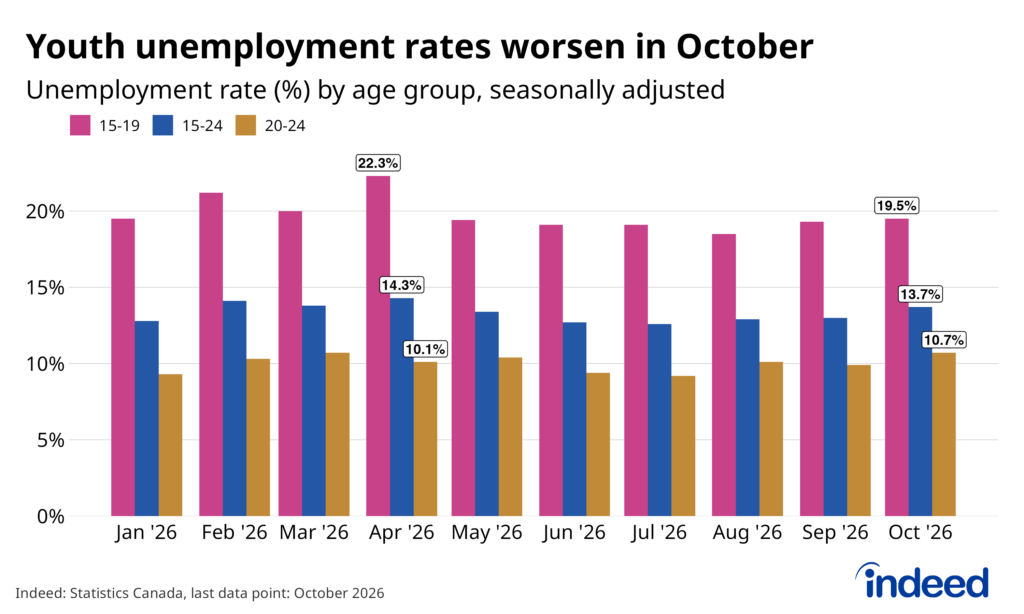
Despite some recent signs of progress, the youth unemployment rate rose by 0.7 percentage points to 13.7% in October 2026, erasing the past 6 months of improvement and putting the jobless rate at its highest since April. Total youth employment is down 2% from a year ago, the only group with objectively fewer jobs than at this time last year. Breaking it down by age shows that close to one-in-five workers aged 15-19 are unemployed. The rate is roughly half that (10.7%) for those aged 20-24, but still concerningly high for a group that includes many recent college graduates and a troublesome sign of an economy struggling to provide workers a foothold in the labor market. And for young workers that once held a job and are now trying to get back in, the picture also remains stark: The job search for roughly 1-in-7 unemployed youth is currently taking six months or longer.
There is reason for optimism in Indeed’s Job Postings Index (JPI), which offers a forward-looking read on hiring. The JPI rose 3.2% at the end of October from a month earlier, to a reading of 104.7 (the number of job postings on Indeed is 4.7% higher than it was prior to the pandemic), a notable jump in employer demand over a single month. Job postings tend to lead hiring, so a pickup like this is often an early sign of potential future job growth. With the US facing a new political landscape, the path for trade policy remains uncertain, but greater clarity in the months ahead could give employers the confidence to increase hiring and open more doors for young jobseekers.
But if this optimism doesn’t translate into tangible growth going forward, the surprising weakness in headline employment will start to look less temporary and more like the beginning of a renewed cooling in the labour market.