Key points:
- Australia’s data centre investment is forecast at around $150 billion through to 2030.
- Around 1% of Australian job postings are related to data centres, around 2.5 times higher than a year ago. Job postings are concentrated on Australia’s east coast, particularly in New South Wales and Victoria.
- Searches for data centre jobs have increased 160% since December last year.
While much of the focus on artificial intelligence (AI) has centred on its potential impact on existing jobs – from task automation to reshaping entire occupations – its greatest near-term impact may instead come from the infrastructure needed to enable AI usage at scale.
Australia is investing heavily in data centre capacity. Data centres are dedicated facilities that store, manage and distribute data and information. They aren’t necessarily new, but the growing use of AI services has greatly increased demand for new and larger data centre capacity.
This investment is already affecting the job market, with data centre job postings surging in Australia over the past year. A strong investment pipeline suggests hiring demand will remain elevated in the years ahead. Recently, these jobs have also started to attract greater attention from jobseekers.
Australia’s data centre investment boom
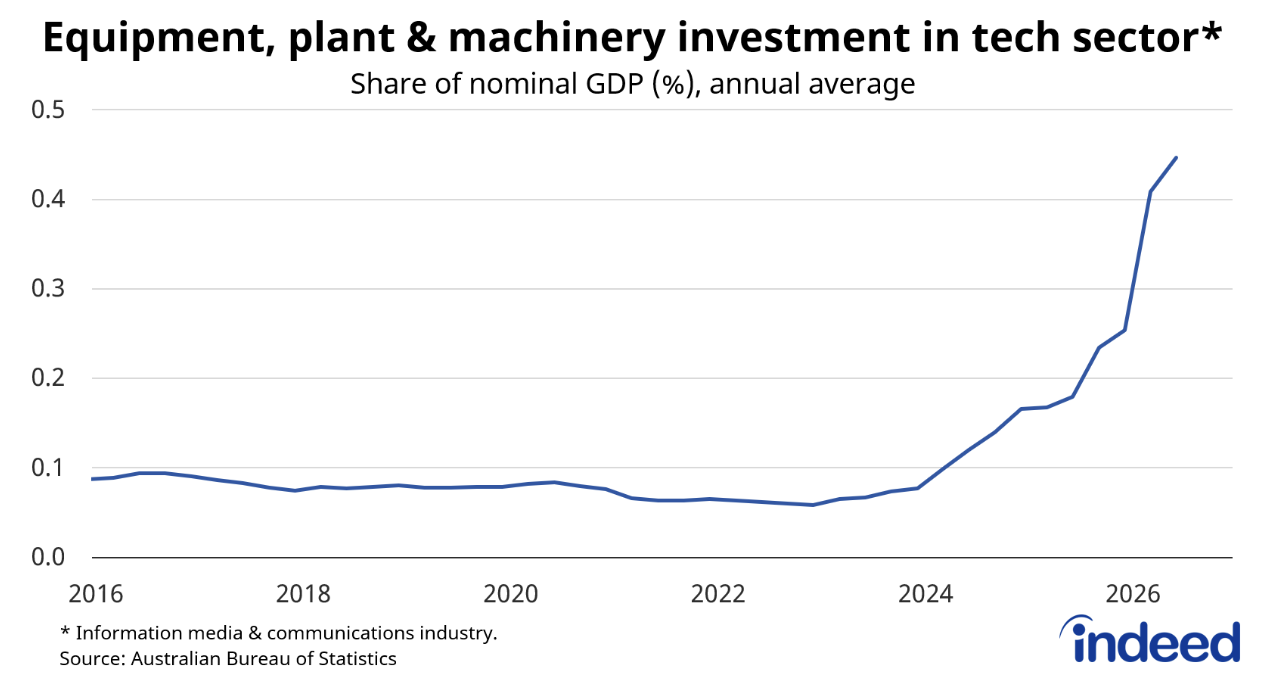
Australia is forecast to invest around $150 billion in new data centre capacity by 2030, according to the Commonwealth Bank. Investment in equipment, plant & machinery across the information media & communications industry – a rough proxy for the tech sector – has increased to 0.4% of annual nominal GDP, around 2.5 times higher than a year ago.
Despite the scale of this investment, its net contribution to the Australian economy may be smaller because an estimated two-thirds of the investment reflects imports – meaning that this money flows outside Australia. The Commonwealth Bank estimates that data centre investment will add 0.2 percentage points to real GDP growth in both 2026 and 2027.
This investment boom also isn’t without its drawbacks. It may put pressure on resources, leading to higher prices for labour, building materials and electrical equipment. It’s a story that will be eerily familiar to those who remember the mining investment boom of the 2000s, albeit that investment boom was much larger – at around $400 billion – and in a smaller domestic economy.
Energy consumption is also a concern. Data centres already consume around 3% of the electricity supplied to the grid. The Australian Energy Market Operator expects that share to reach 13% in a decade – almost matching the energy currently used by all homes in New South Wales and Victoria. Globally, the high energy and water demands of data centres have prompted protests. However, in Australia, the reaction has been more muted.
Data centre projects are concentrated in New South Wales and Victoria
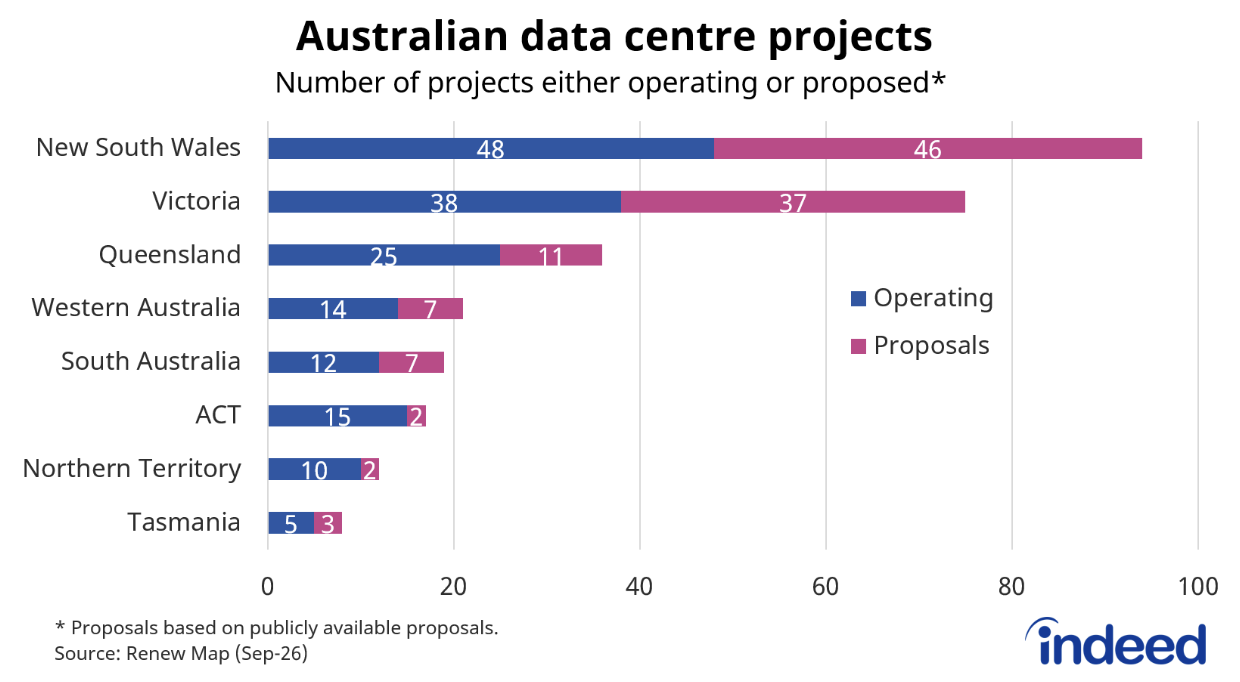
Currently, there are 167 data centre projects already operating in Australia, with another 225 projects in the pipeline (although information is publicly available for around only half of those projects). New South Wales currently has 48 data centres operating, compared with 38 in Victoria, 25 in Queensland and 15 in the ACT. The investment pipeline, however, skews more towards New South Wales and Victoria.
These data will change as more information becomes publicly available, new projects get announced and other projects are cancelled or delayed. However, based on current proposals, data centre capacity will become increasingly concentrated in these two states over the next five years.
Investment is already flowing into the job market, with job postings for data centres surging over the past year. Given the strong pipeline of planned investment, demand for workers will likely remain elevated over the coming years.
Data centre jobs are booming
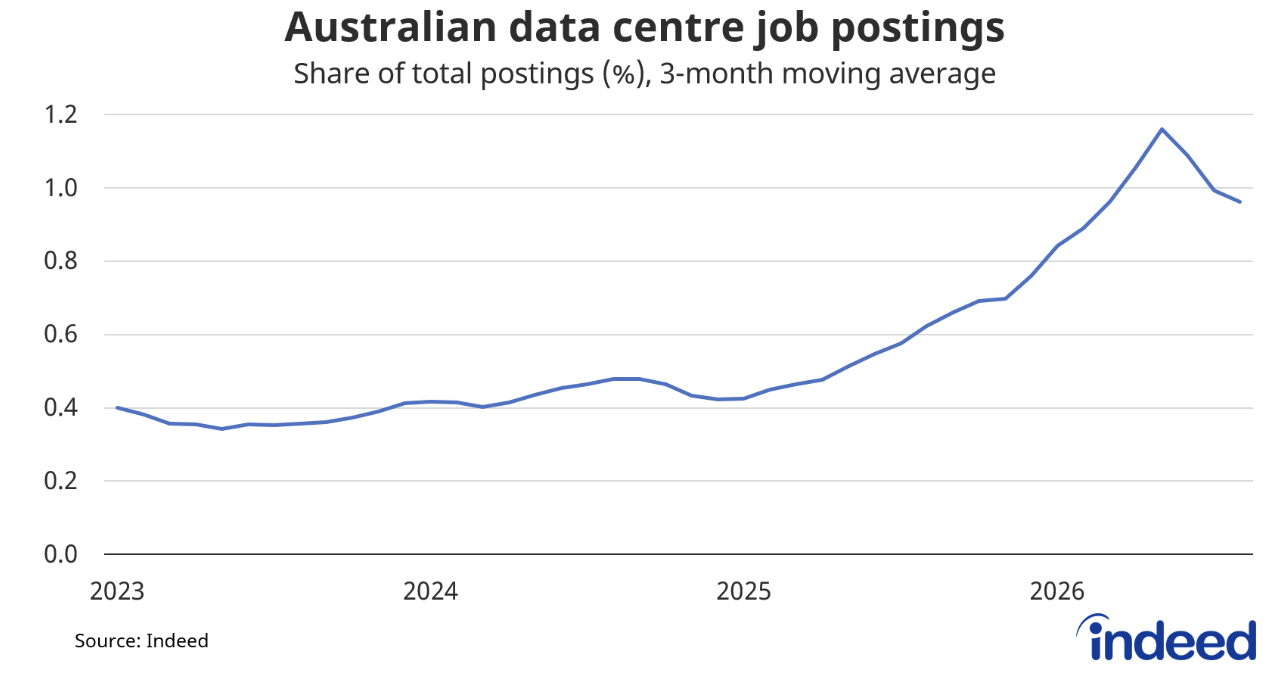
In August, around 1% of Australian job postings mentioned data centres – after peaking at 1.2% a few months ago – around twice as high as two years ago. Growth has significantly outpaced both the broader job market and the tech sector, with postings in each segment little changed over the past couple of years.
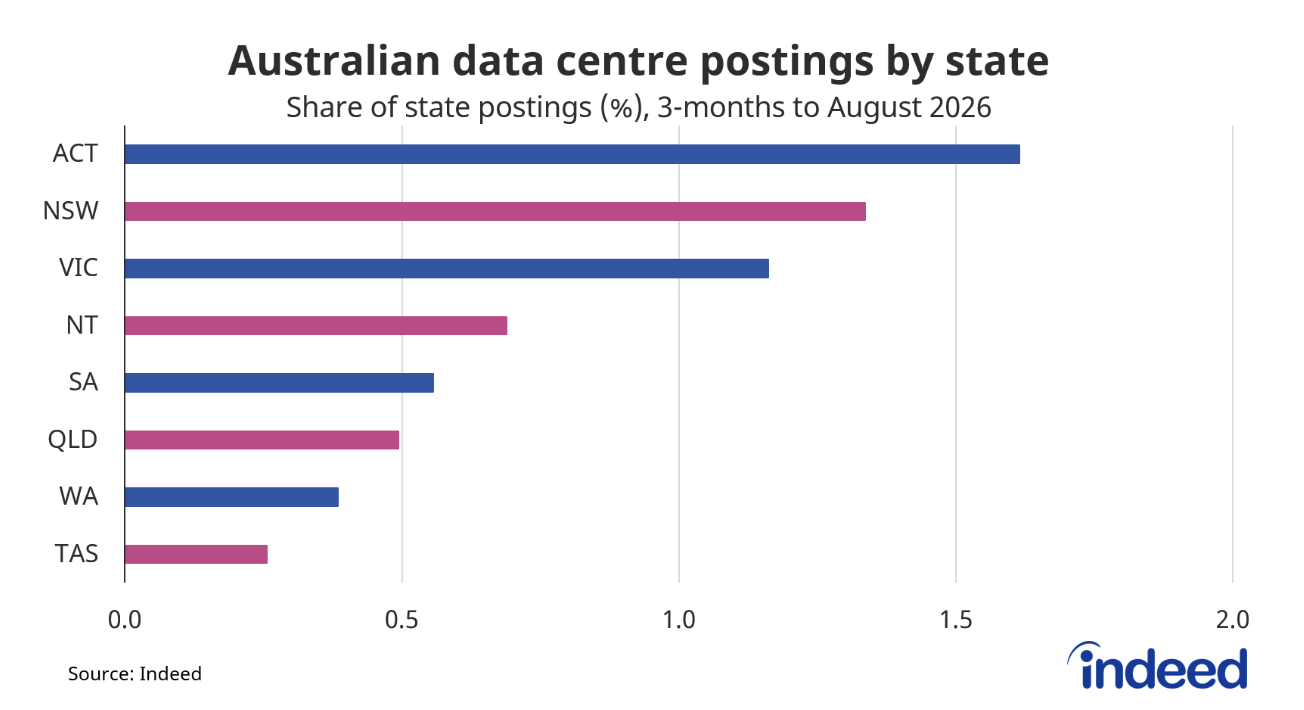
Job creation thus far has been concentrated heavily on Australia’s east coast. Canberra punches above its weight with data centres mentioned in 1.6% of job postings in the three months to August.
New South Wales and Victoria also stand out. Around 1.3% of New South Wales job postings and 1.2% of Victorian job postings mention data centres, easily exceeding the other major states. Overall, 48% of data centre posting volume comes from New South Wales, 28% from Victoria and 11% from Queensland.
With most major data centre projects located in New South Wales and Victoria, these trends will likely continue.
Job creation isn’t simply a tech story
While data centre investment is creating considerable demand for tech workers, job creation is much broader than you might expect.
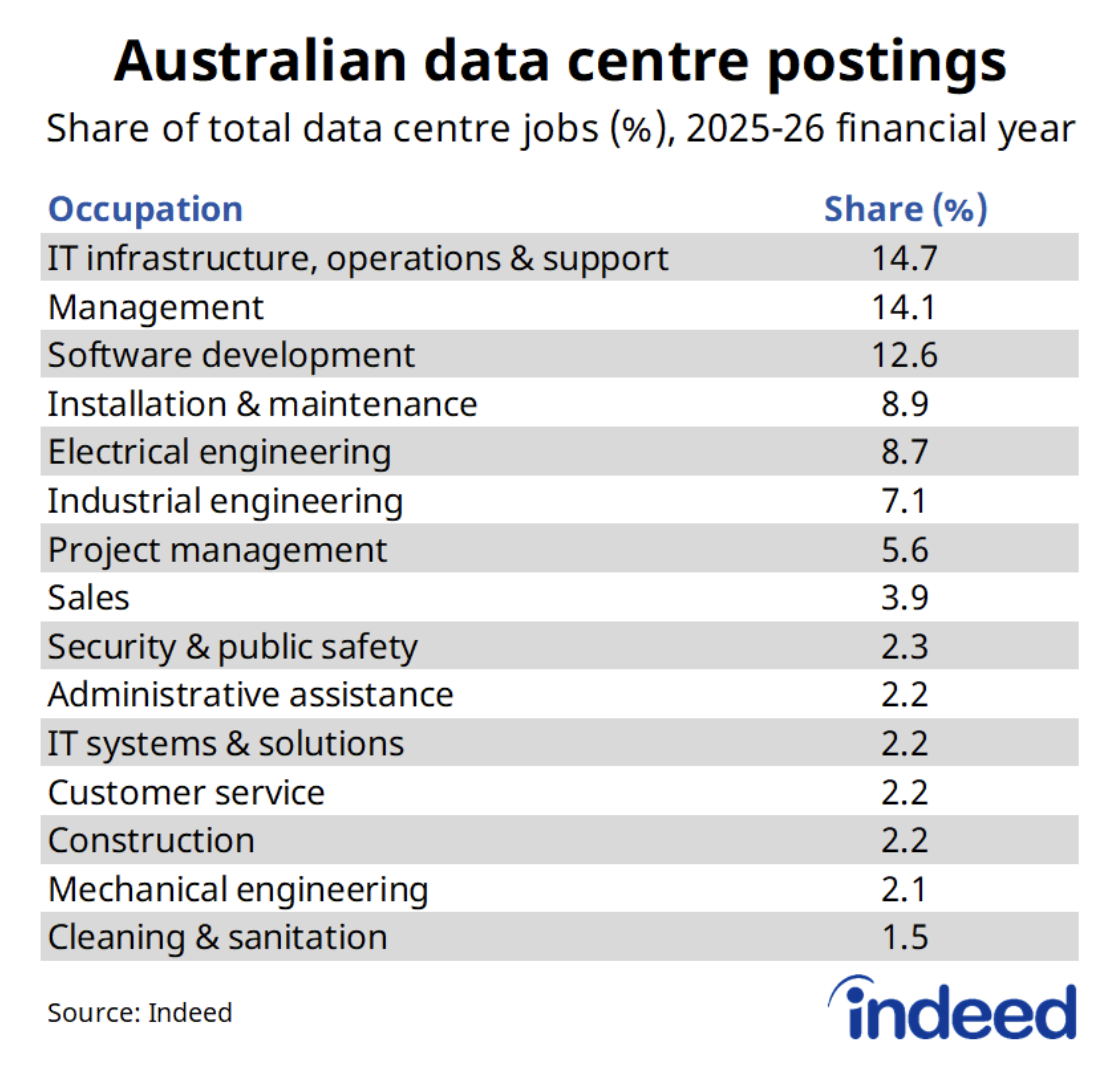
In the 2025-26 financial year, 14.7% of data centre job postings were in IT infrastructure, operations & support, with a further 12.6% in software development. But a vast majority of data centre job postings were for non-tech occupations.
Around 14% of data centre job postings were for management, ahead of 8.9% in installation & maintenance, 8.7% in electrical engineering and 7.1% in industrial engineering. This mix reflects the broad range of workers needed to build, operate and maintain large-scale data centre facilities.
Strong demand for workers across these occupations could put upward pressure on wages, particularly where labour supply is limited. Skill shortages are still quite common across Australia. This could also spill over to other parts of the economy, creating broader wage and price pressures, similar to what happened during Australia’s mining investment boom in the 2000s.
Jobseeker interest in data centre jobs has recently surged
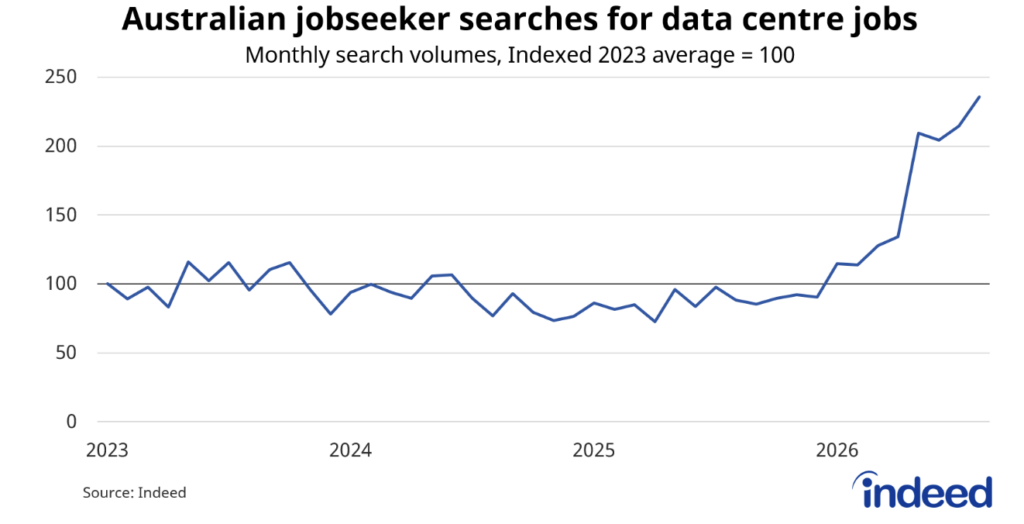
While data centre job postings began to rise in 2025, it took until this year for jobseekers to notice. From 2023 to 2025, jobseeker searches for ‘data centre’ and similar phrases didn’t grow, with search activity actually lower last year than in 2023.
But that changed this year. In August, search activity was around 160% higher than in December last year and 136% above the 2023 average.
The sharp increase speaks to the growing awareness of data centres and recognition of the opportunities created by this investment boom. As investment gathers pace and new projects attract greater attention, we expect jobseeker interest to push even higher.
Conclusion
Australia is at the beginning of its largest investment boom since the 2000s. Data centre investment is forecast at around $150 billion over the remainder of the decade, contributing noticeably to real GDP growth, although the net economic impact is muted somewhat by the need to import equipment and materials.
Nevertheless, the labour market impact is already emerging. Data centre job postings have increased sharply, with demand extending well beyond traditional tech occupations. Jobseekers are also starting to take notice.
Strong competition for workers with in-demand skills could put upward pressure on wages and resource costs more broadly, particularly in Australia’s eastern states where most of the investment is concentrated.
Methodology
We track data centre postings by identifying job postings on Indeed in Australia that include the terms “data centre,” “datacentre,” or “data-centre” anywhere in the job title or job description.
We use a similar methodology to identify data center searches by isolating searches on Indeed in Australia that include terms such as “data centre,” “datacentre” or “data-centre”.