
Key Points:
- The labor market held steady in 2026, but cracks are forming. Unemployment and layoffs remained low all year. But long-term unemployment hit its highest share outside a recession since 1950, and wage growth slowed.
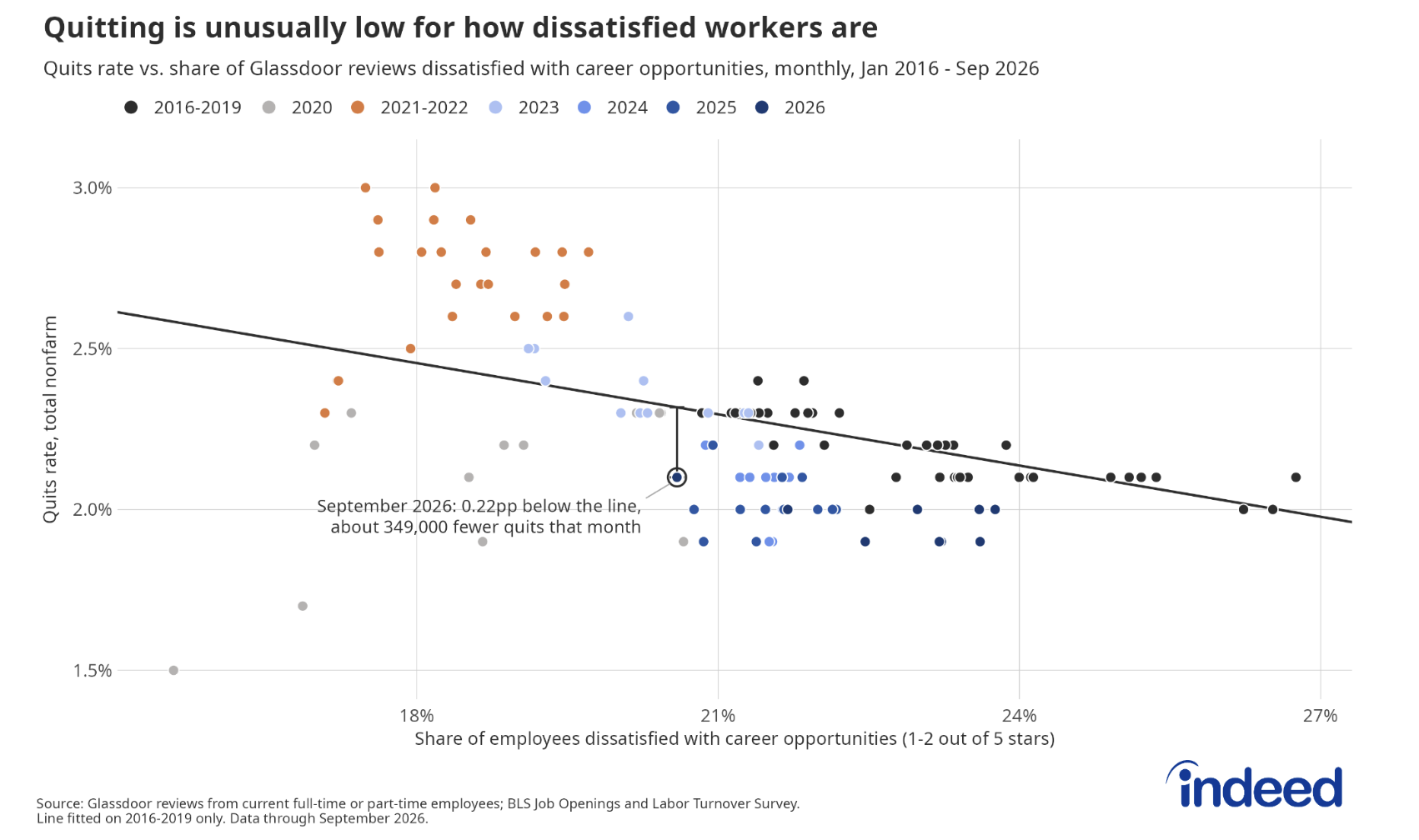
- Workers are stuck and unhappy. The share of Glassdoor reviewers dissatisfied with their career opportunities rose to 21%, up from 17% in 2022. Yet quits are running about 349,000 a month below what that discontent would predict. If market conditions improve, these dissatisfied workers could be the first to leave.
- 2027 is likely to break the stalemate, one way or another. Rising job postings and hiring manager sentiment point to a rebound that could unleash pent-up turnover. Meanwhile, high energy prices, expected rate hikes and a costly AI buildout could push the economy toward layoffs.
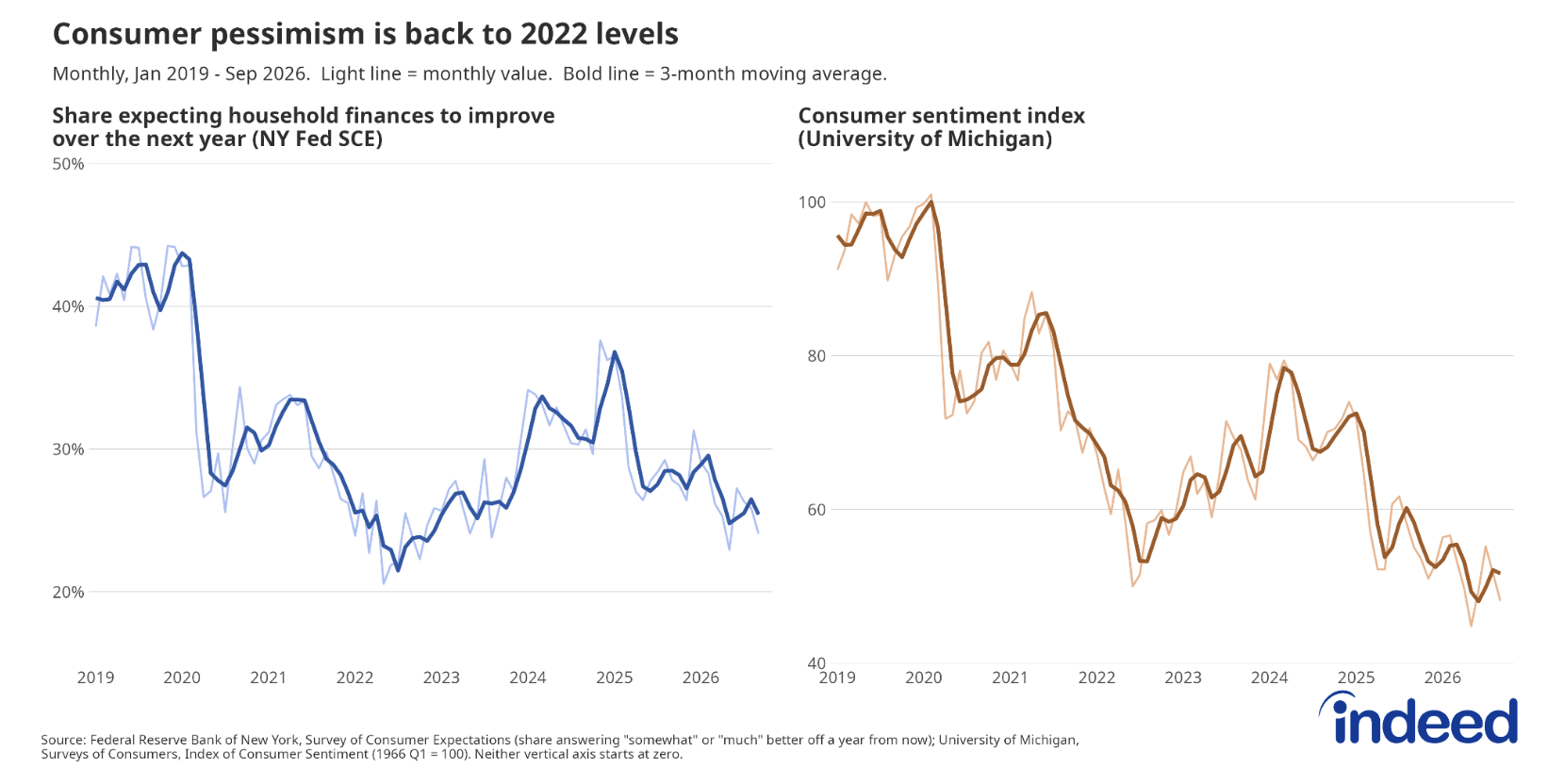
Heading into 2027, US workers and consumers appear anxious. From rapid technological advancement to a sharp decline in immigration, energy price shocks and rising interest rates, the US economy withstood a barrage of disruptions over the past year. Various measures of economic sentiment show a consistent pattern – people don’t feel great, or even good, about current conditions.
Yet, if you were to only look at data from the labor market, you might have no idea.
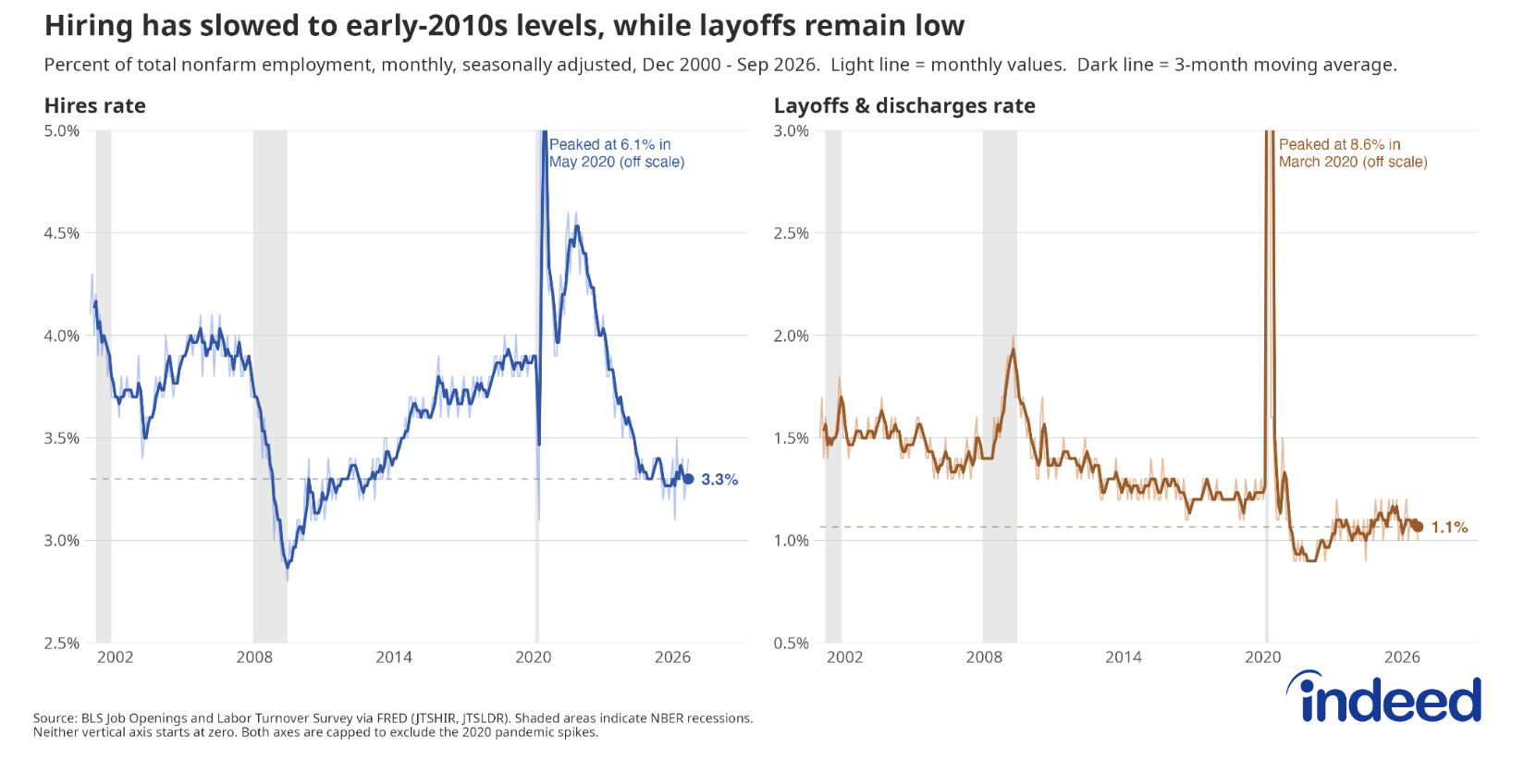
The US labor market remained remarkably steady in 2026, proving more durable than policymakers feared coming into the year, offering stability to those already employed but also providing little relief to struggling job seekers. Employers added just 696,000 jobs through the first three quarters of 2026, only a slight improvement from 2025 and near the fifth-lowest rate recorded during an economic expansion. Still, much of that slowdown has been absorbed by retirements, changing demographics, and subsequent declines in the size of the labor force, thus far preventing the materialization of mass layoffs. The layoff and discharge rate has ranged between 1% and 1.2% this year, a notch below its pre-pandemic level, and, if anything, it appears to be set for further long-term declines. Several other of the labor market’s most-watched indicators have also barely budged. The overall unemployment rate has hovered between 4.1% and 4.4% thus far this year, with similarly small deviations for quits and wage growth.
But cracks have begun to form. More than a quarter (27.6%) of unemployed workers have been out of work for 27 weeks or more, the highest level since 1950 (outside of periods immediately following a recession). And even for workers with a job, weaker hiring has eroded bargaining power, in turn slowing wage growth. According to analysis by the Federal Reserve Bank of Atlanta, median wage growth has fallen to its lowest level since 2021, and the Indeed wage tracker shows a similar trend for advertised wages.
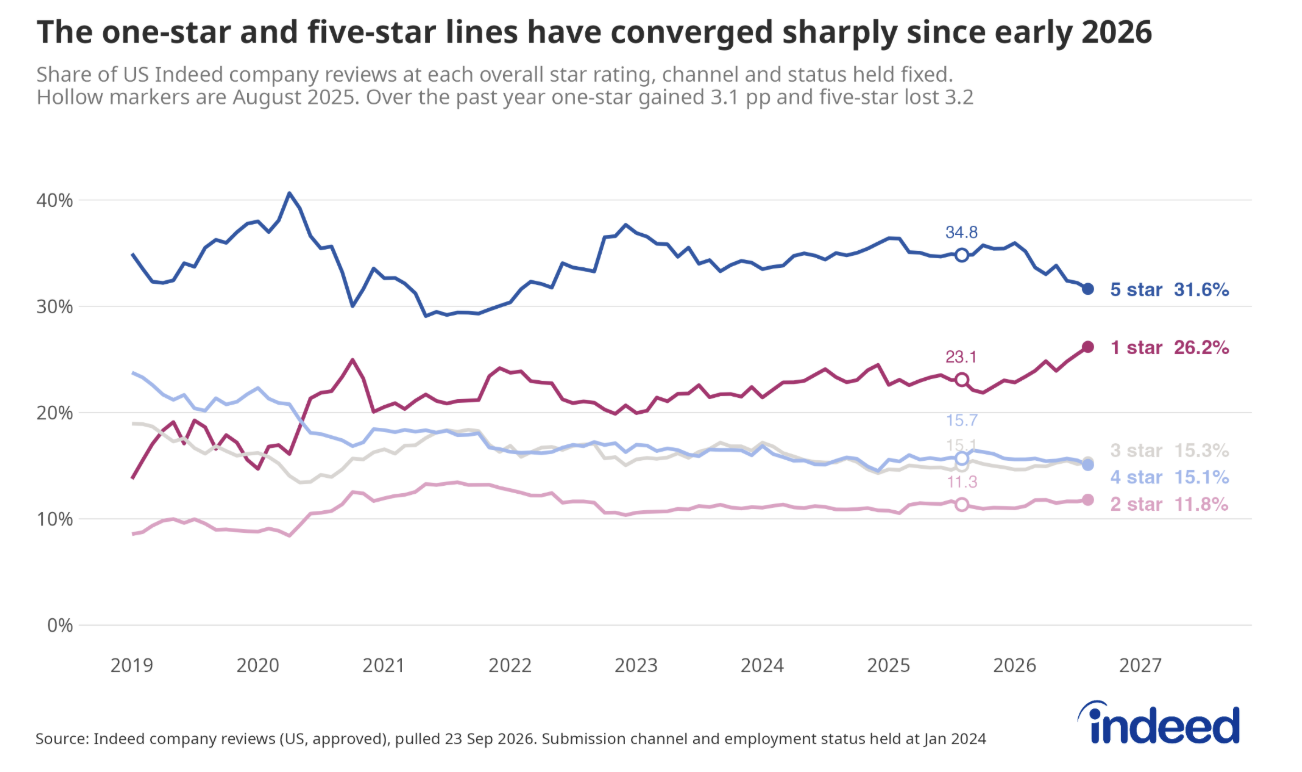
Meanwhile, employer reviews left by workers on Indeed and Glassdoor reveal growing discontent. The share of workers giving their employer a one-star rating (out of five) on Indeed, for example, has risen by about 3 percentage points over the past year – largely at the expense of 5-star ratings.
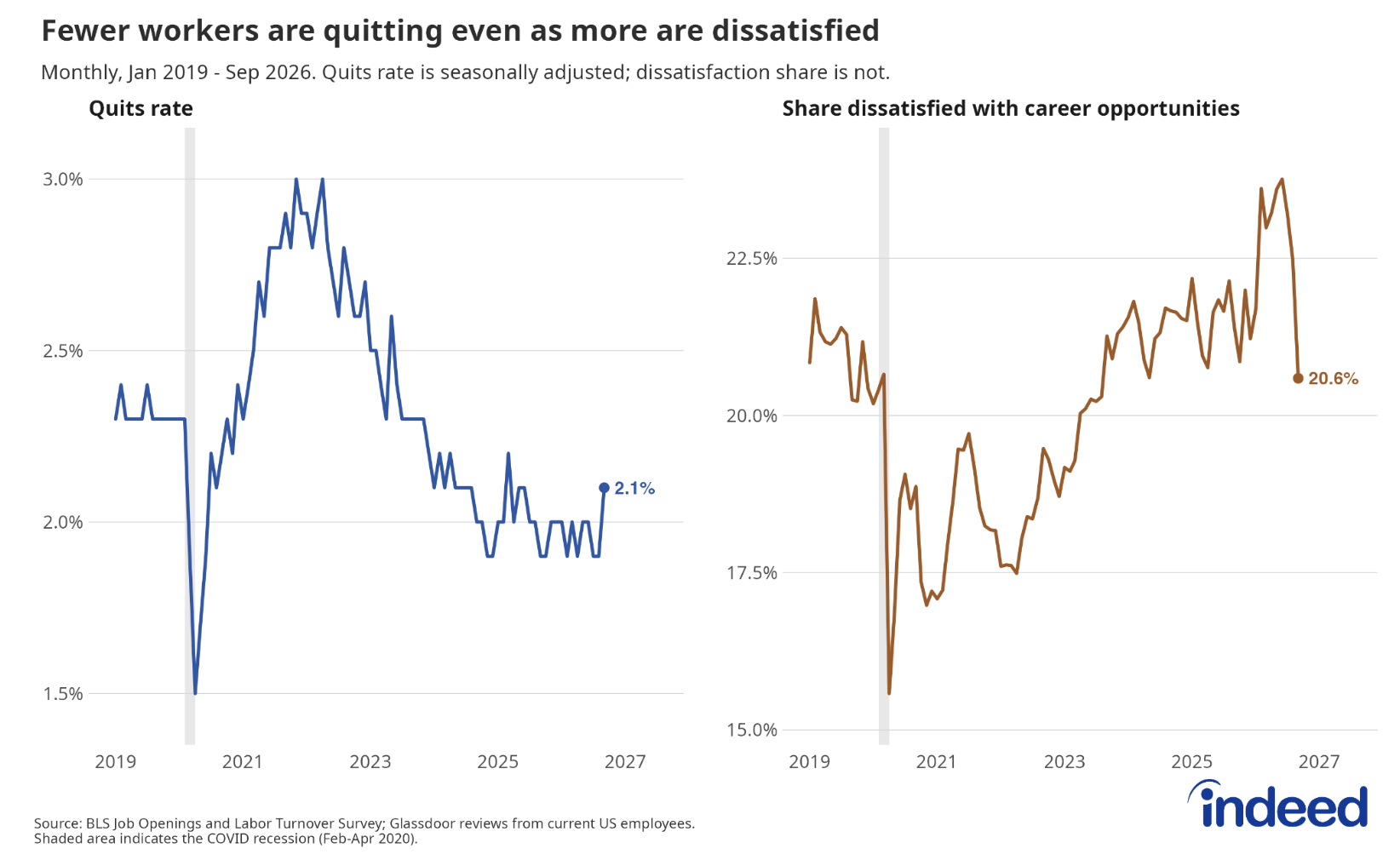
On Glassdoor, the share of employees dissatisfied with their existing career opportunities (rating them 1 or 2 stars out of 5) stood at 21% in September 2026, up from 17% in April 2022. Coincidentally, the quits rate peaked at 3.3% in April 2022, according to the Bureau of Labor Statistics, but has since declined sharply to 2.1%. Hiring slowed and quits fell at the same time as worker dissatisfaction grew, a likely signal of workers feeling increasingly trapped without the ability to quit and find a better job on the open market.
On a worker level, employee dissatisfaction predicts higher likelihood of turnover, with a 1-star decline in career opportunities ratings associated with a 28% increase in turnover intent (measured by job applications started on Glassdoor).
But what makes the current job market unusual is that quits are even lower than what worker dissatisfaction would predict. Given the current level of worker satisfaction and assuming a consistent historical relationship between the two, the quits rate should be 0.22 percentage points higher than it is, which corresponds to 349,000 more quits on a monthly basis. The soft hiring environment may be locking those unhappy workers into their jobs, and their engagement and productivity are likely suffering in the short-term. Over the longer-term, they are likely to be the first to exit if and when the job market heats up again.
An inflection year
But thus far, the bottom hasn’t fallen out. Signs are mounting that that is likely to change in 2027, one way or another.
As geopolitical tensions continue to drive up energy prices with no clear end in sight, markets increasingly expect the Federal Reserve to step in and continue to raise interest rates to rein in price growth. In turn, that would only make an already outrageously costly, debt-fueled AI infrastructure and data center buildout even more expensive. Recent analyses suggest that the AI industry will need to generate staggering revenues by 2030, equivalent to nearly 10% of current GDP, in order to meet its debt obligations. Failure to do so could drag down the value of AI loans and batter tech stocks, and in a worst-case scenario could cause bank runs or crises of confidence at overexposed lenders (as we saw with Silicon Valley Bank in 2022).
It wouldn’t require a full-blown financial crisis to produce significant economic drag. With wage growth largely stalled, wealth created by rapid stock market growth has supported consumer spending for large swaths of the economy. A significant decline in asset prices risks shutting down that valve and removing what has been one of the economy’s most reliable sources of growth for the past five years. Absent this spending to prop up growth, we would expect to see layoffs start rising.
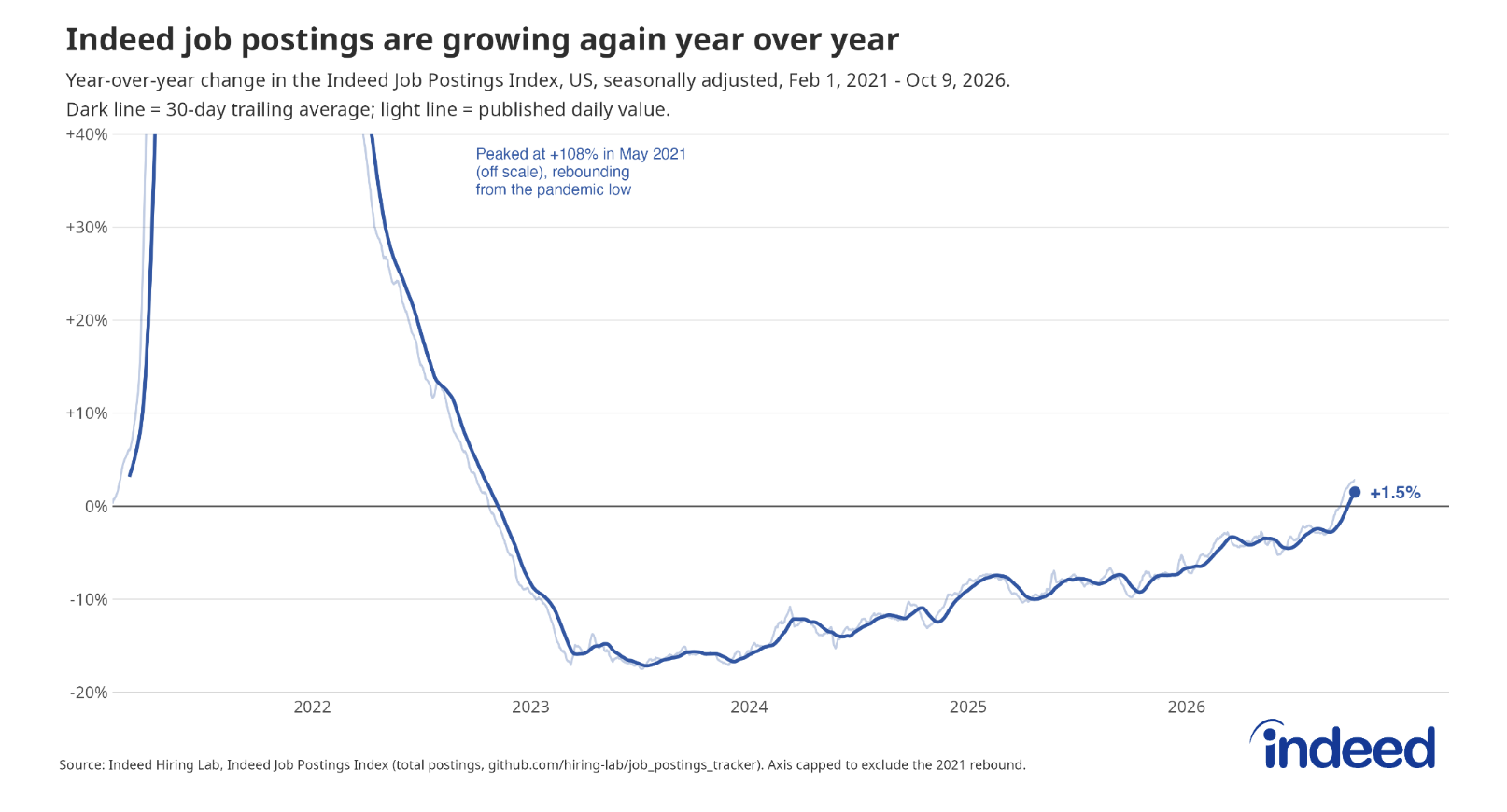
On the other hand, reports of the labor market’s impending death have been greatly exaggerated over the past few years. If anything, current trends point to expansion. The Indeed Job Posting Index (JPI), for example, grew on an annual basis this September for the first time since 2022. JPI rises when more jobs are posted and can also increase if and when existing job postings stay active for a longer time, which is also likely happening in the current environment. Anecdotal evidence does suggest that employers are gearing up to hire more in the coming months.
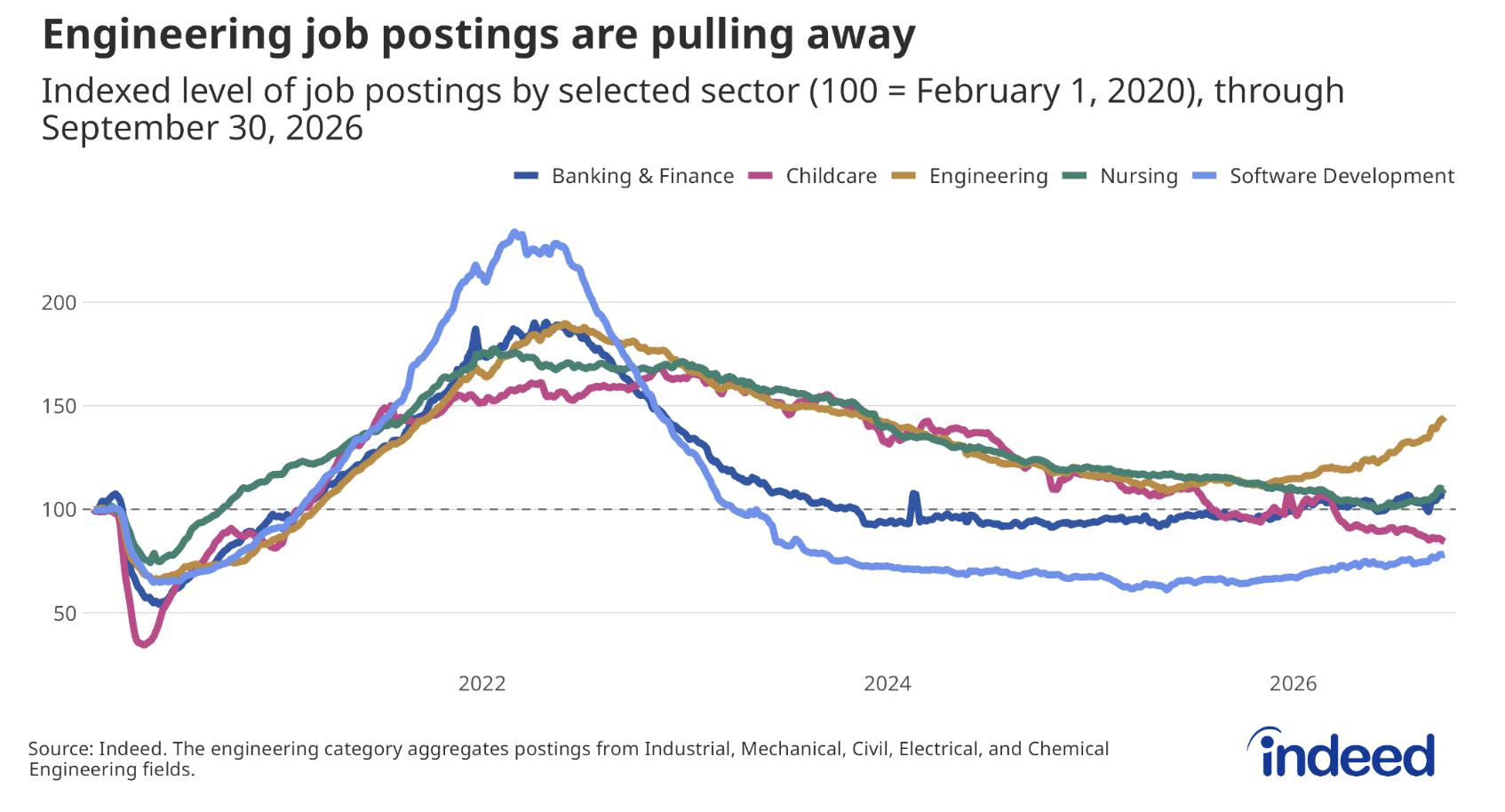
Not only have job postings on Indeed been growing, but they’re growing in the same segments that were previously pulling JPI down – mainly those highly exposed to AI. Postings for software development, banking and finance, and engineering have seen recent growth, while less-AI-exposed sectors including childcare and nursing have softened. If this trend continues, and hires increase in some of these previously-soft white collar sectors, pent up quits could result in a relatively quick return to dynamism.
With both sides ready to move, the foundation exists for the labor market to shift into gear this year. The state of financial markets will likely determine if it’s in drive or reverse.
Takeaways for employers and job seekers
Employers should be prepared to embrace a potential economic rebound in 2027, but also be clear-eyed about what that may mean for their current and future workforces. A stronger economy would mean a stronger job market and more competition for talent, especially if pent-up frustration gives way to a wave of turnover next year.
For job seekers, a stronger job market would be a welcome relief. Now is the time to prepare for the possibility of clearer skies – by updating resumes, practicing for interviews, activating networks and developing in-demand skills so they are ready when the clouds part.
A downloadable version of our full 2027 US Hiring and Worklife trends report can be found here. Detailed methodology statements for this and each of the six chapters in this year’s report can be found here.