
Key Points:
- On average, panelists expect the September 2026 unemployment rate to come in at 4.15%, essentially unchanged from August, before drifting up to 4.23% by the end of the year and to 4.32% by next September.
- The level of job openings is expected to rise a slim 0.13% on average during Q4, reversing earlier expectations of continued gradual declines.
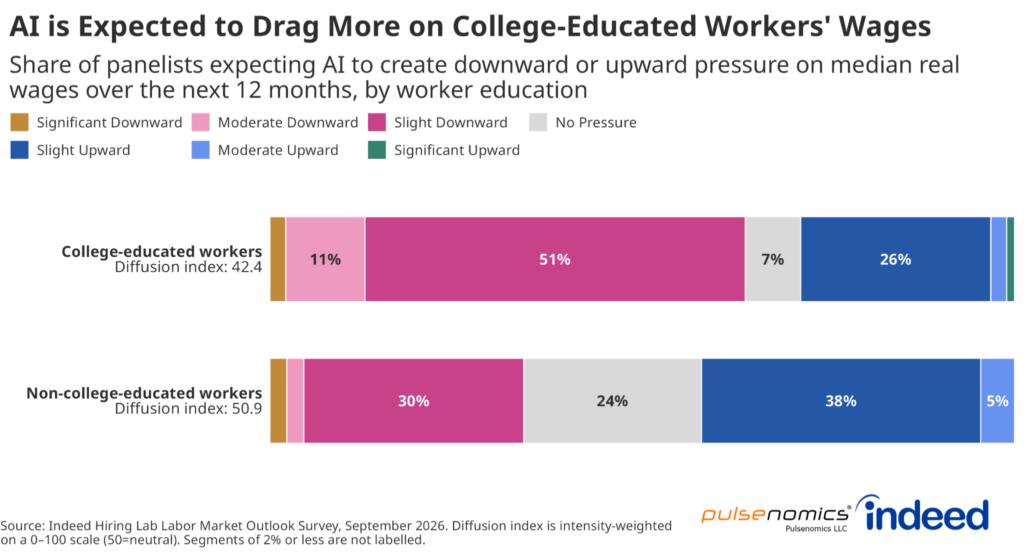
- Panelists said they expect more downward pressure on the median real wages of college-educated workers as a result of AI than they did last quarter. The panel doesn’t see AI exerting meaningful wage pressure in either direction for non-college-educated workers.
- Almost a third (30%) of the panel said they expect a substantial or transformative impact on productivity as a result of AI, up from 29% a quarter ago, a meaningful and growing minority.
Dozens of economic and labor market experts grew modestly more upbeat on near-term hiring demand over the summer, according to an Indeed Hiring Lab survey, but their concerns about AI’s potential to push college-educated workers’ wages downward have deepened.
The latest quarterly Indeed Hiring Lab Labor Market Outlook Survey asked more than 120 US academics and economists to offer their near- and medium-term expectations for job postings growth, unemployment, and the impact of AI on wages and productivity, among other topics. The results point to a cool labor market that is expected to keep drifting rather than break sharply in either direction, with AI’s full impact on employment remaining cloudy. But the panel’s expectations for how AI will impact wages are much clearer: The near-term economic bite is more likely to be felt specifically in the paychecks of degree-holding workers.
AI is more likely to displace college-educated workers and dent their pay
Panelists were asked to assess how much their views on AI’s potential to displace workers had changed over the past year. Responses were combined into a diffusion index running from 0 to 100, with 50 representing a neutral read. The diffusion index for college-educated workers stood at 55.6, signaling a slight but noticeable sense among the panel that the likelihood of AI-driven displacement has risen for that group. The reading for non-college-educated workers was a near-neutral, and somewhat more optimistic, 48.1.
Along with those slightly heightened expectations for AI-driven job loss, panelists also said they expect more downward pressure on the median real wages of college-educated workers over the next 12 months than they did last quarter. The diffusion index reading on whether AI would have a more negative impact on the wages of college-educated or non-college-educated workers fell from a near-neutral 47.3 last quarter to 42.4 in this edition of the survey, the most pronounced quarter-over-quarter change in the entire survey. The comparable reading for non-college-educated workers was unchanged at 50.9, suggesting the panel doesn’t see AI exerting meaningful wage pressure in either direction for that group over the next year.
Unemployment and job openings are both unlikely to move much
On average, the panel expects the September 2026 unemployment rate (scheduled for publication by the Bureau of Labor Statistics on Friday, October 2, 2026) to be 4.15%, essentially unchanged from August, drifting up to 4.23% by the end of Q4 and to 4.32% by next September. That gradual softening is roughly consistent with prior projections. On average, the most optimistic projections for the December 2026 and year-ahead (September 2027) headline unemployment rate are 3.9% and 3.6%, respectively. The most pessimistic expectations for the same dates are 5% and 5.5%.
While unemployment is expected to remain steady in the near term, panelists said they expect the level of job openings to rise, reversing earlier expectations of continued gradual declines. On average, panelists said they expect the Indeed Job Postings Index (JPI) to rise a slim 0.13% through the end of the year. But that average masks real disagreement: The most optimistic quartile of panelists expect postings to rise 1.35% during Q4, while the most pessimistic quartile expects a 1.67% decline. It appears the panel is not converging on a positive recovery narrative, but rather inching away from an entirely negative one.
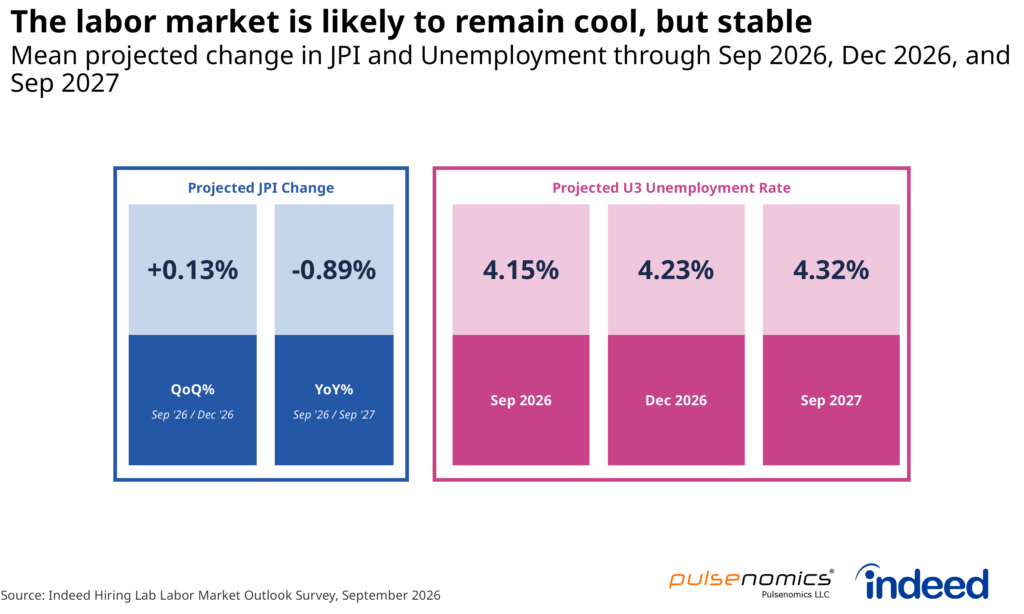
Looking further out, the panel’s year-over-year outlook was a touch more downbeat. On average, postings are expected to be 0.89% lower by September 2027, with an even wider spread between optimistic (+2.20%) and pessimistic (-3.95%) quartiles.
Personal Care & Home Health and Nursing, respectively, led the list of fields in which panelists expect the biggest gains in job postings over the next 12 months. Administrative Assistance and Software Development topped the list of fields with the largest expected declines. Software Development once again appeared on both lists, a sign that panelists remain genuinely split on whether the current macroeconomic environment represents a headwind or tailwind for tech hiring in the near term.
Is AI helping or hurting employment? Yes
Reinforcing the lack of consensus at the sector level, panelists’ responses were again mixed when asked whether AI’s net effect on employment was broadly positive or negative. Almost half (45%) said that AI’s net effect on employment was a “minor negative,” while a quarter (25%) said it was a “minor positive,” and 21% said AI is having no net effect on employment. Asked directly which fields will see the largest AI-driven percentage changes in employment over the next 12 months, panelists singled out the Administrative Assistance, Software Development, and Data & Analytics sectors as those expected to see the largest losses. The largest employment gains as a direct result of AI impact were expected in the IT Infrastructure Operations & Support, Software Development, and Data & Analytics fields.
Notably, the care and health roles that dominated panelists’ job postings-growth expectations, including Personal Care & Home Health and Nursing, don’t appear on either the AI-loss or the AI-gain list. At least in the panel’s view, AI simply isn’t yet touching what has been the fastest-growing corner of the labor market over the past several years. But Software Development and Data & Analytics showed up on both lists, a reminder that even within deeply technical fields, there is no expert consensus yet on the medium-term impact of AI in these areas, either positive or negative.
Growing more bullish on AI’s productivity punch
Lastly, panelists signaled that they remain confident AI will meaningfully lift US labor productivity over the next three years. Almost half (47%) of panelists said they expect AI to provide a “moderate” enhancement to overall productivity over the next three years, up from 40% last quarter, while the share expecting a “substantial” boost ticked up to 27% from 25%. Another 3% said they expect a “transformative” gain, and just 2% said they expect no meaningful enhancement at all. Almost a third (30%) of the panel continues to expect a substantial or transformative impact on productivity as a result of AI, up from 29% a quarter ago, a meaningful and growing minority.
Conclusion
A single wave of a survey like this is a snapshot. A series becomes a record of how expert opinion moves as new data arrive, as AI capabilities and adoption evolve, and as the labor market itself shifts. Two waves in, the panel’s views are more unified when asked about broad economic conditions — expect the low-hire, low-fire dynamic to continue — but far less so on the specific impact of AI. The experts are more convinced than they were three months ago that AI will weigh on pay for college-educated workers specifically, but otherwise remain divided on several key assessments of AI’s ongoing labor market impact.
Methodology
The Indeed Hiring Lab Labor Market Outlook Survey is a quarterly survey of professional economists and experts, sponsored by Indeed and administered in partnership with Pulsenomics LLC. This edition was fielded between September 8 and September 16, 2026; 123 individual panelists provided a response. JPI expectations are reported as percent changes from the current level of the Indeed Job Postings Index. For the AI questions, diffusion indices summarize the balance of opinion for each question on a 0–100 scale, where 50 represents a neutral reading. Panelists participate in their individual capacities; their views are their own and do not necessarily represent those of their affiliated organizations or employers.
The Indeed Job Postings Index (JPI) and the findings, projections, and opinions expressed in the Indeed Hiring Lab Labor Market Outlook Survey are provided for informational purposes only and are not indicative of the potential revenue, earnings, or financial performance of Indeed, which comprises a significant percentage of the HR Technology segment of its parent company, Recruit Holdings Co., Ltd. Survey results, projections, and labor market data referenced herein reflect the views of survey panelists and Indeed’s Hiring Lab researchers at the time of publication; they represent estimates that may change and may differ materially from Indeed’s or Recruit’s own assessments, forward-looking statements, or actual results. Nothing contained herein should be viewed as an indicator of the performance of Indeed or Recruit, or construed as investment advice. Please refer to the Recruit Holdings investor relations website and regulatory filings in Japan for more detailed information on revenue generation by Recruit’s HR Technology segment.