
Key points:
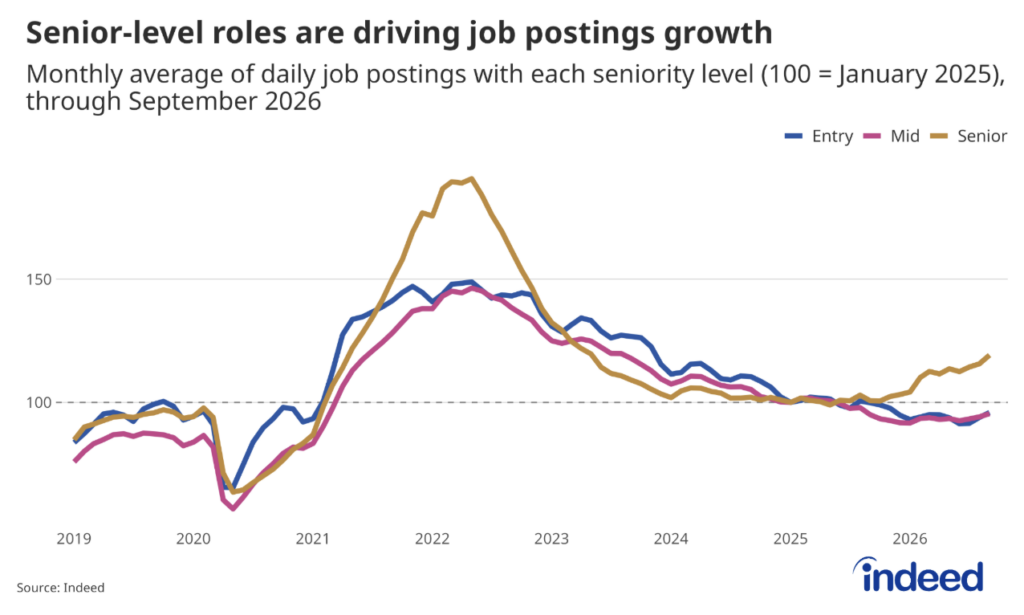
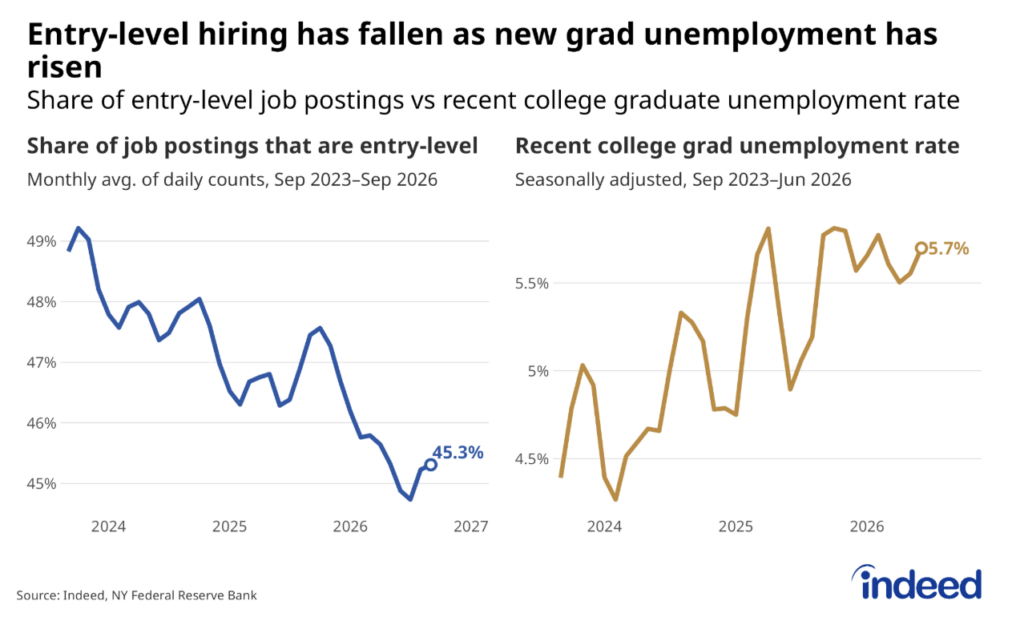
- The bottom rung of the career ladder is moving higher. Senior-level postings are up 19.2% since January 2025, while entry- and mid-level postings are each down about 4%. Unemployment among recent grads has risen 1.3 percentage points since 2023.
- Landing a job isn’t the same as starting a career. 50.4% of the class of 2025 were underemployed a year after graduating, up from just under 40% for most of the past decade.
- Investing in early-career talent pays off. Entry-level workers who do find jobs are the most satisfied with their career opportunities, and they especially value training and mentorship. Employers that stop hiring and developing junior talent risk thinning their own future pipeline.
Employers want workers who can hit the ground running. But where are those workers supposed to get their start?
Fewer openings, more competition
The divide between entry- and senior-level hiring is becoming harder to ignore. Employers are starting to show a clear preference for more-experienced workers, lifting the bottom rung of the job ladder higher for workers trying to establish themselves at the same time as opportunities to acquire said experience become more scarce. Recent graduates are often held up as the poster children for this catch-22, but the consequences extend well beyond the graduating class.
Since January 2025, senior-level roles have been the only ones showing growth, partly offsetting broader labor market weakness. By September 2026, senior-level postings were 19.2% above their January 2025 levels, while entry- and mid-level postings were each down around 4%.
A closer look at the past three years highlights the squeeze on recent graduates trying to get their start. In September 2026, entry-level job postings as a share of all job postings were almost four percentage points lower than September 2023 levels, and the unemployment rate among recent graduates rose by 1.3 percentage points over the same period (through June 2026). Taken together, these figures paint a clear picture of a market where getting established has become harder, even for those with a degree.
The squeeze is also evident in job seeker activity – entry-level postings attract several times as many applications per posting as senior-level roles. That means workers seeking their first opportunity in the labor market face substantially more competition per job opening, and that volume can help explain why a job search sometimes feels like sending applications into a void.
The problem is compounded by the fact that entry-level jobs don’t necessarily have to be set aside for entry-level workers. Prior research shows that as recently as May, almost half of applications from job seekers with 10 or more years of work experience went to entry-level roles. This relative flood of candidates applying for these roles can tax already busy recruiters and hiring managers, lengthening the feedback loop and leaving many jobseekers unsure where they stand once their application is submitted. For many applicants, it’s likely that their feelings of being “ghosted” during job search could stem more from a crowded and lengthening hiring process and not necessarily a lack of qualifications.
In a market marked by information asymmetry, even relatively simple efforts by employers, including automated application updates or status trackers, can go a long way in preserving goodwill with the job seekers they may one day hope to hire.
Landing a job is only half the battle
Finding work is one hurdle. Finding work that puts a degree to use is increasingly becoming another.
One measure of how graduates are getting started is whether their jobs typically require a degree – if they are working in a job that is unlikely to require someone with their degree, we consider them “underemployed.” We measure underemployment by identifying normalized job titles where more than 20% of that occupation’s job listings on Indeed require a Bachelor’s degree. We then use Indeed profiles to identify the jobs graduates hold one year after earning their bachelor’s degree. After hovering just under 40% for much of the past decade, the share of graduates that were underemployed one year after graduation rose to 50.4% for the class of 2025, a vivid illustration of the challenges facing the more than 2 million people that graduated last year.
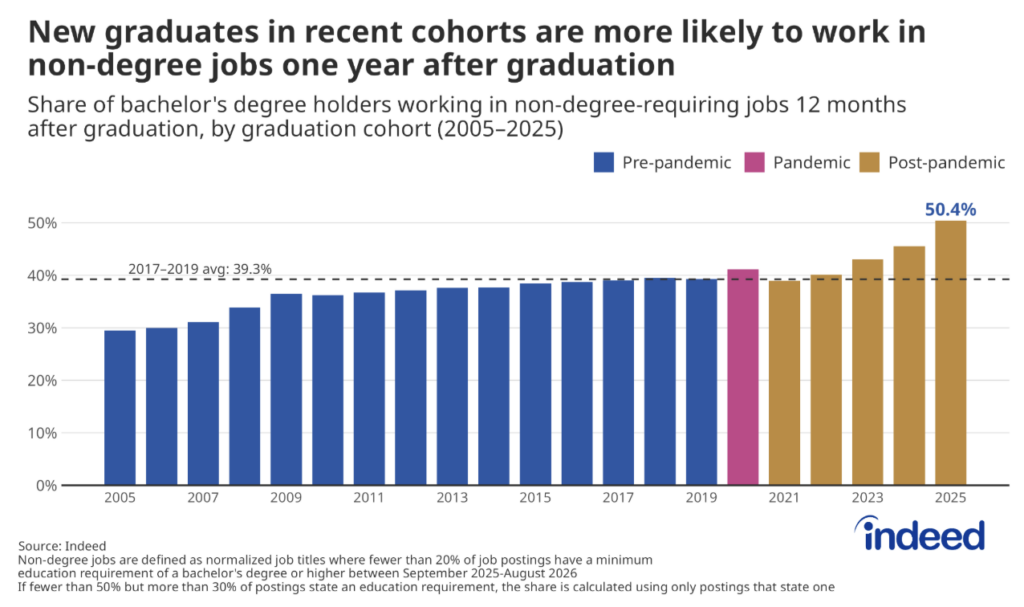
Other estimates of underemployment can vary with methodology. What’s key is the direction: holding the methodology constant, last year’s underemployment rate as calculated by Indeed was more than 10 percentage points above its pre-pandemic average.
For new graduates, the risk then becomes that a first job acts as a detour rather than a stepping stone. Work that does not require a degree can provide valuable experience and reliable income, but it may offer fewer opportunities to build the specialized skills needed for a recent grad’s intended career. This can have long-term impact on wages too: graduate underemployment has been shown to lead to lower earnings that persist well beyond the first few years of work.
This doesn’t mean that pursuing a degree is no longer worthwhile – employers may prefer or reward a degree even when one isn’t explicitly required. For example, a restaurant manager role may not specifically require a bachelor’s degree on paper, but having one could still give an applicant an advantage. A degree may therefore help applicants get hired even when it isn’t a formal requirement. Research has also found that bachelor’s degree holders working in jobs that don’t typically require a degree still earn about 38% more at the median than workers with only a high school diploma in the same occupations. Still, a pay advantage over non-degree holders is not the same as a payoff equal to what they might earn in a role that truly requires a bachelor’s degree.
Hiring an “overqualified” candidate is often seen as somewhat risky, because that candidate may be more likely to leave when they find a better opportunity. The lesson for employers is not to avoid overqualified candidates, but to give them reasons to stay with you. A softer job market means employers have better access to high-potential talent, even if they don’t have the work that fits them best right now. Getting access to this talent is extremely valuable, but access only matters if employers convert that into retention by offering career opportunities that allow that talent to grow along with the company.
At the same time, if a degree is truly a prerequisite, employers need to say so. Leaving it out of a job posting creates a misleading picture of who has a realistic chance of being hired. If a degree really is not necessary for a job, applicants without one should receive genuine consideration. And if employers expect degree-level skills, compensation should reflect those expectations.
Does the career ladder end at the first rung?
Entry-level opportunities matter beyond the graduating class, and workers’ views of their prospects differ by years of experience.
When workers rate their satisfaction with their employers’ “career opportunities” on Glassdoor, entry-level workers with 0–2 years of experience are actually the most satisfied. Through mid-September, entry-level workers rated career opportunities 3.41 out of 5 stars, solidly higher than for more-experienced workers. And while career opportunity ratings have declined across all experience groups since 2022, the declines have been larger for workers with more experience. This is not to say that entry-level workers have had it easy, but instead that younger workers who do find jobs in today’s job market still feel like they have the ability to grow their careers.
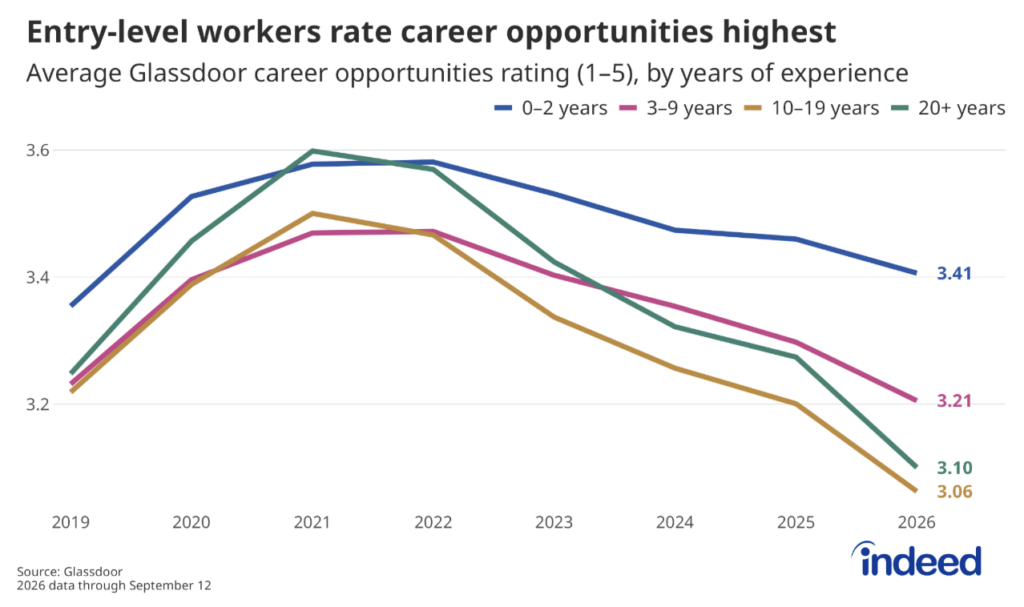
The challenge, then, is not just helping workers get a start, but ensuring that the opportunities to develop do not fade as their careers progress. Entry-level workers are 47% more likely to mention “training” and 35% more likely to mention “mentorship” as workplace positives in Glassdoor reviews than more experienced workers. Growth opportunities matter to employees of every age, but they stand out most for those early in their careers.
Younger workers worry about AI
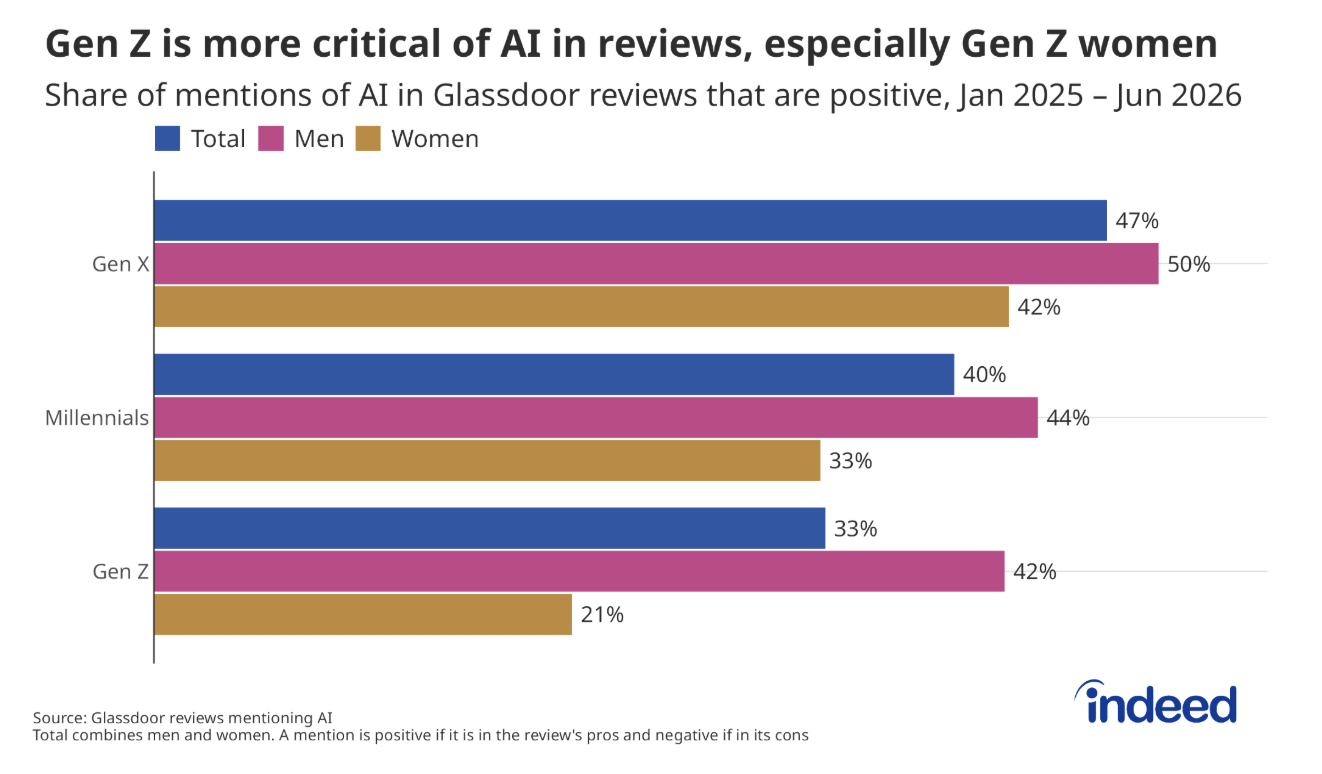
AI has also been pointed to as a potential cause of the entry-level hiring slowdown. While evidence for this is still mixed, entry-level workers are nevertheless visibly frustrated with AI. Gen Z workers are most critical about AI in Glassdoor reviews, with only one-third (33%) of mentions being positive, compared to 40% for Millennials and 47% for Gen X. And that’s especially stark for Gen Z women: Almost 80% of comments mentioning AI that come from Gen Z women were negative over the past year, while just 21% were positive.
Takeaways for employers and job seekers
A degree can help applicants qualify for a job. It cannot create an opening. For those entering the labor force, the challenge may be less about having the right credential and more about whether employers are hiring people who still have something to learn.
In order to develop a deep pool of experienced workers tomorrow, employers need to give less experienced workers a way in and invest in career growth today for the workers they do hire. If fewer graduates enter roles that require continuous learning, businesses risk narrowing their own future talent pipeline.
For job seekers, a slow hiring environment means diversifying your approach. While most job interviews are still earned by online job applications, referrals through alumni or peer networks can help supplement your search. Applying to jobs in a wider variety of industries, occupations or locations can also help widen the net. Outside of more specialized fields, most sectors call for a broad mix of skills, and some skills carry over across nearly every sector, meaning a background that looks unconventional on paper may still be a strong fit. For entry-level workers in a job, formal career growth may be slower at this moment, but there are still opportunities to grow by developing skills, seeking out opportunities to partner outside their team, and preparing for their next step when the job market does heat up again.
A downloadable version of our full 2027 US Hiring and Worklife trends report can be found here. Detailed methodology statements for this and each of the six chapters in this year’s report can be found here.