
Key points:
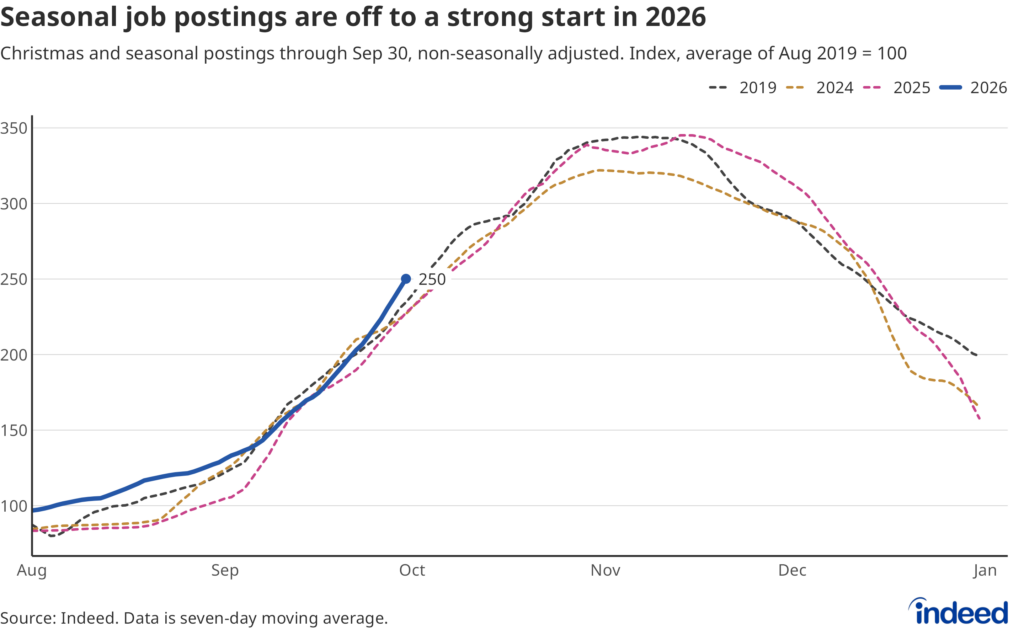
- As of September 30, seasonal job postings were up about 10% from a year ago, and roughly 7% above 2019.
- Several large employers are posting fewer seasonal roles, but more part-time (and presumably year-round) jobs this year.
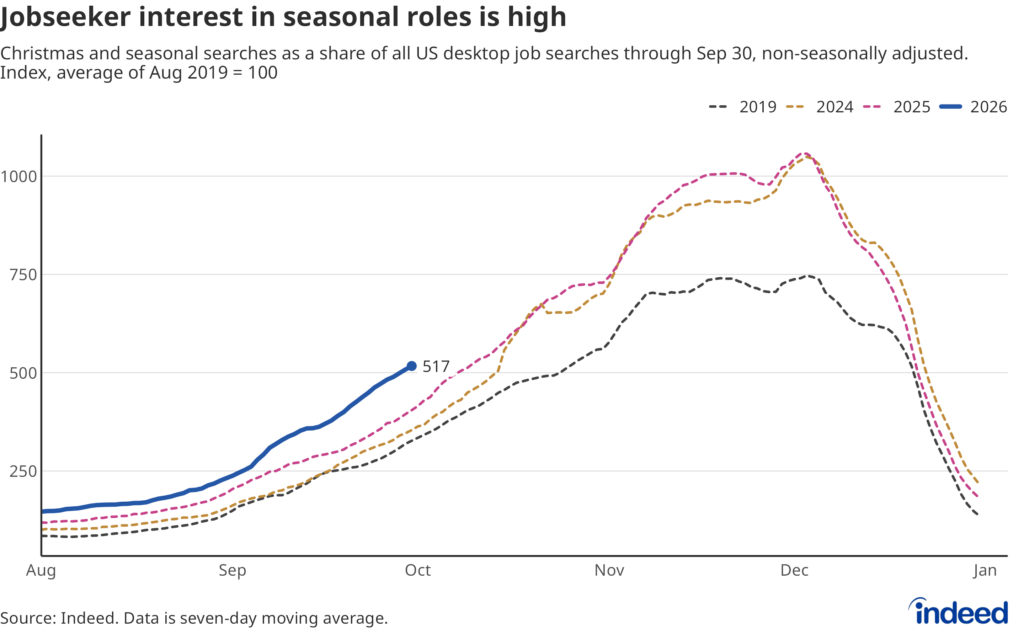
- Job seekers are looking harder for seasonal work, with desktop searches for those roles up 28% from last year.
Seasonal hiring is off to its best start in several years. As of September 30, seasonal job postings on Indeed were up about 10% from the same point last year, and were running roughly 7% ahead of 2019 levels. That early strength is one reason to expect the momentum could carry past this year’s holiday shopping season.
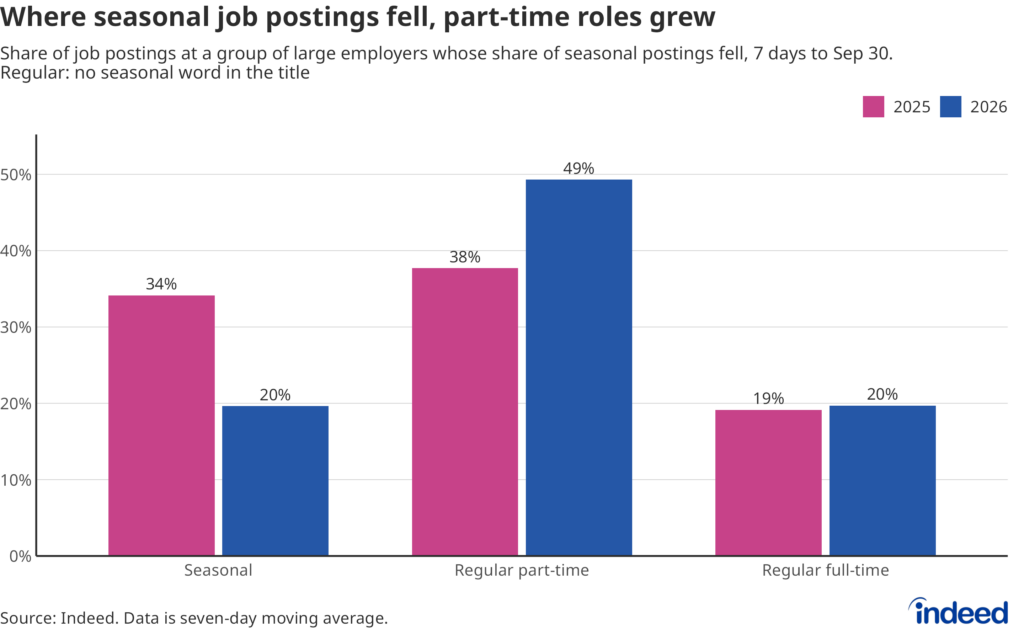
A group of large employers is posting far fewer seasonal jobs than they did a year ago, but making up for some of that drop by shifting toward hiring more non-seasonal, part-time roles — a potential sign of optimism heading into the final months of 2026. Job seekers, it seems, are leaning into the opportunity, with desktop searches for seasonal and holiday jobs up about 28% year over year. Taken together, it looks like a season in which employers are generally more optimistic about what may come after the holidays, and workers are increasingly seeking a little extra income before the year ends.
A faster start to the season
Seasonal hiring follows a familiar pattern each year: Postings begin to appear in August, then build from mid-September through mid-November as retailers and shippers staff up for the holidays. This year, postings started in August at a higher level than in recent years, fell back in line with past seasons for a few weeks, then broke higher again in late September. The early lead relative to recent years could fade, but it’s a good start.
Not every employer is joining in
A broadly rising line can hide a lot of movement underneath it. A group of large employers, mostly retailers, are relying less on seasonal postings than they did a year ago, and one of last year’s most active seasonal recruiters has yet to post a meaningful number of seasonal jobs in 2026. That may sound like an ominous sign for the labor market, but a closer look tells a different story.
A deeper dive into those large employers shows that they are hiring less, but for a different kind of role. At the end of September last year, about a third (34%) of postings from these companies were overtly labeled as seasonal. This year, that figure is about 20%. Part-time labels became more common over the same period, rising from 38% to 49% of these companies’ postings, while the share labeled full-time held steady at about 20%. Some of this may simply be timing, but the shift toward part-time roles is worth watching. Unlike seasonal jobs, part-time jobs are less likely to end at the conclusion of the holiday season, suggesting that at least some employers may expect demand to hold up well into 2027.
Seasonal jobs are moving out of the store
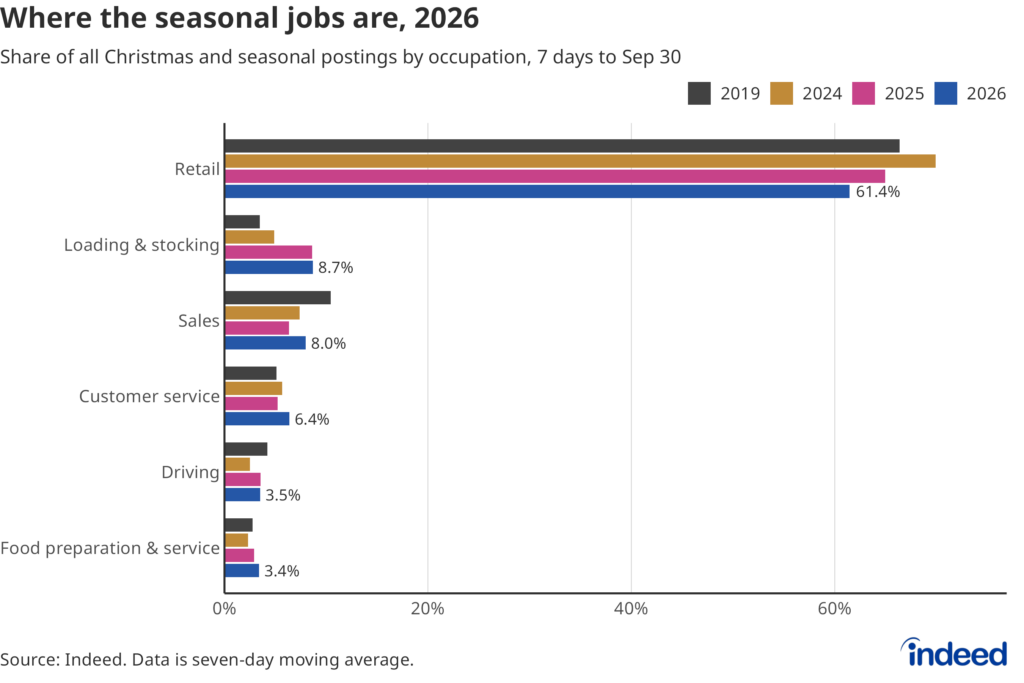
Retail remains the center of the seasonal world, but its gravity has weakened somewhat in recent years. In 2019, retail accounted for about two-thirds of all seasonal jobs, compared to a little over 61% this year. Much of that share has moved into loading and stocking roles, the warehouse work that sits behind every online order. It now accounts for about 9% of seasonal postings, up from 3.5% in 2019. The data send a clear signal that the holiday shopping season is increasingly shifting towards e-commerce and fulfillment centers and away from sales floors.
Job seekers are looking to seasonal jobs for extra work and pay
More job seekers are looking for seasonal roles than last year, with desktop searches including seasonal and holiday terms up 28% year over year. This season’s uptick in searches is the latest in a string of years with a larger pool of workers seeking seasonal jobs. Clearly, an extra paycheck matters after years of stubborn inflation and the recent spike in energy costs, especially during an already-expensive season. With the broader labor market stuck in a low-hire environment, and annual inflation still well above the Federal Reserve’s 2% target, many workers appear to be turning to seasonal work to supplement their income.
Job seekers who already hold multiple jobs often work in the same kinds of roles that dominate seasonal hiring. Previous Hiring Lab research found that 16% of job seekers on Indeed already work at least two jobs, with many of them working in retail or other service-sector jobs. For these workers, a part-time seasonal role can be a way to bring in some extra money and get a foot in the door at a new employer without necessarily leaving the old one.
Which seasonal jobs are most in demand?
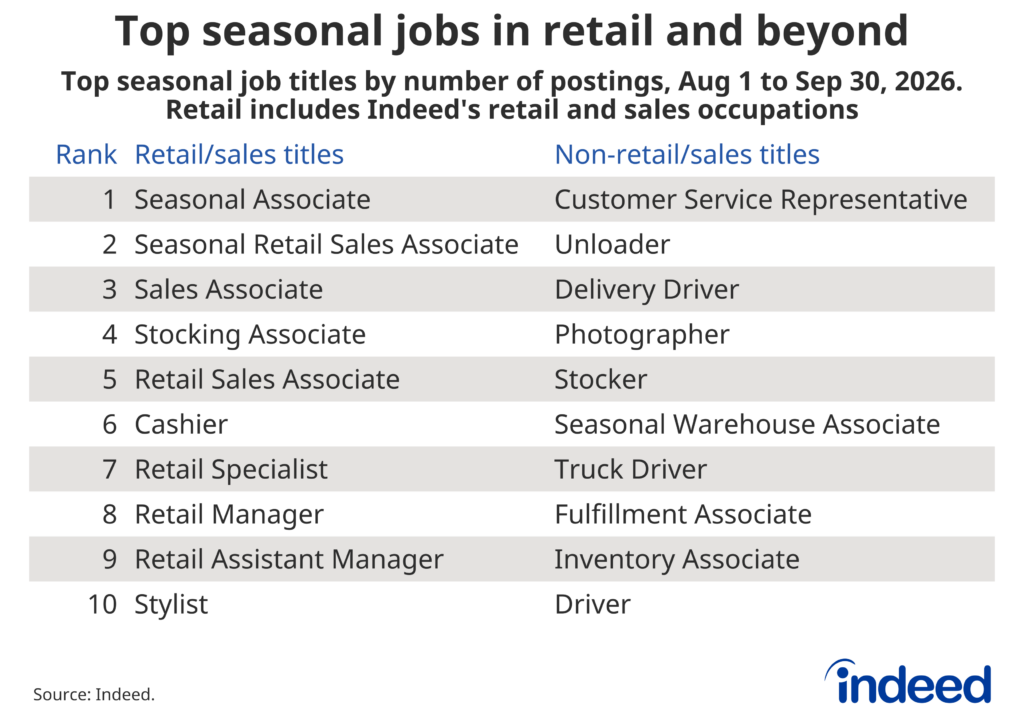
Retail and sales jobs still account for the majority of seasonal work, and this year’s most-prevalent seasonal job titles are exactly what you would expect: seasonal associates, seasonal retail sales associates, and sales associates. Common seasonal roles outside of retail include customer service representatives, unloaders, and delivery drivers. Many of the remaining top seasonal job titles — including stockers, seasonal warehouse associates, fulfillment associates, and inventory associates — reflect the work that happens behind the scenes of online shopping. Interestingly, photographers also crack the top five among non-retail/sales-related titles, possibly reflecting demand for holiday family portraits, parties, and/or winter weddings.
A similar takeaway for job seekers and employers: Start early
For job seekers in the market for seasonal work, it’s best to start applying now. The biggest rise in seasonal postings typically occurs between mid-September and mid-November, and competition for these jobs is likely to be fairly stiff this year. Employers hiring for these roles may benefit from a larger pool of interested workers, but they are also competing against rising demand from other employers. Posting early and making their pitch clear (the pay, the hours, and whether the job can lead to something longer) is likely to help them stand out. In a season that started ahead of schedule, the early movers on both sides of the market are likely to come out ahead.
Methodology
We define seasonal job postings as those with one or more holiday-related terms in the job title, including but not limited to: “holiday,” “seasonal,” “temporary,” and “Christmas.” Definitions may change slightly from year to year, so previous holiday hiring analyses are not directly comparable. Seasonal job searches are defined as those that contain one or more seasonality-related terms on Indeed. Desktop searches are reported because the addition of a quick search option for “seasonal” jobs in the Indeed mobile app near the end of 2025 affected the ability to compare with previous years.
The number of job postings on Indeed.com, whether related to paid or unpaid job solicitations, is not indicative of the potential revenue or earnings of Indeed, which comprises a significant percentage of the HR Technology segment of its parent company, Recruit Holdings Co., Ltd. Job posting numbers are provided for information purposes only and should not be viewed as an indicator of the performance of Indeed or Recruit. Please refer to the Recruit Holdings investor relations website and regulatory filings in Japan for more detailed information on revenue generation by Recruit’s HR Technology segment.